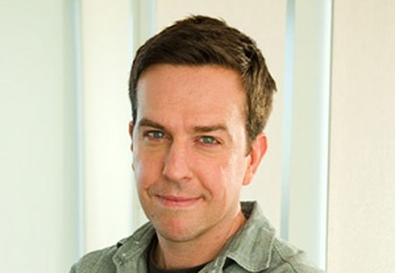
Photo Source: Blake Gardner
Tim is a sheltered creature who has never flown on a plane before, let alone had to deal with the kinds of debauchery—including adultery and bribery—he encounters on his work weekend. Along the way, Tim emerges from his shell with the help of his roommates (John C. Reilly and Isaiah Whitlock Jr.), a seductive peer (Anne Heche), and the local prostitute (Alia Shawkat). And though Tim begins the journey somewhat overwhelmed (he exclaims upon his arrival in Cedar Rapids, "It's like I came to Barbados or somewhere!"), he soon realizes he can't stay stuck in a rut for the rest of his life. Tim may be a late bloomer, but he has to start taking chances.
Though "Cedar Rapids" requires Helms to show a more dramatic side at times, Tim bears similarities to other Helms creations. In recent years, the actor has excelled at playing eager, clueless types, be it cuckolded brownnoser Andy Bernard (aka "The Nard Dog") on "The Office" or henpecked dentist Stu in "The Hangover." But in real life, Helms bears little resemblance to his characters. He doesn't even quite look the same: Dressed in his own clothes, he's far more attractive than he appears on screen and carries himself in a casual, loose-limbed manner. More important are the differences in his personality: Unlike his reticent characters, Helms has built his career out of taking risks and even walking away from a good thing when the time was right.
Warm-Up Act
Helms grew up in Atlanta on a steady diet of comedies like "Fletch," "Vacation," and "Ghostbusters." So it's no surprise that his main goal was to land a job on "Saturday Night Live," where many of his heroes rose to fame. "I was very analytical in my approach, trying to figure out how to make my mark," Helms reveals. "It became clear I would have to prove myself first. I looked at these people I'd grown up admiring and figured out what their launching pads were. It was either try The Groundlings in L.A., like Will Ferrell and Phil Hartman had done, or The Second City in Chicago, where so many greats like John Belushi and Chris Farley had come from. Or, I could go to New York and try the standup route, which is what people like Adam Sandler and Chris Rock did." He decided to take to the New York comedy stage.
Asked to describe his style of standup comedy, Helms says he started out trying to do wacky, character-driven jokes. "Over time, I found what people actually enjoyed was just storytelling and these protracted tales from my life. So rather than a traditional joke set, I went into more of a Bill Cosby or even Eddie Murphy type of storytelling, and found that worked best for me." Helms also took a class at Chicago City Limits, a small theater on New York's Upper East Side, and formed a sketch group with other students called "The Jakes" ("Jakes" was an acronym for the first names of the performers). "Eventually, it wasn't the same tone of the kind of things I wanted to do," he admits. "But it was a formative experience for me because we worked off our asses off and took rehearsal seriously, and I learned how to take an idea and execute it well."
At the same time, Helms had landed a job right out of college—where he had majored in film—doing tech support for Avid editing systems. While there, Helms got the idea to try to get into the world of voiceover and called a local agency, asking for sample voices. "They sent me a CD that I listened to over and over again until I figured out how the business works," he says. "And then I recorded my own demo reel."
From there, he went to work for a production company called Crew Cuts, where he was an assistant editor. Soon, he was doing temporary scratch tracks for commercials—voiceovers that would later be replaced by hired talent. At one point, a client heard his scratch track for a Burger King commercial and suggested using Helms for the job. He was able to parlay that into landing a V.O. agent at the agency now known as Cunningham Escott Slevin & Doherty—which happened to be the same agency he had called years earlier for the voice samples. "It got to a point where I actually had an income from doing voiceover," Helms says. "At the same time, I was doing well at editing. I loved the job and the people I worked with, and I was on track to become a major editor. But I also knew if I really wanted to make a go of the comedy, I would have to dedicate myself to it 100 percent. And I wanted to try it, I wanted to do comedy." After a lot of soul-searching, Helms says, he made his decision. "I quit my job."
'Daily' Grind
Helms threw himself into comedy full time. "As soon as I quit, I went out every single night, to every open mic in town, every shitty little bar show that some other comedian was doing—whatever I could do," he recalls. "Before long, I felt like a part of the community, and I knew I was where I should be." It wasn't always easy going. "I spent a long, long time struggling," he says. "But I think it was critical for me to go through that, to find my voice and become aware of my own sensibilities as a comedian and a comic performer." Regardless, he loved every second of it—even the tough times. "There were lean years, but super fun and intense," he recalls. "All the hard parts, all the heckling and the long nights, I felt like I was earning my stripes. I remember being home for vacation, and I couldn't wait to get back to go onstage at some shitty comedy club and get heckled."
He also performed at Upright Citizens Brigade, which he cites as a major influence in his career. "I think I had already built this foundation, having studied other comedians for so many years on TV and in person," he says. "But you have to drill yourself and get out there as much as you can. And Upright Citizens Brigade was great at letting me just try anything. Because it's only after thousands of hours of performance—most of which is very, very bad—that you start to dial in on the things that work for you."
Around 2002, Helms says, a lot of his friends were beginning to audition for "Saturday Night Live," and he felt like his call "might be imminent." But then he went on what he calls "a fairly straightforward audition" for a correspondent slot on "The Daily Show" and landed the job. Soon, Helms was trading quips with Jon Stewart, being attacked by a beagle while wearing a Speedo, and keeping a straight face while interviewing the founders of the charity "Guns for Tots."
Helms stayed on "The Daily Show" for five years but never stopped looking at outside projects. In 2005, he shot a pilot for NBC called "Lies and the Wives We Tell Them To," which he describes as "a very unfortunate title for a really smart, fun show." Though the pilot wasn't picked up, NBC offered him a holding/development deal. But Helms believes the short film he made with his friend Nick Poppy about an everyday zombie, called "Zombie-American," is what caught the eye of "The Office" producer Greg Daniels. "It had talking-head interviews, sort of like 'The Office,' and I played a character who was very hopeful but also in denial," Helms explains, "all themes and tones that exist on 'The Office.' " In his first meeting with Daniels and fellow producer Paul Lieberstein, Helms says they first discussed the idea of the character that would become Andy. "We had this image of a spoiled Connecticut child of a yacht-club family who's been nothing but a disappointment," Helms recalls. "And that he probably had anger management issues. A lot of his personality was discussed in that first meeting." Soon, Helms had an offer for eight episodes. "They were sort of vague," he admits. "They said they were going to try out this storyline where Jim moves branches from Scranton to Stamford, and if it didn't work, they'd cut me loose pretty quickly." At the same time, Helms' contract was up at "The Daily Show," and with several correspondents leaving—including Stephen Colbert and Rob Corddry—Helms realized he would be the senior correspondent if he stayed. The producers at "The Daily Show" told him they would have to look for somebody else if he took the "Office" job. "It was a tough moment," he says. "It was either this really ephemeral 'Office' job, which might disappear at any point, or stay at 'The Daily Show,' which I really loved." Again, Helms chose to take a risk. "I just felt I had to mix things up." He did his eight episodes, and the character eventually moved back to the main Scranton branch. But Helms still didn't know how long the job would last. "A few episodes in, they told me, 'We're sending Andy off to anger management, and we'd like to figure out a way to bring you back full time.' And they did it in the most weird and wonderful way."
'Rapid' Filmmaking
On the big screen, Helms began popping up in several small roles—mostly glorified cameos—in films like "Walk Hard" and "Harold & Kumar Escape From Guantanamo Bay." Helms says he didn't have a traditional audition for "The Hangover" but rather a series of meetings with director Todd Phillips. Certainly his role in that 2009 blockbuster helped him garner the clout to get "Cedar Rapids" made. Helms had met writer Phil Johnston through a mutual friend and read his script "Jeremy Orm Is a Pervert," which had landed on the 2006 Black List, which catalogues the industry's best unproduced screenplays. Johnston shared his concept for "Cedar Rapids" with Helms, and the two soon found themselves riffing on ideas. "It was exciting because we were on the same page and hashing it out," Helms recalls. "Then Phil went out and wrote the script in something like two weeks."
Helms was on board as executive producer, and soon director Miguel Arteta ("Chuck & Buck," "The Good Girl"), who had directed Helms on "The Office," signed up; the three were in agreement on the tone of the film. "From the beginning, we agreed that we didn't want to make fun of this world or these characters," Helms says. "Obviously, there's a lot of humor that comes from these situations, but it doesn't come from a place of ridicule or humiliation." Helms pauses, then says with a laugh, "Well, there's some humiliation, but it's not ridiculing these people for who they are." In the end, he says, they wanted the film to be a love letter to the Midwest. The script was sent to writer-director Alexander Payne, whose films "About Schmidt" and "Election" have similarly paid homage to Middle America, and Payne quickly signed on as producer, along with his writing and producing partner, Jim Taylor. The project was quickly set up at Fox Searchlight and then, Helms says, "It was off to the races. In film time, it was really fast: From the inception to the release date, it was less than two years."
Helms was active in casting, and quite a few of his friends from Upright Citizens Brigade, including Corddry, stepped into small roles. Asked if he wants to produce more in the future, Helms hesitates. "I like to be involved as early as possible in any creative endeavor because it gives me the illusion of control and I feel more invested in something," he says. "I've been in movies where I was just a hired actor and enjoyed them immensely. But as an actor, you can get pinged around like a pinball at times, so it's good to generate material that I think will be a good fit for me."
Tim is indeed a perfect fit for Helms, an opportunity to play on his aw-shucks persona while also stretching into more dramatic territory. Arteta, for one, has nothing but praise for his star. "There's a Jimmy Stewart quality to Ed's performance, in the way he brings out the nobility of a character who is kind and decent and can find the good side to almost anything," Arteta says. "Ed had such a intuitive sense of this character. He was willing to just jump off the cliff and try anything."
Up next, Helms will reprise his role as Stu in "The Hangover, Part II," due out in May, and appear opposite Jason Segel in the comedy "Jeff Who Lives at Home." Helms admits it's great to find himself so in demand after struggling for many years. "I mean, I'm competing for movies that I could only have imagined a number of years ago," he says. "But I had to learn long ago not to take any of this—the good or the bad—personally." Helms recalls the days when he would go on an average of 50 auditions before booking anything. "It took a long time for me to realize that sometimes you're just not right for the part, no matter what you do," he says. "When you're young, high school and college theater teach you that you can play everything. You're 16 years old and playing an 80-year-old man. But it's not how the professional world works at all. An 80-year-old man is going to play an 80-year-old man." Helms says that once he made peace with that realization, he was a lot happier. "I try to explain to people that you get the roles that are right when they're right," he says. "If you have a nerd character but you're kind of a cool guy, you're probably not going to get the nerd part. The nerd is going to get the nerd part. You know, someone like me."