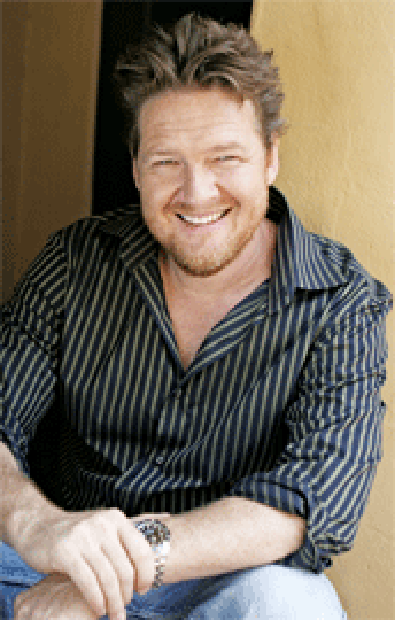
At times, Donal Logue does not sound unlike Dex, the philosophizing underachiever he played to perfection in 2000's The Tao of Steve, the movie that proved to be his breakthrough as a leading man. Prone to discussing "Zen-like moments" and the "template of the sidekick role," Logue shares the charm and fierce intelligence of Dex, but one could never accuse him of resting on his laurels. For starters, the actor has no fewer than eight movies currently scheduled for release over the next year and a half, beginning with Ed Burns' The Groomsmen, opening July 14 in limited release. The film co-stars the impressive ensemble of Burns, John Leguizamo, Jay Mohr, and Matthew Lillard, but it is Logue's sympathetic portrayal of the embittered best man who considers himself a failure in life that steals the film. The indie Groomsmen will be followed by several films, most notably Ghost Rider, in which Logue appears as the sidekick alongside Nicolas Cage in the big-budget adaptation of the graphic novel. The Ghost Rider and Groomsmen roles were written specifically with the actor in mind. And in the fall, Logue will return to weekly television as producer and star of the ambitious half-hour comedy Let's Rob..., about a motley crew of thieves who set out to steal from Mick Jagger (and, yes, Jagger appears as himself).
Logue is no stranger to television: He spent five years as the patriarch on the sitcom Grounded for Life and did multiple episodes of ER, playing Sherry Stringfield's paramedic husband. Television helped launch Logue's career--albeit in an unusual way. Beginning in 1994, Logue began popping up in promos for MTV as Jimmy McBride, aka Jimmy the Cab Driver, the fast-talking king of non sequiturs who bored his passengers but delighted television audiences. That Logue was able to turn his cache as Jimmy into a solid film career in the following years with supporting turns in movies as varied as Blade, Runaway Bride, and The Patriot might seem like luck, but Logue only makes it look easy. The actor, who attended Harvard University and the British American Drama Academy in London, takes his work very seriously. As it turns out, it takes a lot of work to appear so natural and easygoing.
Back Stage: How did your return to series television come about?
Donal Logue: I had an opportunity to do a half-hour show because, for some weird reason, I have some currency in that area coming out of Grounded for Life. I don't have that currency elsewhere. But I seem to be one of those people [to whom] networks say, "Hey, we'll do something with you if you want." I had an idea for a show that was different. And my agents asked who I would want to get together with. I said, first of all, Rob Burnett and Jon Beckerman, who have been friends of mine since I did the Cab Driver. I used to do walk-on bits on Letterman years ago when they were there, and I did the pilot of Ed, their show, but I couldn't do the show. I called Rob, and he said, "We have an idea for a show; can we just run it by you? It's about a blue-collar guy who's down on his luck who decides he wants to rob a celebrity after watching one of these shows where the guy's waxing on about his 5,000 handmade shoes." They had thought there was something about Jeff Goldblum that would be really funny: his level of celebrity, his unique mannerisms and affectations. So when we went to go pitch the show to all the networks, Rob would say, "Let me just give you the title of the show before we get into it. It's called Let's Rob Jeff Goldblum." And everyone would laugh, and it would break the tension up.
As it turns out, Jeff was busy doing something at NBC. So other names came up, and I think it was Steve McPherson at ABC who thought about Mick Jagger. And that's as cool as cool gets. Mick is someone who clearly has a sense of humor and is game to act and has done a number of movies. So Rob and Jon went back and wrote a script they adapted entirely for Mick Jagger. And we didn't hear, so we figured it was a crazy idea. But then he got back to us, and we found out he liked it and was interested. It was tricky because we didn't have a final commitment going into the pilot, so we were hoping it would work out so we didn't have to go reshoot or dub in someone else's name over his.
We put the cast together, which was a fantastic process. Bonnie Zane was the casting director. We called in Kevin Richardson, who I worked with on a pilot called The Next Big Thing years ago. Sofía Vergara came in, and she's a cool, funny, ballsy chick. She's a Maxim pinup girl, but she's also a throw-down lady. I think people would love to assume that gorgeous men and/or women are probably not smart or ballsy, but it's completely untrue. The unfairness of the universe is that they are that beautiful and they're cooler and smarter than you are.
We got our team together and were so excited. Jon and Rob are nice guys, fun to work with, and mellow about everything. It's just a really happy universe to work in. I felt incredibly lucky. We had so much fun doing the pilot; it was hard not to laugh out loud during most of it. Good thing I'm a producer so I can't get fired. Unless I fire myself at some point.
Back Stage: Is it ever difficult when you're on a set and the atmosphere isn't good?
Logue: I have rarely been on a film where the atmosphere wasn't pretty damn good. Or it's tailored to what it is. The nature of The Groomsmen is different, but I loved the vibe because it's like being in a fraternity. You've got five really strong male personalities, all good, no one afraid of busting each other's ass. It was an awesome environment. And my part was a lot darker on The Groomsmen compared to some of the other characters. I play a real bitter asshole.
Different projects call for different things. One thing about a movie is, you go somewhere and you know there's this finite amount of time; it's like going to camp. On a series, it could go on for years, and it just becomes part of the fabric of your life.
Back Stage: In addition to Groomsmen, you have the big-budget adaptation of Ghost Rider coming out. Were you making a conscious effort to balance the smaller projects with the blockbusters?
Logue: No, I would never. It's much more organic than that. A friend of mine would say, "Why are you doing this? Why don't you do Breaking the Waves?" You think I wouldn't have done Breaking the Waves? Lars von Trier didn't call me. You go after stuff; some you don't get, some you get. I did Ghost Rider and Groomsmen back to back, and in both cases they had written a part for me for different reasons. What's weird is that there's something about what you do that resonates towards different directors. That's really nice. The roles couldn't have been more disparate, in a way, which is fantastic. It was a really fascinating year for me, to experience as an actor all those different forms of acting.
Working on Ghost Rider was like working on Blade. When I did Blade, I had a total blast. There's a complete and other side of acting, which is: What is it to pretend to be a vampire? It's a fantastic suspension of disbelief and commitment and playing around and having fun. Then there's stuff like The Groomsmen that taps into psychological aspects. I'm playing an older guy who, by all his definitions of what a successful man is, he's failing at every one of them.
I don't have a method. Sometimes I think it couldn't be more simple than when Adam Hann-Byrd, the young actor in Little Man Tate, asked Jodie Foster, "How do you act?" She said, "Just pretend real hard." I don't know if it gets any more clear than that. I take what I do seriously, but I try not to take myself seriously in it. If there's an actor who takes their approach to it really seriously, they better be good, or else their level of indulgency cannot be forgiven by anyone in the environs.
Back Stage: As an actor, what do you value in a director?
Logue: On The Groomsmen, we were all sitting around a table telling stories about our acting histories, and Ed was talking about working with Spielberg on Saving Private Ryan. Ed has a totally different experience than the rest of us: He said he's only had to audition for something once, ever. We were all like, "You are crazy!" Because the rest of us have all done what your readers have done: We've all gone through plays and looked for USC grad films and hustled here and there. Just the shit we all go through. Ed was cast in Saving Private Ryan on the basis of Brothers McMullen, and he said Spielberg would let them do four or five takes of a scene without doing anything. You would think a guy like Spielberg would be directing all the time. But he said, "Look, I cast you guys because I knew what you could do. Sure, if into it I feel like it can vibrate in a different direction, I'll step in." Ed did the same thing with The Groomsmen. He knows what Jay and John and Matt can do, and he lets us figure it out. It shows a lot of trust and lets things happen. If you micromanage too much, it starts putting stones in the shoes of the actors.
We did some scenes in The Groomsmen that were long takes on a Steadicam. There's one where Leguizamo confronts me outside of a strip club, and it's essentially a long guitar solo. It's slow and it's fast, and if someone steps in in the middle of that and tells you that in this one moment you have to do something, everything before and after is obsessed with that one moment. It completely fucks up the nature of the solo. So Ed is really good about letting things flow. He keeps control of the set and reminds you of the scene. It's Acting 101, but it's so helpful to have someone say, "Remember where you're coming from when you're coming to this place."
Even when we were doing Grounded for Life, it was important that we kept it coming from a place that felt emotionally real. People think sitcoms are fake, but the best ones are real. The funniest stuff about Frasier is that they are 100% committed to the emotion of that moment, and that's why it's funny. David Hyde Pierce isn't running around trying to wisecrack. John Blanchard, who directed most of Grounded for Life, would always remind me of the critical emotion to the scene. He could help define what I was walking into if I got lazy. Which happens. If you think about doing 100 scenes, 10 takes each, you can get rote going into it, and you have to be reminded to be fresh and real. The best directors have a good sense of when to step in and stay out.
Back Stage: Most people probably first saw you as Jimmy the Cab Driver. Was that a tough character to be associated with for so long? Did people think you had become an overnight success based on a series of MTV commercials?
Logue: Yes, and I'd done 20 movies before that. You know, there's always some bitter guy that did musical theatre all his life who feels like he's been screwed. He's like, "I did the theeeatre!" So what? Why would you get to play the Irish gangster more than someone else because you played Che in your college production? It's this false reality. It's about who can appear real and be believable. And what reality you can make happen for yourself. Like a lot of actors auditioning for commercials and stuff, I would find myself testing for things I didn't think were that funny and praying I'd get a job. And one day I thought, "Screw it, it's slow right now; I'm going to get together with my friends, and we're going to create stuff that's tailored to my strengths and create a real character, so real that people will say, 'This is some whack dude from Boston they found and followed around with a video camera.'" I've had people sit across from me and talk about Jimmy and have no idea I'm the guy who played it. To me that was the ultimate acting compliment. Also, I know people from Ridley Scott to Sean Penn who, when they meet me, that's the one thing they talk about. Because another actor recognizes when you dip so thoroughly into the cloak of another character.
We weren't hired to create Jimmy; we just got a video camera and drove around one day and came up with it. And it found its way to the right people. Which is another thing: You never need an adult to give you permission to go out and create. So many actors—and I've been there too—bitch and whine about the opportunity to do their craft. But if you wanted to go out and do a one-man show on a street corner, no one could stop you. If you were to get attention and jobs from that, good for you. Because you should never wait for permission to do what you're supposed to do. If you do, you'll find yourself spinning your wheels for 20 years. Have the balls to go out there and create stuff for yourself.
I had a Zen-like moment recently. I heard a guy bitching, and he said, "I'm in the entertainment industry, which we all know is total bullshit." And I thought, "No, it is what it is." It is super fair. It's like an escort agency: If you're not the best-looking one, you better do the best sex tricks. And if you don't do great tricks or haven't figured out how to show people, don't be surprised when people don't know who you are. It is kind of viciously straightforward in what it is.
You can't have sour grapes, and, honestly, I think most working actors don't. Because we're all in it, and if someone else gets something, well, good for you. I used to go out for parts and always be up against John C. Reilly and Philip Seymour Hoffman--all these guys in my group of actors who are fantastic. Guys like Vincent D'Onofrio and, at one time, Viggo Mortensen, weirdly enough. There's just a ton of these actors, and they're all good, and there's a mutual respect, I think. If you wish success on other actors, it will more readily come to you. They always say resentment is a poison you take, hoping it will kill them. "I'm sipping poison! Why is his career thriving?" You get nowhere wishing ill will on people, yet it is a town that [revels] in schadenfreude.
Back Stage: Have you ever been concerned about being typecast?
Logue: I always think...the onus is on you to define who you are. If you get really passive about it and think you're pigeonholed, show them you do something else. Eric Bana was a sketch comic in Australia, and, honestly, if he had done that here in America, would they have let him do Munich? I don't know. But he and Emma Thompson and Bill Murray clearly can do whatever they want to do. It's about the level of intelligence. To be a comic performer like Mike Myers takes a tremendous machine filled with pathos and intelligence and anger and observation. So the idea they couldn't do drama is so absurd. Because some of the people who only do drama are some of the least interesting people you've ever met. They do their one thing, and people are comfortable with them in serious situations. The harder thing is to do what Mike Myers does.
I remember David Alan Grier said when he was working with Jim Carrey on In Living Color, Jim would mess around, and David told him, "If I could, I would pay you $10 million to film that. But no one's ever going to let you do that." As it turned out, they did. It's like Sullivan's Travels: You need those people who make you laugh.
Back Stage: What's the one piece of advice you wish someone had given you when you started acting?
Logue: Don't get bitter, don't give up. Always do plays if you're in doubt. When I came out here, the biggest thing to happen to me was, I did a play called BeBopALuLa with Paul Hipp [in 1992] at a place called Theatre/Theater that Jeff Murray ran. We did a good run, and if you do a good run of a play in Los Angeles, people come. And I had a long run of work after that. And it puts your machine in motion, and when you go to auditions, you're freer because you know you have a performance you're excited about that night. Just stay busy. When I was in New York and bumming out, my father would say, "Isn't there something you can do, like an athlete who trains to stay in shape?" I'd say, "You don't understand, man." But he was 100% right.