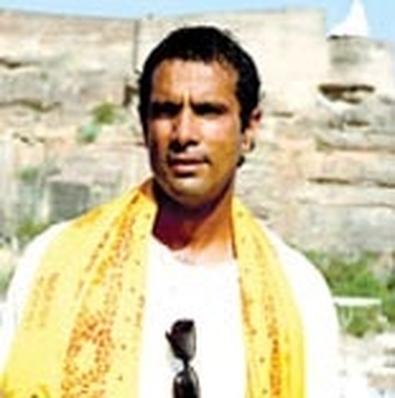
Filmmaker Tarsem Singh is the first to admit he loves eye candy. His first feature, The Cell, starring Jennifer Lopez and Vincent D'Onofrio, was dismissed by critics as all style and no substance. Like a lot of commercial and music video directors who try their hands at features, Singh focused more on the gorgeous look of his "pop opera" than on the performances or the thin serial-killer plot. So when it came time to tackle his second and much more personal feature, The Fall, he learned that he could get away with all the eye candy he desired as long as the relationship between the two leads worked. "I decided there would be no camera moves, and it would be sitting static in the hospital scenes," Singh says. "So it was much more difficult terrain for me to go into than The Cell was."
The film succeeds because it has the childlike imagination of Pan's Labyrinth, the scale and silliness of a Terry Gilliam film, and the ethnic flavor of the globe-trotting masterpiece Baraka. Set in a Los Angeles hospital in 1915, The Fall centers on an injured stuntman, Roy Walker (Pushing Daisies' Lee Pace), and his friendship with a 5-year-old fellow patient, Alexandria (newcomer Catinca Untaru). The film shifts back and forth between the intimate hospital scenes and the epic fantasy Roy tells Alexandria to convince her to get him the pills he needs to end his life.
The film is presented by Singh's friends and colleagues Spike Jonze (Being John Malkovich, Adaptation) and David Fincher (Fight Club, Zodiac). "I'm not a person that takes advice from many people, but they were very key in guiding me in certain ways," notes Singh. "Fincher ended up making his kinds of films for the system and Spike outside of the system. And I realize I hadn't made the movies I wanted to make, so I think my whole relationship with them pushed it into an area that I had to move now, and they helped from the beginning." Fincher has described The Fall as "what would've happened if Andrei Tarkovsky had made The Wizard of Oz."
The Indian-born Singh took his time making The Fall and did it on his own dime and his own unorthodox terms. It took 17 years of location scouting and four and a half years of shooting in more than 24 countries. The cast and crew were treated equally in a "communist-style" setup: same paychecks, travel, and accommodations. "You would be surprised how much people will lie down [under] a truck for you if they know there is nobody else getting a better deal," he says. "People would do anything."
Singh kept the script loose, altering it based on Untaru's suggestions, allowing her to come up with her own dialogue and reactions and shooting the scenarios — such as a swimming elephant — she seemed most excited about. He catered so much to his young star (now 11, she was 6 at the time) that he filmed the reality portion of the movie in sequence and kept the fact that Pace — then a little-known actor — wasn't a paraplegic in real life a huge on-set secret. "I didn't realize how terrified children were of handicaps," Singh explains. "She came in and wouldn't go near him. She just stood by the door, and I said, 'Just sit.' She wouldn't go there. So I said, 'Play the scene from the door.' Then slowly, she came closer, and then she lay with him. Then I realized she gave me the arc.
For 12 weeks, the production designer, the cameraman — nobody knew that he could walk. So in the end when we told them, some people were crying and some were angry, because these are people I'd been working with 15 to 16 years. They were like, 'You should've trusted me. I feel like such a schmuck.' I was like, 'It had nothing to do with your trust. It had to do with the fact that people react differently when they think you're acting as that character or you are the real deal.' I wanted that atmosphere for the girl. It was very, very difficult for Lee because he had to be kept isolated. He came out really depressed."
Commercial Break
Once the illusion was broken, the cast and crew shot the fantasy portion of the film over four years. Whenever Singh would shoot a commercial in an exotic locale, he'd fly the actors in to do part of the feature. Because of this sporadic schedule, it was essential that the actors all be relatively unknown and available at a moment's notice.
Casting directors Daniel Hubbard and Christa Schamberger were responsible for finding Pace, who up until then had appeared only in an episode of Law & Order: Special Victims Unit and as a transgendered nightclub performer in the indie film Soldier's Girl. After seeing Pace's performance in Soldier's Girl, Singh knew he had found his Roy Walker. "I did no reading, no nothing," recalls the director. "I just went to him, and I said, 'Only one question. If that's a positive, I'll take you on the journey if you want to come along with.' I told him the journey, and he asked, 'What's the question?' And I said, 'If you have a penis, the part's yours.' He said, 'I've got a penis.' I said, 'Okay, it's your part.' "
Singh always prefers actors to audition on tape rather than read in person. "[Actors] have this little window to put on this show and come and tell you they're good. I get embarrassed for them," he admits. "I always just say, 'Get somebody else and just tape it.' Then at least they don't have a face to hate. They won't hate every Indian they meet if they don't get the part. I just think, 'I'll pick a person for the right atmosphere.' Even in commercials when I do it, I'm just too terrified."
That said, Singh's biggest challenge in making The Fall was finding the right child to play the pivotal role of Alexandria. Singh wanted a performance on par with the confident Victoire Thivisol in the French film Ponette. After hundreds of kids and six and a half years of searching, he discovered Untaru. "Forever I would send people around everywhere on the globe. Whenever I'd be shooting, I'd say, 'Go to some school.' I was obsessed. Then [one] day someone sent me a tape of this Romanian girl, and she was 6, but she didn't speak English. And it was pretty phenomenal, what she was doing," he says of his leading lady. "The day I found her I said, 'Four months from now she's a different person, so we start [principal photography] in one month.'"
Untaru became nearly fluent in English within 10 days, but she picked up Singh's Indian accent along the way. "So I had to shut down, and then I had to get her to speak with the Romanians, so I'd tell [her family] to speak to her so she wouldn't speak like me," he says, laughing.
Returning to the serial-killer genre, the director's next tale is a "big crash-and-burn film" called The Unforgettable. In it, a cop chases a killer in an attempt to clear his own name and in the process realizes he may be connected to the murders in an unusual way. "Now that I have ended up with no money and a film that I absolutely adore," Singh says, "I'm as happy as a pig in poo. It was a very, very long project and something I was obsessed with — a monkey I had to get off my back."
Outtakes
The Fall won best feature film at the 2007 Berlin International Film Festival
A graduate of Art Center College of Design in Pasadena, Singh has helmed spots for Smirnoff, Coke, and Nike; won the BAFTA/LA Award for excellence in commercials in 1999 and the Directors Guild of America Award for outstanding directorial achievement in commercials in 1997; and received two Grand Prix de la Pres awards at Cannes
His music video for REM's "Losing My Religion" won video of the year at the 1991 MTV Video Music Awards