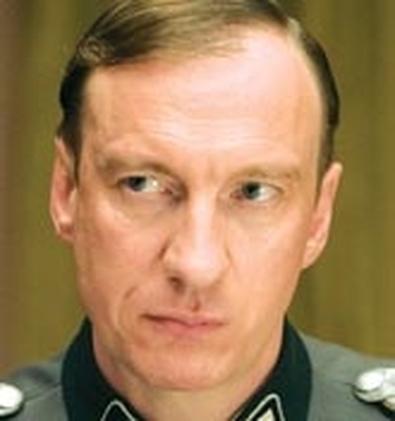
In general, we think of David Thewlis as a thoroughly solid actor who is undoubtedly a good person, even when playing revolting (the pimp who serves neighborhood pedophiles in Prime Suspect 3). He has also played romantically obsessed (French poet Paul Verlaine in Total Eclipse), a bemused hero (Edward in1996's The Island of Dr. Moreau), and of course a patently good guy (Remus Lupin in the Harry Potter franchise).
The British actor started his artistic life in a band but decided to study acting at London's Guildhall School of Music & Drama when his friends did so. His breakout performance came nearly 10 years into his career, as "rambling street philosopher" Johnny in Mike Leigh's 1993 film Naked, earning Thewlis awards and accolades for playing the fugitive rapist.
But in The Boy in the Striped Pajamas, Thewlis may have given a milestone performance, delving so profoundly into the mind of a Nazi that we're left hoping the actor still is that good man. The film, written and directed by Mark Herman (based on the novel by John Boyne), takes place in an extermination camp where the young Jewish boy (Jack Scanlon) of the title is confined. Thewlis plays the camp's commandant. But in Herman's script, we never see the Nazi at work, only at home, where he is husband to a lovely wife (Vera Farmiga) and their son (Asa Butterfield) and daughter (Amber Beattie). The film thus looks at this monster as family man, giving us a paradoxical character and giving Thewlis immensely rich material to mine, which he does with intelligence and surprising compassion — which is not to say the actor forgave or even fully understood what happened, as Thewlis reveals here.
Back Stage: How did you dig so deep to create this character?
David Thewlis: What I did most of all was try and go to the root sources rather than taking anything from movies I've seen. And I was very fortunate: There was a book called Commandant of Auschwitz, written by Rudolf Hess, written by indeed the commandant of an extermination camp, an autobiography that he was ordered to write between his trial and his execution. He was also a father of five, a married man, and — in numerous passages relating to his extreme devotion to his family — talking about tucking his children into bed and his extreme love for his wife. And I did everything I could to try and make it plausible that such people existed: an idea of a monster, but an idea of a human being who was driven by the times and obviously — in my own belief — his anti-Semitism and his own racial attitudes to perform such atrocities. So this is the most intense thing I've researched in my whole career.
Back Stage: Did you keep researching, even during filming?
Thewlis: There's nothing worse than reading a part and seeing how you're going to do it before you actually turn up for the first day and you bore yourself already. With this I was constantly challenged and kept the research going right through to the very last day — and indeed beyond. I'm still reading about this period in history. So, one did take it home with one — or to the hotel in Budapest, at least. In the evenings I was doing all the research. I'd go back to my hotel room; I never went out. I just stayed in and continued reading, continued viewing documentaries, just to make sure that that world was kept in my head — because my part in the film is mainly the role of a domestic man. You see him almost entirely at home. You don't see what I'm doing. And so I tried to keep the concentration going in the evenings as to what was happening "offstage," if you like, what we're not seeing. It would be [too easy to fall back] into the loving father, the loving husband. It felt very important to me to keep shocking myself every night in the downtime I had, to constantly keep researching it.
Back Stage: Looking back, which scenes are sticking with you, and why?
Thewlis: I think the ones that stick in my mind are the scenes of Vera Farmiga where she's exposed by Lieutenant Kotler [Rupert Friend] to what I'm doing [in the extermination camp], and she challenges me. Those scenes are the most intense, because Vera had an enormous amount of work to do there. When you do scenes like that, everything else disappears. You both take each other very seriously. Vera and I got along during the film — we have great respect for each other — and oftentimes with the children we formed a little family of our own, a joyous family that would go out on the weekends. But during those scenes, even during lens changes, we'd separate, and I felt great animosity coming from her. I'm not just saying this: I think she's a truly special actress. She takes it very, very seriously. And it's always wonderful to act with someone who does that. You can really feel the power when you're working with someone good. It's like a musician playing with another great musician. It's better than somebody who doesn't know what they're doing or they're not taking it too seriously. So those are the scenes I remember. And I suppose shooting the final scenes, which usefully were shot — we shot a lot of the film — in chronological order, partly to facilitate the children's performances. And also, it wasn't a film with many locations. We were fortunate that we could shoot a lot of it in chronological order. So I think the very last thing I shot was the very last shot. That was difficult because you were aware it was the very end of the film. You knew what the end of the film was. You knew that everything was riding on what was expressed in this man's face, as he realizes everything he's done and the consequences of everything he's done.
Back Stage: Was your director very hands-on with you?
Thewlis: I think Mark [Herman] is kind of very laid-back — more so than most directors I've worked with — which makes for a very relaxed shoot, I must say. Sometimes you work with kind of overbearing people and people who are very controlling. Mark was very much in the background. I think one of his things was he cast instinctive people, and he trusted the people to understand what was going on. We had a small amount of rehearsal and got to know each other and read through things. But when it came to actually doing it, there were never big discussions; there were never big notes. I think he trusted that he had cast the right actors and that we all took it seriously and did the background work.
Back Stage: What is the most memorable or useful thing you learned at Guildhall?
Thewlis: My favorite teacher was an improvisation teacher. I didn't find a lot of drama school all that useful, to be honest. I found a lot of it very cerebral and too study-bound. I always liked improvisation. I still like it — my best, greatest teacher being Mike Leigh, who works entirely through improvisation. Improvisation teaches you to listen properly, because you can't say what you're going to say next until you've really listened. I've worked with actors who don't listen. They're too concerned with what they're going to say next. They're practicing their next line in their head. [Improvisation] makes you more daring. You'll take more chances. You usually don't use it as a performance piece; you usually do it as a class exercise. Before I went to drama school, I went to a technical college, whereby we did improvisation very much, and I think that's where I learned to become an actor — through improv.
Back Stage: You've written and directed two films. What have you noticed about casting actors?
Thewlis: Well, because I cast them myself, I actually hardly auditioned at all, because I was in a privileged position of working with many, many people. Certainly, for my short film [Hello, Hello, Hello] I didn't audition at all. I knew Kathy Burke and Robert Pugh very well, and I just was like, "Well, you two are great and you could do it." I know more actors than casting directors. So most of the parts — I only auditioned a few smaller ones. I'll say one of the things — I think casting directors sometimes inhibit actors very much. I think they put them in such restricted situations where they can't really relax and be themselves and give a decent performance. They stick a video camera in their face in a badly lit room and they read to them in a flat voice and are oftentimes of the wrong gender. I think that's very, very unfair a lot of the time. They don't give an actor a chance. And you could get a great actor who's just not got the nerve for auditions and miss someone good. But in my case I didn't hold auditions because I pretty much had in my head who I wanted.
Back Stage: What did you notice in directing them?
Thewlis: Well, the hard thing in directing my own film: I was also in it. I found that rather difficult, because — I get back to this thing about listening. Because when I'm working in the middle of a scene with another actor, I'm seeing their character. I'm not always a good judge of if they're a good actor or not. And it was very difficult because I found that if I gave myself two takes and made the other actor do six takes, that looked conceited. And if it was the other way around, then I looked indulgent. It was a strange situation. But it was something I really liked. But I'm not sure it's something I'll do again.
Back Stage: Do you have any routines or superstitions on the set?
Thewlis: No, apart from just making sure I've learned my lines well. I learn, like, a week ahead. On the film set, there's so much pressure and stress around, and you don't want to add to it by going, "Oh, sorry, can we go again? I forgot." After everything else that is going on, I don't want to cost them one more penny by needing another take because I blew my lines. And also you don't want to be thinking about your lines, because you're trying to act. So I try to learn everything so much in advance that it's like saying the alphabet. Even if your brain freezes, your mouth is going to say it anyway. That's just something I learned in theatre.
The Boy in the Striped Pajamas opens nationwide this week.
Write to the author at dmargolies@backstage.com.