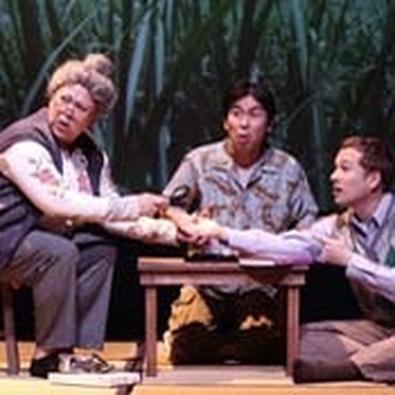
The story begins as one-quarter Okinawan Kama Hutchins (Joseph Kim) comes from Hawaii, where his parents emigrated years ago, to teach English in an Okinawan school. Attempting to give the students practice in using their English, he suggests that each one stand in front of the class and tell something about themselves. His students (Atsushi Hirata, Teruko Kataoka, Taishi Mizuno, Mari Ueda, Kotaro Watanabe) reluctantly agree, and playwright Jon Shirota uses that contrivance to show their disparate attitudes toward their relations with Americans and the military, who are still in Okinawa 60 years after World War II.
Another thread that runs through the play concerns an elderly shaman, Obaa-San (Amy Hill), Hutchins' distant relative, who surprises him with the knowledge that Hutchins will inherit a large sugar-cane farm. He offers it to the military, whose plan to revamp it, which would force Obaa-San to move, will change the pastoral nature of the land. This energizes the class to take action.
Hill, Kim, and school principal, Keiko Oshiro (Sachiko Hayashi) represent past and present attitudes about Okinawa. Hill is particularly effective as the revered yet hip mystic who can converse with souls on the other side. Hayashi also does a nice turn as the rigid autocrat who finds her own humanity as she deals with the class.
Well-intentioned, Shirota's script still seems to be a work in progress. The stories told by the students appear to be more playwright-designed than authentic to the characters. In particular, one young lady describes in detail her rape at the hands of an American soldier. While several cases like that have occurred in Okinawa, this shy young girl seems unlikely to make that her class narrative.
Director Tim Dang handles his bilingual cast effectively, giving the characters authenticity. For non-Japanese speaking audience members, though, there is the sense that knowing the language would definitely help in appreciating the humor or cultural references. Mina Kinukawa's set design, using a large screen with images of Okinawa's past and present throughout the play, is effective. Guido Girardi's varied lighting design is also artful within scenes.
Presented by East West Players at the David Henry Hwang Theatre,
120 N. Judge John Aiso St., L.A.
Wed.-Sat. 8 p.m., Sun. 2 p.m. Feb. 13-Mar. 9.
(213) 625-7000. www.eastwestplayers.org.