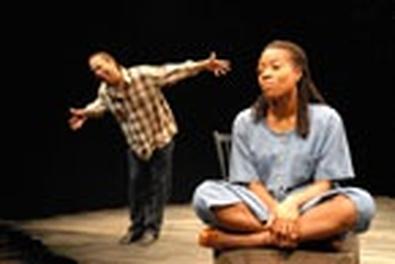
"That was a play about black people for white people," declared an older African-American gentleman after the actors in Yellowman took their bows. Considering that the play is about interracial racism, his observation seemed incongruous yet, from this white reviewer's viewpoint, possibly apt. Still, Dael Orlandersmith's play is a beautifully written body cartography project; its themes, like the themes of any great work, are colorblind. Yellowman was short-listed for the 2002 Pulitzer Prize and it's easy to see why. Orlandersmith has a gift for searing poetry and metaphors that build, rather than sink, through syncopated repetition.
Set in a rural South Carolina town, Yellowman concerns Alma and Eugene, childhood sweethearts who eventually become lovers. Alma is a product of a poor, Gullah mother and an absent father. Like many women, she is cursed with a body she hates, having inherited her mother's dark skin, big body, and, she fears, her cruelty, stupidity, and desperation (one particularly heart-wrenching scene has Odelia, Alma's mother, begging on all fours in the middle of the street like a dog as her lover walks away from her in disgust). Alma longs for a thin body, light skin, and "long swinging hair." Eugene, as a slight, light-skinned -- yellow -- man, has a different set of problems, including an alcoholic dark-skinned father who despises him. Alma and Eugene inherit more than skin color from their families; the self-hatred that they cultivate throughout their lives destroys them in the final moments of the play.
In addition to playing Alma and Eugene, Regina Marie Williams and Thomas W. Jones II portray a host of other characters, and Jones in particular plays the text like an expert jazz musician. His opening monologue is lovely to behold as his body and voice sways, lilts, and almost dances with Orlandersmith's versified poetry: "My father was a big, big man and there was something about that bigness -- especially if you're a child in the south," he says. "I watched my father and men like my father. Black southern men seemed incredibly big -- especially men who labored in heat or knew about that heat/sweat of black men in the south/the sweat just dripping off their bodies/their big bodies -- particular darker/dark men."
Williams, however, doesn't fare as well with such material. The layers of meaning buried in the melodies of the script are unsupported by her voice, which is squeaky and has a limited range of expression. It's hard to tell at times which character she's playing, and moments that should have a startling impact don't always hit their mark. Williams is also hindered by her appearance: the denim tent dress she wears doesn't disguise the fact that she's svelte, muscled, and drop-dead gorgeous.
As a result, Mixed Blood's production is a little uneven; the actors' energy also flags towards the end of the 90-minute marathon. Blessedly, director Marion McClinton does what directors so rarely do these days -- he gets out the way and lets the words speak for themselves. This is good, because Orlandersmith has a lot to say.
Yellowman runs Sept. 28-Oct. 29 at the Guthrie Studio Theater, 818 S. 2nd St., Minneapolis. Tickets: (612) 377-2224. Website: www.guthrietheater.org and www.mixedblood.com.