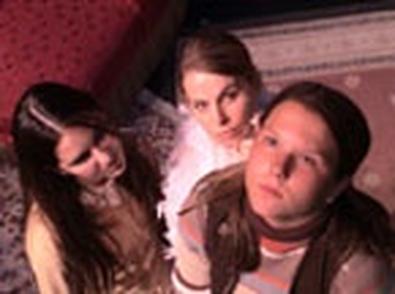
Paul Zindel's 1971 Pulitzer Prize-winning The Effect of Gamma Rays on Man-in-the-Moon Marigolds is one of those plays that swept into the public's imagination for a decade and then seemingly fell off the face of the earth. No doubt part of the problem is the chain-smoking required in the text. But also, the story of eccentric mother Beatrice and her daughters -- odd, epileptic Ruth, and introverted science fan Tillie -- is one that we have seen redone many times since. Still, the original has power: Beatrice seems like a refugee from a Tennessee Williams play, and observing her toxic effect on her children is worth a revisit. You can't call iTheatre Collaborative an alternative company, but rather an eclectic collective. Its production featured excellent performances yet also highlighted how the script has aged over 35 years.
Director Patrick DuLaney allowed the presentational elements in the script to broaden; his Beatrice (Shannon Whirry) is a grand flourish of manic depression. Indeed, Whirry was able to present both extremes of the manic-depression spectrum, edging toward but never crossing the dramatically acceptable line. Taking things one step further was Michelle Chin's Ruth, who spent most of the time acting in a manic whirl. Because DuLaney had her spout her lines, however, her Ruth seemed less realistic. Chin, though, is a stronger actor: When her demeanor dipped, her faรงade cracked, allowing us to see a depth in her that is ominous and scarily believable. Makala Close's Tillie used her expressive face to speak volumes that her character's introversion could not allow. Her monologues seemed like echoes of Beatrice's highs, and she did a nice job of allowing the audience to see this connection.
In supporting roles, Barbara McGrath was a sadly oblivious, unendingly cheery Nanny, yet DuLaney went too far in allowing Shannon Pauley's Janice to play her character like a junior high school queen bee in desperate need of Ritalin.
DuLaney's choice to direct Marigolds as a period piece helped support some of the quainter notions that were much more disquieting in 1971 than today. Subsequently, Todd Norris' costumes and DuLaney and Christopher Haines' production design successfully immersed us in the era. They used some excellent isolation lighting to further enhance the fracturing of the post-nuclear family.
The Effect of Gamma Rays on Man-in-the-Moon Marigolds ran May 5-20.