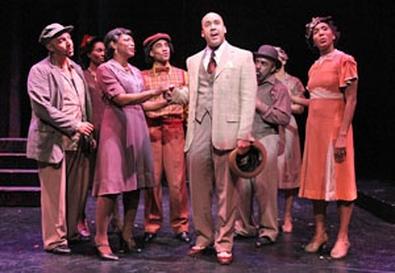
Urban Stages has itself a fresh, original winner in "Langston in Harlem," a new musical based on the poetry and life of Langston Hughes. Director and co-author Kent Gash's inventive production strains the tiny black-box space at the seams with its vitality and intelligence, and a crackerjack 12-person cast delivers the show with rich humanity and flair.
This unique piece has the wisdom not to overexplain itself, allowing the audience to put together its own portrait of Hughes through his work. All the fascinating pieces of his life are in place: poverty, politics, race, fame, homosexuality. Indeed, the only time the show falters is in a few baldly expositional dialogue scenes Gash and co-author Walter Marks, who also wrote the strong score, have cooked up among Hughes and his friends and fellow writers Zora Neale Hurston and Countee Cullen. They're necessary, because we need the clothesline of Hughes' life as a plot on which to hang the poetry, but they could be accomplished with more subtlety.
Far more important are the show's considerable strengths, and foremost among them is Marks' music, which confidently strides through the various sounds of the Harlem Renaissance. The composer's main claim to theater fame is the music and lyrics for two 1960s Broadway flops, "Bajour" and "Golden Rainbow," the latter of which produced the you-can't-kill-it-with-a-stick pop hit "I've Gotta Be Me." Nothing in that work prepared me for the sophistication and power of Marks' music here. Every glorious word is by Hughes, and Marks sets the poetry with sensitivity, insight, and clarity. Standouts include Hughes' introductory "Who Am I?," his mother's "Crystal Stair," a haunting "Troubled Water" for the poet and a sailor lover, and the seismic one-two punch of Hughes' "Jukebox Love Song" and Hurston's "The Sweet Flypaper of Life," the last becoming a sensational climactic number for our protagonist when reprised. Marks and Gash have also structured the score smartly, with number after number landing with welcome inevitability at just the right point in the story.
Josh Tower, as Hughes, is rarely offstage and runs the marathon effortlessly, acting and singing with power and conviction. Kenita Miller's Hurston is feisty, warm, and entirely winning, while Jordan Barbour is memorable as both a smooth, polished Cullen and a hunky sailor on the prowl. Glenn Turner is Simple, an older man on hard times who was once a top-flight dancer, and the authoritative Turner gives him dignity and grace, particularly in the wonderful "Dancer," when Byron Easley's fine choreography shows us what Simple once was. (Easley's work also shines in the stark dance of a young heroin addict and the propulsive and defiant "I Am a Negro," for Hughes and the angry men of Harlem.)
Gayle Turner is compelling as Hughes' religious mother; C. Kelly Wright is wry and maternal as Madam Alberta K. Johnson, a neighbor who works as a domestic and is a fan of the still-undiscovered Hughes; and Francesca Harper creates an intriguing portrait of the show's one white character, Mrs. Poindexter, a well-meaning socialite who becomes Hughes' patron but can never quite overcome the patronizing racism with which she was raised.
Emily Beck's spare but fluid set is crucially enhanced by Alex Koch's imaginative contextual projections, Austin K. Sanderson's distinctive period costumes, and William H. Grant III's poetic lighting. Musical director John DiPinto confidently leads the smoking six-piece band through Steve Cohen's colorful orchestrations.
"Langston in Harlem" presents Hughes in all his thorny complexity, never shying from the darker aspects of his story. And yet the show leaves you with an irrepressible sense of joy in its celebration of a great American artist.
Presented by and at Urban Stages, 259 W. 30th St., NYC. April 15–May 9. Tue.–Fri., 8 p.m.; Sat., 2 and 8 p.m.; Sun., 5 p.m. (Sun., May 2 and 9, performance is at 2 p.m.) (212) 868-4444 or www.smarttix.com.