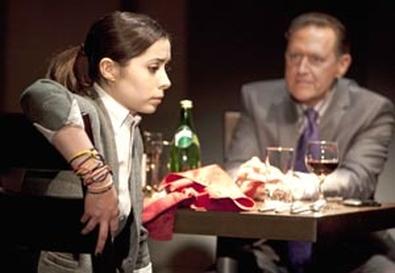
British playwright Polly Stenham was just 19 when she wrote "That Face," a drama depicting a family for whom the adjective "dysfunctional" is an understatement. Mother Martha is an alcoholic and pill addict who can't seem to get dressed most days. Father Hugh, a high-stakes broker, flew the coop long ago for Hong Kong and a second wife. Son Henry has dropped out of school to care for his boozy mum, with whom he has developed a borderline-incestuous relationship. Daughter Mia is close to expulsion from her upper-crust boarding school for giving an overdose of Valium—stolen from Martha's stash—to a schoolmate named Alice during an initiation gone horribly wrong. That's a lot for an author barely out of her teens to handle, but the British have eaten it up, showering Stenham with awards and nominations, including one for the Olivier Award for best new play, for the work's London production, which transferred from the Royal Court to a West End run.
I haven't seen the British version, but the American premiere, presented by Manhattan Theatre Club and sharply directed by Sarah Benson, artistic director of Soho Rep, thankfully avoids veering into soap operatics. That is, until the final confrontation, when Hugh returns to commit the over-the-edge Martha to a rehab clinic. Previous to this scene, Benson and her cast maintain credibility, and Stenham reins in the hysteria. But the climax drags on too long, and what should be a shocking conclusion, with a broken Henry dressed in his mother's clothes and urinating himself, is instead a shouting match with an actor in drag using an embarrassing stage effect.
Stenham shows a remarkable flair for brutally honest dialogue and situations. She has sympathy for her misguided family but unstintingly displays their casual cruelty and shameless manipulation of each other. Yet there are structural problems. Mia is sadly underdeveloped, almost a minor character, upstaged by Izzy, a flashier school friend who is an accomplice in Alice's hazing. We don't know very much about Hugh and Martha's early marriage and what caused their breakup or her drug dependence. Martha is a bit on the familiar side. Not only does she recall the same-named voracious vixen from Edward Albee's "Who's Afraid of Virginia Woolf?" but also the monster mother figure—twisting her children's lives for her own ends—that we've seen in so many American plays, ranging from Clifford Odets' "Awake and Sing" and Paul Zindel's "The Effect of Gamma Rays on Man-in-the-Moon Marigolds" to Michael Weller's "Spoils of War."
Fortunately, Laila Robins screws a tight lid on Martha's madness and only lets a little out at a time. Cristin Milioti clearly conveys Mia's moral struggle and desperate need for stability. Betty Gilpin's Izzy is a charismatic charmer who maintains her attractiveness even as she commits repulsive acts. Victor Slezak makes for a steady presence as the practical Hugh. Christopher Abbott details Henry's unraveling with solid technique but succumbs to melodrama in the final moments.
Stenham is a promising author, and it's clear she had to get her "angry young woman" play out of her system. It will be interesting to see what she does next.
Presented by Manhattan Theatre Club at New York City Center Stage I, 131 W. 55th St., NYC. May 18–June 27. Schedule varies. (212) 581-1212 or www.nycitycenter.org. Casting by Nancy Piccione.