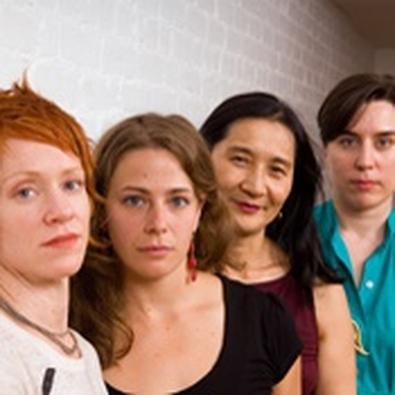
For the first time ever, Americans have been given the chance to vote for a feasible female candidate for president of the United States. This historic opportunity -- and the fact that it took so long for a woman to be considered viable presidential material -- makes the celebration of Women's History Month this March especially relevant. And while paying tribute to women, there is perhaps no more appropriate program for dancers to laud than Sugar Salon.
Sugar Salon is dedicated to mentoring and presenting the work of female choreographers. "Or, as we prefer to say, exceptional choreographers who happen to be women," explains Marisa König Beatty, executive director of the Williamsburg Arts Nexus, commonly known as WAX. Founded in 2000 in the Williamsburg section of Brooklyn, WAX, an organization that supports the work of emerging artists, was one of the founding partners of Sugar Salon.
Defining a Need
It was startling statistical evidence gathered by the Gender Project that led to the creation of Sugar Salon. "The Gender Project was a collective of women artists, choreographers, and administrators -- people such as Janis Brenner, JoAnna Mendl Shaw, and Ellis Wood," says Beatty. "They conducted a study in which they compared men and women in the field of modern dance in terms of whose work was being produced, who was being funded, and who was getting media attention. The results of the study showed that, even though there are many more women than men working in the field of modern dance, the men receive much more funding, production opportunities, and more media coverage."
Sugar Salon was an attempt to counterbalance that. The program was initiated in 2005 by a small group of female choreographers, including Beatty, Kate Weare, and Tami Stronach, in collaboration with former Paul Taylor dancer Mary Cochran, chair of the dance department at Barnard College, the women's college affiliated with Columbia University. "We all agreed that there really needed to be an organization devoted to providing resources for women choreographers," says Beatty. The program provides 10-week summer residencies for one mentor and three emerging choreographers to create work at Barnard, which provides its dance studios free of charge. Sugar Salon also pays the choreographers a small commissioning fee and funds a full presentation of their work at a theatre space in Manhattan. In addition, if they're interested, each choreographer has the opportunity to accept an adjunct faculty position at Barnard the following spring, set a work on the students, and have it performed at the college's spring dance concert.
Beatty describes Sugar Salon as "a happy marriage between two very different organizations, WAX and Barnard, both looking to support the same purpose: to help women make their work. While we at WAX are committed to supporting emerging choreographers, Mary is always looking to expose her dance students to new choreographers, especially ones who are making work in New York City, and to bring their choreographic work into the campus arena."
"There is also a generational mentorship aspect to the program that's very important," says Lanileigh Ting, Sugar Salon's associate producer. "In selecting the program participants, the first thing we do is pick what we call our headliner. That's an established choreographer who will work as a mentor with three younger choreographers. Then we take the applications that we receive from the emerging choreographers and have them reviewed by a panel that includes myself, Marisa, some prominent artists in the dance field, and the mentor choreographer. From those applications we pick the three young choreographers whom the program will support that year."
Developing the Complete Artist
In selecting its mentor choreographer, Sugar Salon looks for artists who have been in the field for at least 20 years. "The artist should also have a personal interest in sharing her knowledge with the next generation," says Beatty. "And we're looking for choreographers who are working in a very modern or postmodern vein, not in a classical style. Having the mentor choreographer involved in the selection process allows her to pick emerging choreographers whose work interests her, but we also like to have aesthetic variety. For example, our first year, Susan Marshall was our mentor choreographer, and she worked with three very different emerging choreographers. There was Yanira Castro, who has done a lot of site-specific work and isn't very movement-driven but very visual and abstract. We also had Dana Ruttenberg, who's Israeli and comes from a very physical -- and very technical at times -- background. And then we had Ivy Baldwin, who has theatrical and visual elements like Yanira yet also brings a sense of humor to her work."
During the summer residency, the mentor choreographer is also given access to rehearsal space that she can use to work on her own choreography. "The idea is that the choreographers are sharing the space," says Ting. "They are seeing each other's works all the time; they're talking regularly with one another about their choreographic challenges; they're discussing career development ideas. The exact role of the mentor changes with each mentor and each group. It's very flexible. For example, this year our mentor was Donna Uchizono, and she really focused a lot on the creative process. She spent a lot of time encouraging the young choreographers to discuss their process and tried to get them to use their residency time to really explore avenues they haven't necessarily explored before." The mentor also participates in the administrative workshops that Sugar Salon offers. "We had one workshop this year in which we discussed how to prepare grant applications," Ting says. "We talked with the choreographers about how to select appropriate samples of their work." Topics also included the differences between applying for a grant and preparing an application for a university position.
If it appears that Sugar Salon is discriminating against men, Beatty explains: "When we set out to create this program, there was not only one but two programs already in place specifically designed to support male choreographers. One of them, Moving Men at Dixon Place, has now become a little more open to women, but the other one, the annual In the Company of Men concert at Dance New Amsterdam, not only caters just to male choreographers but also requires that the entire performance cast of the works be all men. And meaning no disrespect to either of those programs -- which have very specific reasons for doing what they do -- we don't see that there's any discrimination involved in our program. We feel we're meeting an important need that definitely exists for women choreographers."
Funded by individual donors, the New York City Department of Cultural Affairs, Barnard College, and the Brooklyn Arts Council, Sugar Salon is committed to meeting the rich and varied needs of choreographic artists. Ting emphasizes that "the program is not just about a residency and a performance; it's about the complete development of the choreographers. It's about helping them develop as artists, furthering their careers, giving them resources they wouldn't normally have access to, and exposing them to other artists they might not necessarily get to work with." Sugar Salon's mission is based on the belief that in order to develop as artists, female choreographers need to receive the same exposure and fiscal support enjoyed by their male counterparts.
Having just completed its second round, with a presentation last month at Abrons Arts Center of works by emerging choreographers Luciana Achugar, Renée Archibald, and Heather McArdle, Sugar Salon will soon be announcing its choreographic mentor and choosing its three participant choreographers for 2008. The program does not take applications for the mentor choreographer position; it's by invitation only. "However, we are currently accepting applications from emerging choreographers," says Ting, "and we hope to make our selections by late March or early April." Those interested in further information should visit www.wax205.com.
Lisa Jo Sagolla can be reached at ljsagolla@juno.com.