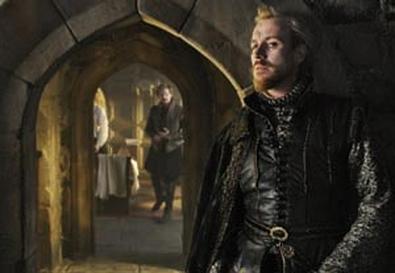
Photo Source: Columbia Pictures
"A friend told me all about it and showed me a documentary on it," Orloff recalls. "And I thought, 'Wow, that would be an amazing film, if only somebody could figure out how to write it.' " That somebody would be Orloff himself, though it would take almost 20 years and countless drafts. Now, the screenwriter offers his take on history with the film "Anonymous," a sprawling drama from director Roland Emmerich that is a Shakespearean tale in its own right.
Orloff didn't immediately leap into penning "Anonymous" he says he was far too intimidated. "I couldn't imagine writing a script that put dialogue in Shakespeare's mouth," he says. "So I didn't really do anything about it for years, other than researching more about it, for fun." In the 1990s, Orloff was working in advertising when he began dating an HBO executive who would become his wife.
"HBO was making a lot of films based on nonfiction ideas at that time," he notes. "She would bring home scripts, and a lot of them were horrible. So I sort of pitched my idea to her, and she told me I should write it. She said, 'If it's no good, you don't have to show it to anybody.' "
Orloff notes that this happened before the Internet became prevalent, which meant he had to do extensive research in libraries, reading not just books about the Oxfordian theory but volumes on 16th-century politics and drama production and biographies on all the people who would be characters in his screenplay.
He finally finished his script, then titled "Soul of the Age." Two months later, "Shakespeare in Love" came out. "I thought I'd had this great, revolutionary idea of making Shakespeare a young, handsome, sexy actor," Orloff says with a laugh. "It felt like such a fresh idea 12 years earlier, but suddenly I turn around and Joseph Fiennes is doing it. So that kind of put the kibosh on things."
Though the script didn't sell at the time, it provided Orloff with his breakthrough in screenwriting. A friend who read scripts for CAA passed it around to some agents, one of whom passed it on to Tom Hanks. Orloff landed a job writing two episodes of Hanks' HBO miniseries "Band of Brothers." "It was my first spec, and it got me an agent and got me into a lot of offices and ultimately started my career," Orloff says.
Unexpected Development
Orloff would see two of his scripts made into movies—the Mariane Pearl story "A Mighty Heart" and the animated "Legends of the Guardians: The Owls of Ga'Hoole," but he assumed his pet Shakespeare project would never get made. Then, seven years ago, he met with Roland Emmerich, best known for big-budget disaster flicks like "Independence Day" and "The Day After Tomorrow." Orloff didn't think he was right for the film Emmerich was proposing and said so. "So then Roland said, 'What else have you got?' And I did what I've done in 100 other meetings, which was to talk about 'Soul of the Age,' " Orloff recalls. "He was getting more and more into it, and finally he asked to read it. Two weeks later, I get a phone call saying he loves it and wants to buy it."
That was only the beginning of a seven-year process for the pair, during which the script changed dramatically. Originally, the story centered on de Vere, Shakespeare, and actor-writer Ben Jonson, who was involved in the cover-up. Emmerich brought in the idea of developing a story involving Queen Elizabeth, who had only been a minor character in earlier drafts. "Roland had read many theories about Edward and Elizabeth having a son together," Orloff says. "I'm not sure I believe it personally, but it's a fascinating idea."
Orloff then began incorporating flashback scenes detailing de Vere's early years, where he romances the queen. "As a result, the script went from a movie that might have been similar to 'Amadeus' thematically to a Shakespearean drama in the sense of politics and sex and violence." As well, Shakespeare is reduced to a minor character in the film, which focuses more on de Vere's personal life and how his writing helped to ignite a rebellion.
Orloff says the most difficult part was figuring out the script's structure. "It was an incredibly complicated task; it took me about 25 drafts," he notes. "I had so many choices: Is it a biopic; is it a mystery; is it set now or then? It took me a long time to figure out." Orloff says he's not "a big outliner," that he likes to discover as he's writing. That often means mistakes and wrong turns. "At first I would feel like I wasted time, but now I believe wrong roads can be valuable. You learn more about your characters, or write a bit that is still a good scene, just not right for that movie. So I constantly go back to scenes I've rejected and steal something from them."
From Home to Coffee Shops
Orloff also says he's not great at working on a set schedule, although he's improved now that he has kids. "They don't allow you to be quite as free with your time," he notes. He likes to mix up where he writes, moving from his office in the house to an office outside the house to coffee shops. "I have a problem going into the same room every day." He also listens to music when he's working, often making a set list for a particular project. "For 'Band of Brothers,' I listened to the soundtrack to 'Saving Private Ryan.' 'Anonymous' was Enya, and a lot of Elizabethan lute music."
Emmerich might seem an odd choice to helm a dramatic period piece, but Orloff says they had a wonderful collaboration. "Roland is a much more interesting, complicated filmmaker than I think people give him credit for," he says.
Orloff was on set every day and involved during preproduction. Even while shooting, he says he was constantly rewriting. Though it's a thrill to see his movie finally completed, with Rhys Ifans playing de Vere and Vanessa Redgrave as Queen Elizabeth I (in flashbacks the roles are played by Jamie Campbell Bower and Redgrave's real-life daughter, Joely Richardson), Orloff says the making of the film was probably his personal high point.
"Walking on the sets and seeing the people in costume was almost more amazing than seeing the movie done," he says. "It was incredible to see these people making this thing that I had been carrying in my head for so many years."