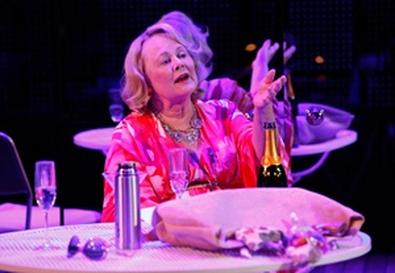
Photo Source: Carol Rosegg
So, when the chance to do "Masks" came her way it was almost a no-brainer despite the myriad challenges that exist in this complex, final, and surreal work. Set in a purgatory-like netherworld, "Masks" centers on Babe, her much younger poet husband, his college-age male lover and a collection of tormented oddballs, all of whom have been kidnapped and spirited off to this no-man's-land, where they are guarded by corporate thugs. Directed by David Schweizer, "Masks" is playing Off-Broadway at the Culture Project.
"The challenge in all of Williams' work is that his characters are so complicated," explains Knight. "In 'Masks' there's also the tremendous stamina that's required. The other issue is that I'm such a natural actress. It's impossible for me to do anything that's fake. But Babe is larger than life, such an over-the-top personality. But Babe is also incredibly damaged. Babe is amalgam of all of Tennessee's characters and Tennessee himself. The play is Tennessee Williams' kitchen sink, meaning everything is thrown in. It's not like his other plays. I'll be very interested in seeing how it's interpreted."
To Play King Lear
A Goessell, Kansas native, Knight grew up with her sights set on an opera career. She majored in music at Phillips University and Wichita State University, but her life took an unexpected turn when enrolled at the Pasadena Theater School between her junior and senior years. Knight had no intention of acting professionally; indeed, she was studying drama to enhance her singing talents. However, at the school showcase she was discovered by an agent and within short order offered contracts at Warner Brothers and MGM. The year was 1959 and earning $400 a week for six months was a lot of money. Knight jumped on board with Warners, though it never occurred to her that the contract would be renewed.
Her whirlwind career took off and she hasn't stopped working in half a century. Her first film was "The Dark at the Top of the Stairs," co-starring Robert Preston, Dorothy McGuire, and Angela Lansbury. Knight played a 15-year-old girl and was nominated for an supporting actress Oscar. Shortly thereafter Warners loaned her out to MGM to play Heavenly in "Sweet Bird of Youth" starring Geraldine Page and Paul Newman. "Tennessee said I looked exactly the way he wanted Heavenly to look," Knight recalls his comment at their first meeting.
Knight remained a contract player for five years, appearing in numerous films and TV programs, including such classics as "Maverick," "77 Sunset Strip," and "Cheyenne."
She looks back at the old studio system with mixed feelings. "You were really taken care of," she says. "They did all the publicity and when I was nominated for an Academy Award, they took me into the wardrobe department and said you're the same size as Joan Fontaine. They brought out a gown she wore in one of her movies and that's what I wore to the Oscars. The next day I returned it."
On the flip side, actors were obliged to appear in whatever the studio bosses decided, no matter how absurd or counterproductive. After Knight co-starred in "Sweet Bird of Youth" and received her second Oscar nod, "Jack Warner put me in a grade-B movie about women in prison," Knight laughs.
Always more interested in artistry than fame, Knight decided to relocate to New York City to study with Lee Strasberg at the Actors Studio. Her inspiration was Actors Studio disciples Newman and Page whom she felt "knew something I didn't." She says moving to New York thwarted her film career, but she has no regrets.
Indeed, to this day she feels you cannot master the art of acting unless you are on stage or at least in class. Knight insists it's no coincidence that her best film performance was in the controversial "Dutchman" by Amiri Baraka, which was preceded by her playing the same role in a long Off-Broadway run.
At the moment, her thoughts are centered on "Masks" and her hope that audiences "appreciate Tennessee that much more and after seeing the play say, 'He wrote that?' People who know his work feel this piece was him at his most open, especially about homosexuality."
Knight still looks hopes to appear in "Red Devil Battery Sign" someday. "I'd also like to play Alexandra Del Lago in 'Sweet Bird of Youth.'" But the role that most intrigues her is King Lear. "I'm not interested in playing it as a woman. I'd play it as a man."
Asked if she has anything to add, Knight doesn't miss a beat. "I'm astounded by the fact that at 75 I'm still interested in pursuing the puzzle of what I do."
"Masks Outrageous and Austere" will run through May 26 at the Culture Project, 45 Bleecker St., NYC.866-811-4111 www.masksoutrageous.com
Outtakes
—Won a Tony, three Emmys, and a Joseph Jefferson Award, among others
—Had a recurring role in "Desperate Housewives," and guest-starred in "House," "N.Y.P.D," "Thirtysomething," and "E.R."
—Appeared in more than 20 films, including Rebecca Miller's "The Private Lives of Pippa Lee," James Brooks' "As Good as it Gets," Sidney Lumet's "The Group," and Francis Ford Coppola's "The Rain People."
—Was married to the late British playwright, John Hopkins
—Continues to sing in recitals