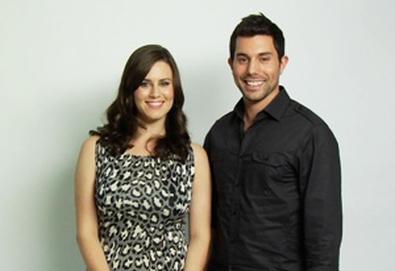
Not that they're complaining; the pair are extremely grateful for the attention and to the fans who took part in Paramount's "Demand It" campaign, which had people write in and ask for the film to be shown in their city. Neither actor even expected the film to be released: After playing the festival circuit, it was bought and shelved with the intention of being remade as a vehicle for big movie stars. That is, until Steven Spielberg took home a copy and found himself terrified. Spielberg recommended a new ending, and now the film and the people behind it find themselves the toast of the town, meeting with Hollywood players and receiving marriage proposals on their Facebook accounts.
Both actors moved to L.A. in 2005 to pursue entertainment careers; Featherston had just graduated from Southern Methodist University, and Sloat was attending music school at the time he booked "Paranormal." By 2006, they were shooting the film that would change their lives, but it would take another three years for that movie to reach a wide audience. During that time, they were unsure about the movie's fate, but their faith in Peli and the film never wavered.
Back Stage: How did you hear about the casting for "Paranormal Activity," and what was the audition like?
Katie Featherston: There was no script, but the audition was on LA Casting. We both just submitted, and the audition was purely improvisational for me.
Micah Sloat: For me, too.
Featherston: I walked into the room, and Oren, our director, said, "Why do you think your house is haunted?"
Sloat: Without even asking for a headshot, or a name, or anything.
Featherston: Immediately I was like, "Well, let me tell you…" And we had to go into it.
Sloat: The callbacks were awesome. Within 30 seconds of meeting, he said, "Micah, this is Katie; Katie this is Micah. Tell us how you guys met." We talked for a good 10 minutes.
Featherston: He just kept asking us question after question.
Sloat: But it felt natural; it didn't feel like we needed to come up with anything. That's the way it is: We were dating for three years.
Featherston: We listened to each other really well. And created that backstory.
Sloat: And it stuck. Oren, as a director, is really open like that. He's a pleasure to work with. The creative input we had was unparalleled. It's unique and special for a guy to have such an ironclad creative vision, and yet allow us to be so open.
Back Stage: Do you remember what the initial casting notice said?
Featherston: "Prepare to work long hours, around the clock."
Sloat: I'll put it this way: No SAG agent would have submitted their talent for these roles, simply because it was like, "We're not going to provide a script; there is no script. You're going to have to shoot all hours of the night without sleeping, without even knowing what's going to happen to you next."
Featherston: "Be prepared for anything."
Sloat: "We're looking for actors who basically go into this haunted house and get tortured and filmed."
Back Stage: What made you respond to the project?
Featherston: It was different; it told you that the person who wrote it was excited and passionate and ready to go with what he was wanting to do. And how awesome is that to be a part of as an actor? So I was in. I love scary movies and I love being scared, so it was exciting.
Sloat: It was a really unique opportunity to go in and do something I had never even seen before. I think I'm attracted to things I don't understand, and I want to find out more. I honestly went to the audition just wanting to see what it was about more than wanting to be in the project, and I think that actually helped when I got in the room. Because I wasn't like, "Oh man, I've got to get this role!" I was like, "Let's have fun, dude!"
Featherston: I remember waiting in the waiting room, and these girls would come out and be shaking their head and sighing and just kind of walking away. And I was thinking, "My gosh, what is going on in that room? What could he possibly be doing to freak these girls out?" They just didn't quite get it, I guess.
Sloat: It was the most fun I've ever had in an audition.
Featherston: It was so much fun! I remember telling my mom I didn't want to stop the audition.
Sloat: I just wanted to stay in that room and keep playing.
Back Stage: How long was the initial shoot?
Sloat: We had a seven-day shoot, and we went back and did reshoots on a weekend later on. It was really intense because we weren't on the budget constraints Oren was. I was in music school, and I took a week off, and they said, "We're going to expel you if you don't come back." We were shooting anywhere from 14 to 18 hours a day. When we finally did get to sleep, it wasn't much. The exhaustion fed into the characters and the film and actually helped a lot.
Back Stage: And you actually filmed at Oren's house?
Sloat: It was shot entirely in Oren's house. People are trying to find the house; I imagine he's a little scared.
Featherston: He did a fancy stairwell and repainted and ripped out all the carpet and put down floors to make it a more dynamic place to shoot and make it a little more ominous.
Back Stage: Was that factored into the infamously low budget?
Sloat: Actually, yes, the majority of the budget was for renovating his house for the feature. If his house had already looked the way he wanted it to be, I would imagine the movie would have only cost three or four grand. That's a guess.
Back Stage: Where did the rest of the money go? Your salaries?
Featherston: [Both laugh.] The camera. Food. Our craft services consisted of us going to Trader Joe's and pushing a cart around.
Sloat: Basically the entire budget of the movie is renovating Oren's house and the camera.
Back Stage: When the film was acquired by Paramount, did you receive a better fee for your acting services?
Sloat: We're, um, not unhappy with the way things are now.
Featherston: [Laughing] We'll be okay.
Back Stage: There was no script, so how did shooting work? Was there an outline?
Sloat: Initially, Oren wanted us to just live in a house and keep the camera rolling, and he was just going to scare us. He quickly realized that not only was that going to create a lot of dead time on film but that we could handle not knowing what was going to happen and we could react and do it again and again.
Featherston: Very quickly he learned to trust us, and then we were this tight-knit unit and it was all collaboration. He had this beautiful, clear vision of what he wanted but was so open to hearing what we thought.
Sloat: He'd say, "This is where you are in the movie, these are the points you need to hit, and you need to establish this and make sure this happens in the scene." So we'd do it and see what works and what didn't. A lot of times, the first take was it. But we'd want to keep doing it.
Featherston: You want that one more time to make sure.
Back Stage: What other preparation or research was involved?
Featherston: It was more about creating the relationship.
Sloat: We went to the beach and hung out and took pictures that are actually in the movie. And we went to Halloween Horror Nights, just to be scared together.
Featherston: Which is where I found out that he was not as macho as I thought. Not that he isn't incredibly macho in general, but in this specific situation he literally jumped behind me and hid as the scary things came out at us.
Sloat: I was just helping you to face your fears.
Back Stage: What is your response when people suggest you're just playing yourselves?
Featherston: I think you have to bring a part of yourself to every single character. I think the fact we have the same names kind of throws people off. If we'd been named something else, I don't know if people would have the same sort of question about that. Absolutely it's a version of myself, but it isn't me.
Sloat: Anything that you like is me. Anything you don't like, that's a character I created. That's my story and I'm sticking to it.
Featherston: That's good!
Sloat: Personally, there's a lot of difference between me onscreen and me offscreen in this particular movie. Just because in order to keep the movie going, there has to be a conflict.
Featherston: I think we as people, if we were really in that situation, we probably would have done other things.
Sloat: As far as acting technique, it's not a typical role where you have the script and you know what's coming. So it was hard to look at a scene and do script analysis or prepare atmospheres or whatever technique you use. We were kind of off the cuff, so we just tried to be honest and truthful in every moment.
Featherston: I think the best strategy or technique to go with that would be Meisner. Those are the questions to ask: what's happening in the moment between two people and playing off of that and listening. Listening is the biggest thing.
Back Stage: What was it like having finished this movie but waiting for it come out? Did you take survival jobs?
Featherston: Sure. That was my life until very recently.
Sloat: I was working as a computer programmer. That was my day job.
Featherston: And I was waiting tables, like most actors do out here. We always believed in this project, so we knew it had amazing potential; it was just a matter of everything lining up. You just keep working, keep heading down this road, keep your fingers crossed, and say your prayers.
Back Stage: And how have things changed for you?
Sloat: Basically, the doors have been opened like floodgates. We've had amazing meetings and auditions just in the last couple weeks alone. But everything has happened because of this one film. It only takes one.
Back Stage: Are you concerned about capitalizing on your success or worried about always being seen as the actors from this one movie?
Featherston: I think we're lucky to have such an awesome manager [Alex Cole of Elevate Entertainment] and we have lots of doors that are opening. And I think between our manager and the representation we'll have soon and all the auditions we're having, we're just going to keep plugging along and keep working.
Sloat: I'm not worried about it. If I'm the guy from "Paranormal Activity," so be it. But I don't think that's going to happen. Anything that happens from now until the end of my life is just gravy.