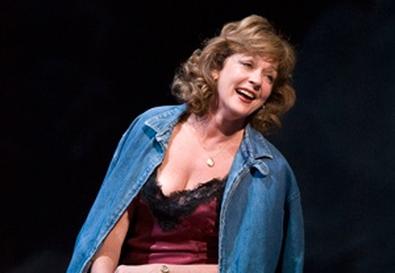
Photo Source: Craig Schwartz
Threads of whimsy and irony are woven throughout, all pleasingly downplayed. In fact, everything about the show is modest, low-key, and unassuming, from LaChiusa’s score and music director Chris Fenwick’s conducting of it to Graciela Daniele’s direction and set designer Christopher Barreca’s sandy beach and bright, cloud-filled sky. As the show is almost entirely sung, Fitzhugh’s lyrics occupy the bulk of the evening, her book comprising just a few words here and there. While some of the text achieves a sense of lyricism, the narrative nature of the sung content sounds almost like everyday speech set to music, far more banal than poetic. Nor is the show’s music anything special, though its performance—by Fenwick, associate music director David O, and eight other instrumentalists—is focused on strings in Bruce Coughlin’s orchestrations, creating sounds that are mellow and moody.
In the first half we see Pawk’s downtrodden yet friendly and cheery woman, who, in her aimless existence as a divorcée with two daughters, crosses paths with various Mexican neighbors, hires a woman from Tijuana as a housekeeper, and has a brief romance with an 18-year-old male virgin from Mexico. In the process she discovers that “they” are really no different from herself or her family and friends. Her realization of the crushing poverty endured by most who come to Southern California from south of the border makes for a stunning moment. Here, as elsewhere, Pawk projects intelligence, a generous spirit, and compassion.

Julio Monge in Los Otros (Craig Schwartz)
In the second half, though, Monge is a much more effective storyteller, probably because his character has more vivid and compelling tales than Pawk’s. In grade school in California at age 12, the Mexican-American lad’s Anglo and Mexican teachers urge their students to speak “good English” to avoid being called a “dumb Mexican.” As an adult, Monge’s character shares the details of his life with us, including being a gay accountant and having a lover who is Anglo. He is candid and brutally honest about himself and his people. His appearance (shaved head and wispy mustache) and voice (a heavy Spanish accent yet still speaking “good English”) are distinctive enough to generate our interest, and accounts of childhood mischief and of the jubilation surrounding V-J Day “because Mexico also declared war on the Axis” are fascinating.
Daniele keeps the chamber musical’s scale aptly small and intimate and the tone tenderly observant and wholly nonjudgmental. We can be grateful that Fitzhugh and LaChiusa know how to create and write for characters eager to open up to us. Hopefully, further rewrites will yield something more extraordinary.
Presented by Center Theatre Group and at the Mark Taper Forum, 135 N. Grand Ave., L.A. June 3–July 1. Tue.–Fri., 8 p.m.; Sat., 2:30 and 8 p.m.; Sun., 1 and 6:30 p.m. (213) 628-2772 or www.centertheatregroup.org. Casting by Mark Simon.