Photo Source: Richard Termine
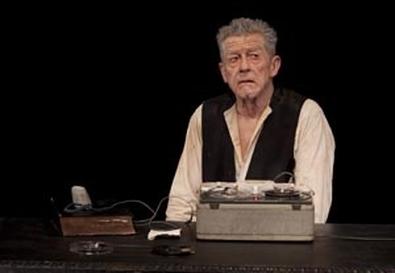
Throughout his life, Krapp has compulsively made reel-to-reel tape recordings of his impressions and observations, and the action of the play consists of him laughing and grimacing over his past bragging about finding love and his calling as an author. From Krapp's alternately bemused and pained reactions, it's clear that neither ambition worked out. He then makes a final, melancholy entry in this audio diary. Sparely staged by Michael Colgan in designer James McConnell's pool of unforgiving light surrounded by inky darkness, the production is like a sad, faded photograph you come across in an attic. Krapp's tragedy of loneliness and self-loathing is not explosively expressed but slowly revealed.
Making his New York theatrical debut, Hurt is the perfect actor for this open wound of a play. What other performer could evoke decades of disappointment merely by sitting still, as he does for a good minute at the top of the show? The entire history of Krapp's sad life is etched into every wrinkle as he reacts to his younger self. Hurt's slightest twitch expresses volumes of subtext. He also wisely does not give in to the temptation to play Krapp as a Chaplinesque clown. (There are bits of business with two bananas that could have been turned into slapstick, lessening the tone of regret.) Hurt does allow himself a twinkling little smile when Krapp steps in and out of the lighted area, injecting the smallest measure of humor into the character's unrelieved and brutal self-examination.
The play's impact is all the more powerful when you realize that the tape machine is an artifact of a pre-digital age. Even the very tapes are as obsolete as Krapp himself.
Presented by the Brooklyn Academy of Music as part of the Next Wave Festival at BAM Harvey Theater, 651 Fulton St., Brooklyn, N.Y. Dec. 6–18. Tue.–Sat., 7:30 p.m.; Wed. and Sat., 2 p.m.; Sun., 3 p.m. (Additional performance Sun., Dec. 11, 7:30 p.m.) (718) 636-4100 or www.bam.org.