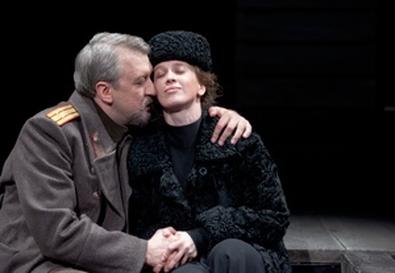
In most productions of "Three Sisters," Anton Chekhov's classic comedy-drama of unfulfilled lives, the passions of the titular siblings and their friends and family dwell deep beneath the surface. After all, repressed longing is the main theme of this story of the Prozorov women, whose constant topic of conversation is escaping the provincial backwater in which they live to return to the idealized Moscow of their girlhood. But in Lev Dodin's searing production from the Maly Drama Theatre of St. Petersburg, now at Brooklyn Academy of Music, the emotions not only bubble to the top but boil over like a sea of histrionic lava. The staging, performed here in the original Russian with English supertitles, is not naturalistic; it's a dreamlike version, in which the characters act out their deepest fantasies and most fervent desires, offering new insights into figures we thought we knew from college drama class.
For example, Ekaterina Tarasova's Irina, the youngest sister, is not the expected prim little girl whose heart is locked away like a piano with a missing key. Instead of being repulsed by the vulgar staff captain Soleny, as the text indicates, she responds to his embraces first by slapping him and then kissing him with ardor. She also flirts outrageously with the boyish sub-lieutenants Fedotik and Rode, who are usually treated as comic relief or cut altogether. Here they are vociferous rivals for Irina's attention and perhaps latently gay, dancing a waltz together in the transition from Act 1 to Act 2.
Passionate, desperate clinches like the one between Irina and Soleny are signature pieces of staging for Dodin, as are bloodcurdling screams muffled by pillows. Irina's plaintive cry of "To Moscow," which concludes the second act, becomes a painful shriek of anguish, and the soul-ripping shout from Masha, Irina's sibling, as her married lover, Vershinin, leaves her forever is equally shattering. In addition to Tarasova, the other actors also bring these subterranean emotions upfront without verging into melodrama. Elena Kalinina gives Masha a clownish humor to mask the character's grave disappointment in a loveless marriage. Irina Tychinina endows Olga, the eldest sister, with reams of subtext, carefully documenting her journey from delusional dreamer to a resigned zombie confined to her position as headmistress of the local school.
Alexander Zavyalov provides the alcoholic doctor Chebutikin with a razor-sharp cynicism and barely contained rage over his thwarted love for the sisters' late mother. Sergey Kuryshev is a charming and appropriately clumsy Tuzenbach, Irina's main suitor, while Sergey Vlasov brings out the kind and compassionate side of Kulygin, Masha's pompous husband. Alexander Bykovsky, as Andrey, the feckless Prozorov brother, and Ekaterina Kleopina, as his grasping wife, Natasha, add love and tenderness to this couple, who are usually portrayed as a 19th-century Russian version of the Bickersons.
Igor Chernevich is particularly moving as the romantic Vershinin. In the most affecting scene of the production, as the town is burning and Vershinin contemplates his suffocating marriage and his futile affair with Masha, this sad figure speaks of the happiness that is destined for later generations but not his own. Chernevich seems to be directly addressing the audience as if speaking to us, the citizens of the future, who are no more content than the three sisters and their circle.
Alexander Borovsky's suggestive set becomes a character itself as the façade of the Prozorov house slowly moves forward, pushing the sisters off the stage and into a blank void.
Presented by Brooklyn Academy of Music at BAM Harvey Theater, 651 Fulton St., Brooklyn, N.Y. April 18–28. Tue.–Sat., 7:30 p.m.; Sun., 3 p.m. (718) 636-4100 or www.bam.org.