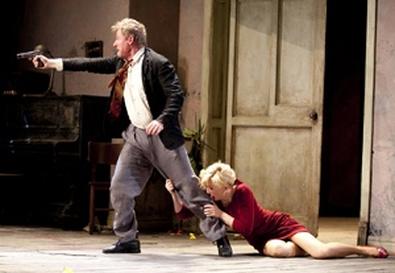
The vastness of New York City Center may not seem an ideal venue for Anton Chekhov's dramas of thwarted lives and deep melancholy. But Cate Blanchett and her colleagues from Australia's Sydney Theatre Company—where she and her husband, playwright Andrew Upton, are co-artistic directors—fill the place to the brim with a gallery of kinetic, larger-than-life performances in their irresistible rendering of "Uncle Vanya." I'm tempted to call their endeavors operatic in the transporting pleasure they engender, except that operatic often implies artificial, and there's nothing unreal or false about what happens in this "Uncle Vanya," adapted by Upton and directed by Tamás Ascher with grand inspiration and insight as well as palpable respect for Chekhov's masterpiece.
The play crams a group of unhappy people uncomfortably together in the heat of a Russian farmland summer on an estate managed by Vanya and his niece Sonya. Vanya's beloved late sister owned the estate, and the profits from the farm are sent off dutifully to her widower, the professor Serebryakov, Sonya's distant father. When Serebryakov, now retired, turns up on the estate with his second wife, the young and beautiful Yelena, she awakens with a vengeance the dormant testosterone in both Vanya and his close pal, the jaded country doctor Astrov. Adding to the tensions are Sonya's hidden unrequited love for Astrov, Vanya's newly emerged resentment of Serebryakov, and Serebryakov's surprising proposal to sell the estate, a move that Vanya declares would leave himself, Sonya, his mother, and the old family nurse homeless.
The actors make each of these characters so deliciously entertaining that when they exit you can't wait for them to come back onstage. As Vanya, Richard Roxburgh is a grand mix of downtrodden clown and rejected lover and a dynamic spewer of bottomless grievances against his former brother-in-law. Hugo Weaving gives Astrov a magnetic sexiness while filling the doctor's prophetic rants against the steady destruction of nature with macho passion. Hayley McElhinney imbues Sonya with a youthful sweetness and intelligence, leavening her lovelorn misery, while the ferocity of John Bell's Serebryakov as he rails against debilitating age and ailments gives added dimension to the bombastic character.
Blanchett, of course, brings undeniable star quality to the stage, but her luminosity lights up her fellow players as well. Her Yelena is an enthralling whirlpool of yearnings barely contained in a sleek exterior, gorgeously garbed in clingy gowns by costume designer Györgyi Szakács. Along with the costumes, the environment has been given a contemporary updating. Astrov rides around the countryside on a motorcycle (heard but not seen); Telegin, an old family friend, listens to a portable radio; and electric lamps light the rooms depicted in Zsolt Khell's impressive scenery. But none of this detracts from the timelessness of Chekhov's writing. The same holds true for the abundance of comic physicality: emphatic gestures, aborted embraces, pratfalls (Astrov tumbles out of a window at one point), and the mounting frivolity when Sonia and Yelena get together for late-night girl talk with vodka.
Upton's adaptation is crisp and economical and provides dialogue that lends itself to comic inflections. Overall, the show tends to emphasize the comedy of the human condition over the agony. Other productions of "Uncle Vanya" may tug more at the heartstrings, but the choice gives the work a refreshing vibrancy without losing its truthfulness. Sometimes it even sharpens it. It all makes for an offering that organizers of the Lincoln Center Festival can justly gloat over with avuncular pride for bringing to New York, even into City Center.
Presented by the Sydney Theatre Company as part of the Lincoln Center Festival at New York City Center, 131 W. 55th St., NYC. July 21–28. Tue.–Fri., 7:30 p.m.; Sat., 1:30 and 7:30 p.m. (212) 581-1212 or www.nycitycenter.org.