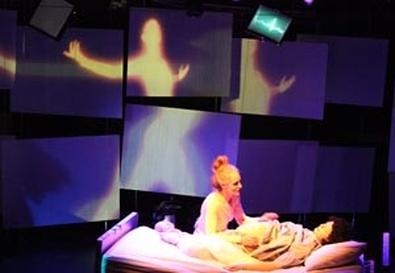
Photo Source: Eamonn Farrell
"Sex in a Coma" begins with a motorcycle crash. The first time we see the rider, a young girl named Corolla (Jessica Weinstein), she's in a vegetative state, potentially a permanent one. Through the intermittent narration of a criminal prosecutor (Maude Mitchell), her post-accident existence unfolds. She becomes pregnant by hospital custodial worker Benito (David-Julian Melendez), is observed by the conniving Dr. Quigley (Paul Kandel), and is reunited with her newly attentive mother (Wendy vanden Heuvel).
The troubling circumstances of Corolla's pregnancy are, of course, what bring the prosecutor into the fray. But what is assumed to be a rape case gets a bit more complicated. As the prosecutor presents her case, we see Benito on the day of the event communing with Corolla, whose spirit has left her body behind to reach for him. In her astral presence, he finds his first love; in him, she finds what she needs to continue living.
Haar, who worked as a prosecutor herself, is familiar with the courtroom world, which might be why the monologues that Mitchell delivers are the play's most compellingly written moments. And Mitchell has the chops to support the writing, roving around the stage as if on the hunt. "The power is in my hands," she crows to the audience. "Pure exhilaration." Her nuanced portrayal is a refreshing escape from the starchy prosecutors who appear in every crime procedural. She can pull out the gravitas when necessary, but isn't afraid to flirt when needed and even admit that she's not in control.
But apart from these moments, "Sex in a Coma" presents a flurry of action without substance. Haar touches on ideas of motherhood, abandonment, and compromised corporality, but they are barely explored until the play nears its end. Instead, the production is thrown off balance by various attempts to illustrate Corolla's out-of-body moments.
The direction by Lee Breuer, whose work at Mabou Mines and elsewhere has garnered him well-deserved awards and praise, is uneven. Splitting Corolla into her two selves—physical and spiritual—allows for more flexibility on stage, but the Corolla we meet is only a shadow of a self, often flitting about like a deranged sprite. Beautiful video sequences by Eamonn Farrell, which are continuously displayed on four computer monitors hanging askew from the ceiling, help focus the action on stage. But Eve Beglarian's music is not nearly so successful. The theme that plays underneath Corolla and Benito's scenes together is so distractingly maudlin and new agey that it makes any otherworldly connection between the two seem like a cosmic joke. So too does the overenthusiastic use of wind and smoke machines, taking what might be a poignant or potent scene and turning it into a sci-fi spectacle.
Presented by and at Here Arts Center, 145 Sixth Ave, NYC. Dec. 1–11. Tue.–Sat., 6 p.m.; Sat. and Sun., 1:30 p.m. (212) 352-3101, (866) 811-4111, www.theatermania.com, or www.here.org.