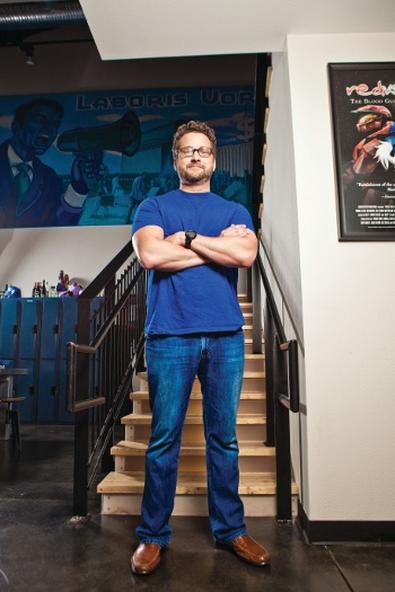
More than just a great name, Burnie Burns co-founded Rooster Teeth Productions in 2003, created the longest-running Web series in history, “Red vs. Blue,” and continues pioneering groundbreaking Internet content out of Austin, Texas.
What does Rooster Teeth Productions do?
Rooster Teeth is the premier creator of digital content for the Internet. We’ve been making content since 2003, since before YouTube started. We were focused on gaming, initially, but comedy is the language of the Internet so we’ve been focused a lot more on comedy, gaming—anything that’s really relevant and interesting to online audiences. We have live-action shorts, sketch comedy, and improv, and we also have personality-driven shows and podcasts.
How do you find your talent?
Well, we’re based in Austin, Texas, and so we work with a lot of local talent here. Austin has a great improv scene. Also, because delivering content online is this big digital community that spans the entire globe, we collaborate with people everywhere. We’d like to get in touch with people who are based in more traditional entertainment centers like Los Angeles and New York; we’ve made a lot of headway in that department, but we’re always trying to meet new and talented people.
What kind of people are you looking for?
Mainly we’re just looking for really, really talented people who are self-starters. We came from a background of trying to go through the traditional system ourselves and running into roadblocks that were barriers to entry, essentially. So we want to work with people who just are dying to make content and want to work and want to create things. That’s what we do here on a daily basis.
What inspired you to create Rooster Teeth Productions?
I was an independent filmmaker and I had made a 16 mm feature-length film when I was in college at the University of Texas. And I thought that when you made a movie, that was 100 percent of the battle…getting the movie made. But then, once we had the movie made, we thought, Well, how do we get people to watch it? And then started a process that was just as long as making the movie: trying to distribute a movie. We did the typical route at the time, which was apply to film festivals, try to get five gatekeepers who work at a film festival to let us show our movie to 200 people in a room—that was a huge goal for us. But while we were in the middle of all that, the guy that I made the movie with, Matt Hullum [CEO of Rooster Teeth], had moved out to L.A., and I was back in Austin making videos with friends of mine. I posted one of them online, and in less than 24 hours, Matt called me and said, “Hey, I saw a guy in my office had the video up on his desktop,” and I said, “Yeah, we made that yesterday after work.” That’s a common story that you hear today—videos go viral and move that fast—but for 2003 that was just crazy. It was the idea that we could just put up content ourselves and go directly to an audience, so that’s what we started doing immediately.
What exactly is “Red vs. Blue”?
It’s a cartoon that is based on the video game “Halo,” and it’s with a kind of animation that we pioneered—or at least made very popular—called “machinima.” What that means is that you animate in real time, and the way that you animate is a lot more like digital puppetry than it is like digital animation. So every time something happens in the show, it’s actually a live performance by the animator, being recorded while he controls the character in real time. It’s a lot more efficient; we can make about five to 10 minutes a week with a creative staff of about six people.
How do you work with the city of Austin?
Austin is great and we’ve recently started working with the city more and more. The sound stage our studio is located on is a project between the city of Austin and the Austin Film Society. They took the decommissioned airport and left some of the hangers that were there for the planes, and they converted them into sound stages for TV and film production. Austin’s always been a town that’s kind of on the edge and prides itself on doing things a little differently. They identified us as a big digital group with a large global audience and so they put us in here next to “Revolution” and films shooting for the El Rey Network.
Like this post? Check out more of our Inside Jobs!