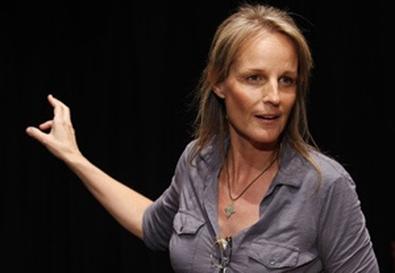
Photo Source: Carol Rosegg
I've been intrigued by the idea of a woman in the part ever since Mary Martin was announced for Tom Jones and Harvey Schmidt's surprisingly effective musical version (sadly now suppressed by the Wilder estate) back in the 1980s. Martin took ill, and it never happened. Had she played it, Martin would have undoubtedly delivered a star turn appropriate to the musical treatment of the piece. The play, however, particularly in this intimate ensemble interpretation, doesn't need one, and movie star Hunt is smart enough to know it. Instead, she slips seamlessly into the extraordinary cast, deftly capturing the straightforward, unsentimental, contemporary tone of Cromer's direction. At only her third performance, Hunt is already in full command of the proceedings. Oh, she may step on a laugh or not quite mine a moment here and there, because she's still learning from the audience, but that's of little consequence and won't last much longer. Hunt brings a fierce simplicity and directness to the role, stripping her work to the essentials, just as Wilder's play does in its portrait of the human condition. It's an admirable interpretation.
Cromer's decision to eschew New Hampshire accents and period-appropriate dress and physicality only reinforces the universality of Wilder's vision, and putting a woman in charge of this patriarchal world (where women vote "indirectly") adds to that effect. The Stage Manager is both outside of the community, commenting acerbically upon it from years later, and of the community, particularly when briefly portraying some of its inhabitants. Nevertheless, his mere maleness entitles him to be in charge. A woman, even one existing today (as this Stage Manager, who begins the show by holding up a cell phone in silent warning, certainly does), isn't granted that automatic entrée, and you can sense that in the intensity of Hunt's assertion of authority. Balances shift. When the Stage Manager talks about how hard women of the era had to work (with nary a nervous breakdown), there's an underlying anger in Hunt's delivery. When the character slips into the role of a male drugstore proprietor, his slight contempt for girls who cry too easily, not always apparent, suddenly pops out. Finally, Hunt's mere presence seems to continually highlight how the immensely capable Mrs. Gibbs and Mrs. Webb must still carefully subordinate themselves to their loving husbands' egos and desires.
The production is in excellent shape, with some principals never having left, some having returned after a hiatus (not always in the same role), and some new blood. Among those who have gone the distance, Kati Brazda continues to shine as a Mrs. Webb who still retains attractive traces of girlishness, and the well-matched Jennifer Grace and James McMenamin remain the epitome of inarticulate teenage love as Emily and George. Taking over new roles, Elizabeth Audley makes a funny and touching Mrs. Soames, who enjoys weddings far too much, and Jeremy Beiler is terrific as the tippling Simon Stimson, executing Cromer's highly amusing staging of choir practice with panache. Cromer's inspired Act 3 coup de théâtre still works brilliantly, even knowing that it's coming.
Hunt is only on the boards for a month, through Aug. 1. She's the perfect spur to revisit or discover this essential production of an essential play.
Presented by Scott Morfee, Jean Doumanian, Tom Wirtshafter, Ted Snowdon, Eagle Productions, Dena Hammerstein/Pam Pariseau, the Weinstein Company, and Burnt Umber Productions at the Barrow Street Theatre, 27 Barrow St., NYC. Opened Feb. 26, 2009 for an open run. Tue.–Sun., 7:30 p.m.; Sat. and Sun., 2:30 p.m. Casting by Pat McCorkle/Joe Lopick.