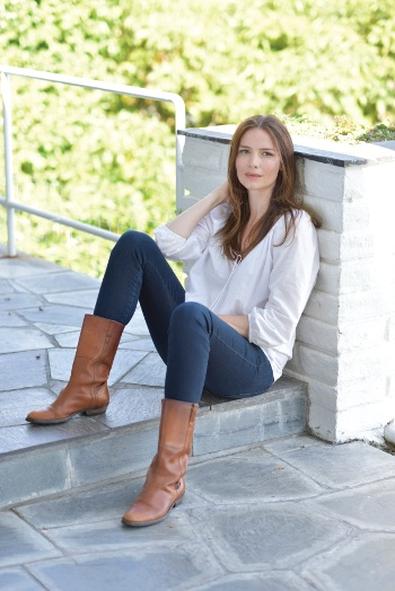
The actor is taking on a new role as a professional cellist in the Amazon original series “Mozart in the Jungle” (available in its entirety Dec. 23), about a fictional New York City orchestra. She tells Backstage about her acting crush, why you should never talk politics in the audition room, and what she first loved about film sets.
Tell us about your latest role.
Cynthia’s been in the orchestra world in this particular job for at least a decade and she’s sort of risen through the ranks in our fictional telling of a New York orchestra. [“Mozart in the Jungle” is] really about exploring the private lives of these musicians versus the public view of them. With my character in particular I get to explore very specific relationships with various people. She’s someone who’s led a very international, rich, kind of varied life because of her musical career. For her there’s something very appealing about having this position in a highly regarded orchestra—you have to achieve a certain level of excellence every week and you have to work very hard. But Cynthia likes to go out late and she doesn’t really adhere to orthodoxies, which is really fun to play.
When did you know you wanted to be an actor?
My mom took me to the theater a lot, and various actor friends of my mother’s, we’d go see them in a play and I’d get to climb all over the scenery! I remember thinking, Well, how amazing to be in that world. It seemed magical but I never thought I’d do it for a living or it’d be my job. I always did drama as a kid, taking improvisational classes after school in the evenings for the pleasure. I started to get into film when I was 17. I was in the first film ever to be directed by a black British woman [Ngozi Onwurah, “Welcome II the Terrordome”]. I remember not being able to believe how many people were on a film set...we were like a circus or something. I loved the camaraderie of it and I remember feeling very high from that when I was a teenager.
Who do you have an acting crush on?
Mandy Patinkin I’m pretty obsessed with on “Homeland”; I revere him. He’s just riveting and everything I hear about him as a human being I like. I don’t know him and I think it’s quite nice to admire people you don’t know because it’s a bit easier.
What’s your worst audition story?
I remember having a debate with a director about the war in Iraq. That was a mistake. I think he was a Republican. It was a screen test and I came away thinking, Saffron, why did you do that? I was really young and would say how I felt in a fiery way. We had this debate that became more than a debate, and to be distracted in that way probably isn’t the best idea.
What’s your worst survival job?
I have to confess I haven’t had one—isn’t that silly? Well, when I was young I grew up in a very left-wing family and I thought I should have an experience like a working person would have, and all my friends were doing work experience in something interesting or cultural. I wanted to work in the local factory so I did that for a few weeks; I was still in school so it wasn’t really a job, but I wanted to experience something that I considered to be important—jobs people do to make the country run. My brother always says I should be a cab driver because in London I’m really good on all of the back streets. He always says that could be my plan B.
What’s one thing you wish you’d known before you started acting?
Just to acknowledge all of who you are. All of life is important and you can allow that to exist there when you’re playing the role; that should be a comforting thing. All we have is ourselves, really, so enjoy that and move forth from there.
How did you get your SAG-AFTRA card?
I had a year in L.A. where I did a lot of low-budget independent films one after another, which was an amazing year. Just from making films like “Friends of Friends,” and then I did one in the Mojave desert with one of the people who has become one of my best friends, Kathy Najimy. It was one of those amazing films that shoots really quickly where everyone was just having fun in the desert—people go-karting in the dark and crazy things.
What have been your most challenging roles?
I did a play that originated in New York that we took to the Kirk Douglas [Theatre] in L.A.—I wasn’t in the original cast. I played a woman grieving. She’s got a young child and her husband’s just died and she’s in a terrible state of grief and she does all sorts of silly things, like sleeping with her best friend’s husband. It was a very naturalistic, modern-day New York.
“Miss Julie,” I had to get my mind into the way she thought and her use of her class; that’s all she had to use as a woman in that time. Clearly her gender was letting her down in terms of rights in that era, but I had to learn her class-wielding as a sort of hopeless gesture of power in some way. The great jobs have been where I really have to dive into a new world. Like now I’ve had the pleasure of various cello teachers in L.A. and New York giving me lessons on cello.
How do you typically prepare for a role?
Each thing is different, really. Obviously if a skill is required, that helps you dive into it in a certain way because it already informs so much of who you’re playing. So with [“Mozart in the Jungle”] and the cello, I was a cellist before in a couple of films and I really liked it, but I don’t know as much about it as I do now. Just the amount of rigor involved and the degree to which your childhood is necessarily devoted to this instrument and how that might affect your adulthood as well.
For plays, I once played [in “The Earthly Paradise”] Janey Morris, the wife of William Morris, the socialist and artist, and the lover of Dante Rossetti, the painter. What was brilliant there was that I got to visit the house that they all lived in in the summers. It was locked up for the winter when I did the play, so I actually climbed over the walls and explored where Janey had lived. I’d driven from London so I was like, I’m not going to give up at this point!
Which of your performances have left a lasting mark?
Jane left a mark because it was such an emotional tale. It was a love triangle that was well written. I really enjoyed that. And I’d say “Miss Julie” on screen; that left a huge impression because of the process by which we made it and the people involved. We shot it in 21 days chronologically so we learned the entire thing like a play. We’d do very long takes, so that was an interesting way to explore a woman and understand a woman from the previous gentry. But this particular one [“Mozart in the Jungle”], I have to say, she’s quite direct with her emotions and I’m very similar to that. I often play very sad roles so it’s actually fun to play something that’s not that.
Like this post? Check out more of our Backstage 5 interviews!