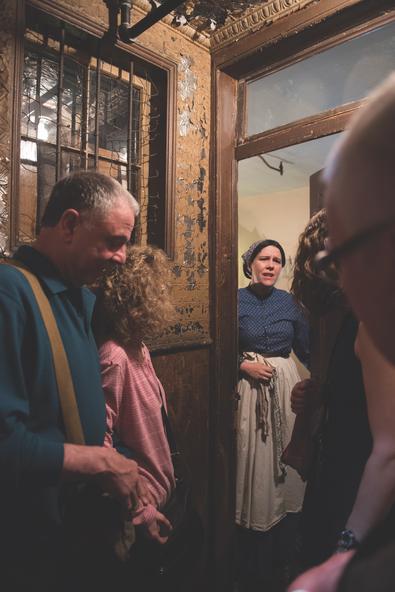
The word “tenement” brings to mind images of squalor and the types of dangerous living conditions that led to the creation of the Department of Buildings, but for the dozens of costumed interpreters at New York City’s Tenement Museum, it also means earning a living.
Constructed in 1863, the Lower East Side building is a historical gateway, one that hires actors to give fact-based interpretations on six of the 7,000 people who passed through 97 Orchard Street over 72 years.
The majority of the building—save for the ground floor, which was temporarily occupied by storefronts—had been left untouched since tenants were evicted in 1935. When the museum was founded in 1988, nearly 50 years of history remained in the top four floors that now house both restored and “ruined” tenements, as well as daily historical performances.
“It’s a similar mental and emotional skill, what historians do and what actors do,” says Jessica Underwood Varma, the museum’s education associate for costumed interpretation. “That sounds kind of funny when you lay it out on the table like that, but the job of a historian is to interpret a time and a place that they did not live in, [and it’s] a lot of the same work that actors do.”
There are no scripts for Tenement players, who refer to 600-page sourcebooks containing researched details specific to their characters—from their home countries to their eyesight problems—as well as their historical era to build a worldview. Varma says the approach to the material is a mix of Lee Strasberg and Stella Adler techniques, using emotional memory to connect.
Groups of about a dozen visitors are led through the museum into different apartments situated in various time periods to learn about real tenants from Sicily; Płońsk, Poland; Ireland; and the Mediterranean. Costumed interpreter tours include Live! At the Tenement, Meet Victoria Confino, Tenement Inspectors, and Our Immigration Stories, a tour designed specifically for immigrant English-language learners.
The synergetic relationship between patrons and performers sets the tone of the experience. Visitor questions vary from “How did you feel when Abraham Lincoln was shot?” to “How much is your rent?”
“You have to really be able to think on your feet,” says Eva Amessé, who plays Jennie Levine, a Polish immigrant, and Victoria Confino, a teenage Sephardic Jewish girl living in NYC in the early 1900s. “When you get thrown a question, even a really simple question, like, ‘Victoria, how many square feet is your apartment?’—she wouldn’t know that! So I went, ‘Twenty. Ten people [live here, so], 20 feet,’ ” she says before laughing.
But playing a costumed interpreter requires more than improv skills and an accent—although all the actors say those abilities are useful with things like fear and adjustments in the audition room.
“You’re not just a performer,” says actor-director Julián Mesri, who plays the Sicilian Adolfo Baldizzi. “You’re also trying to fulfill the role of an educator in that you’re also trying to dig up historical data and turn it into a story.”
“There are a lot of really great actors who wouldn’t be suited for this type of work,” Varma adds about casting roles, some of which can be found on the museum’s website. “You have to be endlessly curious about all these little details and it’s gotta set you on fire.”
Inspired by this post? Check out our New York City audition listings!