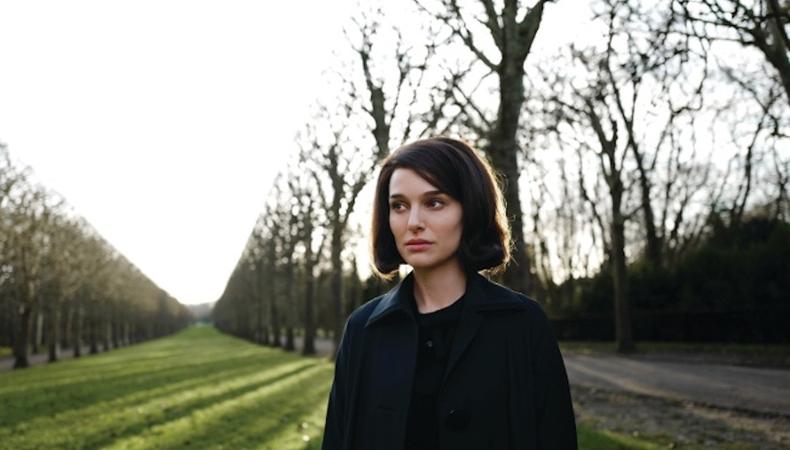
Cinema is like a magic trick, says director Pablo Larraín: With a little sleight of hand here and a lighting shift there, the illusion materializes. But if you’re expecting the equivalent of a cheeky card trick—or in this case, a standard biopic about one of the country’s most iconic first ladies—you’ll be disappointed. The Chilean director’s first English-language feature, “Jackie,” is comparable to the elephant behind the curtain.
Natalie Portman stars in Fox Searchlight Pictures’ piercing character study of Jacqueline Kennedy, garnering critical praise and multiple accolades at the Toronto and Venice film festivals. Taking place in the immediate aftermath of John F. Kennedy’s assassination in Dallas in 1963, “Jackie” is a sumptuously rendered look at a woman and a nation in crisis.
Larraín, whose sixth film, “Neruda,” about poet Pablo Neruda, sparked raves just months ago at Cannes, is comfortable with the task of recreating places and people that live vividly in the memories of his audiences. A look at his distinct body of work shows how he has rooted his directorial career in bygone, politically charged spheres.
“We worked hard with the team to make it feel like the movie was shot back then [in the ’60s], and I guess that’s the challenge,” he says. “There are techniques for that visual illusion that you can work with, but the key is always in the characters and grabbing the proper emotion that would be in the bloodstream of the audience. If you don’t get in there, into that bloodstream, it doesn’t work.”
Larraín, with screenwriter Noah Oppenheim, digs deep into Jackie’s fragmented psyche, emerging with a speculation on a private but very public figure’s innermost thoughts. Between conversations with those around her, we witness the varying degrees of honesty she’s willing to reach with her priest, her brother-in-law, and her confidant (played by John Hurt, Peter Sarsgaard, and Greta Gerwig, respectively).
But in one glorious scene, set to the Broadway recording of Lerner and Loewe’s “Camelot,” we see the extent of her sorrow. As she drifts through her White House wing popping pills, necking bottles, and shimmying in and out of the dresses for which she was so praised, “Jackie” suddenly feels like we’ve drilled a hole into the wall and are peering in at a secret.
“When you go over the story, you realize she told this journalist at Life magazine [played by Billy Crudup] that Jack would play that record every night going to bed. I wanted to know, what is that music? We found it and we played it and I’m like, Whoa! What if we make a sequence? If she goes into his room and plays the record, tries different dresses, not just because she wants to try them but because she has an identity crisis,” Larraín says. “She tries these multiple characters that are Jackie. It’s the existential terror she went through.” The director didn’t hold rehearsals, and instead spoke at length about the character with Portman, who was his only choice for the lead and the sole requirement for his involvement in the project.
Not since “Black Swan” has the actor inhabited such a compelling character. She manages to suffuse a woman at the mercy of circumstance with a complexity that’s at once transparent and impossibly enigmatic. But drawing out those elements meant creating space within his actors’ performances, which Larraín did with spontaneity in his direction.
READ: “3 Quick Tips for Playing Strong Emotions”
In one take, he’d explain the scene’s impetus and ask for a sad, slow delivery. Then, just before calling action on the next take, he’d ask for the opposite. “I try to create contradictions and not to have the actors full of elements and information, so they behave in a way that they don’t control that much,” he explains. “I don’t want to feel that. I want to feel someone out of control, out of the moment, living it and making decisions based on every second of how you’re feeling. I think an actor has to be in a dangerous place to behave properly.”
Inspired? Check out our film audition listings!