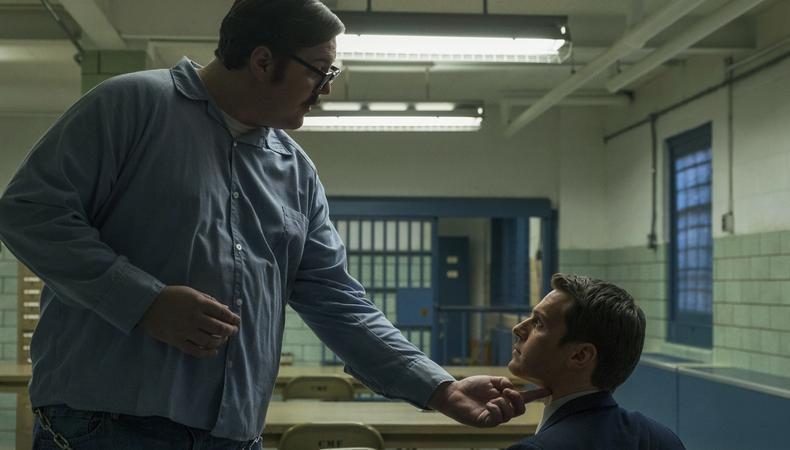
Netflix’s drama “Mindhunter,” from creator Joe Penhall, takes viewers through an account of a massive paradigm shift in criminal psychology: the creation of the phrase “serial killer,” which revolutionized how the FBI hunt and capture these criminals. To do that, two federal agents travel across the country to profile the biggest and baddest killers of the 20th century, including the infamous serial murderer Ed Kemper, played here with chilling, understated intensity by Cameron Britton. Kemper is tall yet soft-spoken, an unpredictable force of energy squinting owl-eyed through thick glasses. Britton, who is now nominated for a 2018 Emmy Award for Outstanding Guest Actor in a Drama Series, spoke to Backstage about working with executive producer David Fincher, what it takes to embody a famous person, and what it’s like to be nominated for playing one of the scariest killers in modern history.
GET CAST NOW: Season 2 of Netflix’s “Mindhunter”
How did you get the part of this very strange, very scary serial killer?
I got it through an email, and it didn’t have any description outside of the title and the name of the series, and that it was a web series. It didn’t say it was for Netflix. It didn’t say anything! Honestly, I thought it was just a cheesy web series. And then I started reading the script and there was something about the dialogue that seemed like a lot of the dialogue was actual quotes from a real person. I looked Ed Kemper up...and kind of went down a rabbit hole of looking at his entire life. And then I did the self-tape, probably until midnight. My wife was saying, “Let’s go to bed, I have work in the morning,” and I just said, “One more take, one more take!”
I auditioned six times over six weeks. And then I had rehearsals and fittings that Fincher would go to, and every time we were in the same room we would discuss Kemper. I had about three months of prepping before I had to perform him, which is so rare and so lucky especially for a guest star—guest stars usually book and then shoot the next week! But what makes “Mindhunter” so great is that it’s a rare system where the guests stars take a lot of the focus of the episode, like “The X-Files.”
What was the best note David Fincher ever gave you?
When you’re thinking, you’re not acting. If you know every corner of your character, then it’s time to take risks, it’s time to surprise yourself, it’s time to play. Once you understand your character fully, then never think about it again. Which is true to life: we don’t pay attention to everything we say, how we say it, what our body position was when we said it. We’re just alive.
Do you have any advice for actors who might play a famous criminal?
Whenever you’re playing somebody who is, by all accounts, rotten, don’t focus on the rotten stuff. That stuff will take care of itself. It’s already in the script, the audience is already experiencing it without you having to add an extra feel of evil. Just play them like regular people. Evil people don’t think they’re evil.
How does it feel to have been nominated for an Emmy after striking fear into the hearts of so many people?
Well, it wasn’t the goal to win an Emmy. My goal was to just not get fired. It was my first guest star role ever, and it was with David freaking Fincher, so I was pretty nervous that I wasn’t going to be able to keep up and they would realize me for a phony and kick me off their set. When I started hearing that I might be up for an Emmy, it wasn’t even something I concerned myself with. Because what sort of selfish person would I be to think that my first guest star would lead to something like that? And when I got the news that I was nominated, my wife and I held each other and we cried. We couldn’t believe that what it felt like to work on that character was resonating with the industry. That they enjoyed watching it as much as I enjoyed performing it is something that I will always hold dear.
I spent all of my twenties doing theater in a little 50-seat theater with my friends. We opened a theater in 2006 called Loft Ensemble in Sherman Oaks. And we write our own plays and do goofy characters and pack a whopping 20 people per night to watch our work. So yeah, the last thing I thought would be that I would be nominated for an Emmy the same year that I’m playing around onstage with my buddies.
Do you still do that?
Absolutely. We’re actually hoping to produce and perform “Wait Until Dark,” which is a great Audrey Hepburn movie, so next summer, if I have a chance, I’ll be in it. Ed in part comes from Loft Ensemble. I did a character there that was this wild, impulsive beast, confused and childish and angry and violent. And I took all of the impulses that I developed for that character and I put them all into Ed, and then I just took a mask and dropped it over those impulses. That was when I knew I was doing Ed right, when I would feel a lot of wild, raging impulses but stay completely still, when I could balance them both. I don’t think Ed was born out of nothing. I can look back on different experiences in my life and different people in my life and realize how much of it was poured into him without me knowing.
What was the process like working with your co-stars Jonathan Groff and Holt McCallany?
We were definitely buddies. I didn’t see them much until we started shooting, and that was by Fincher’s design. The first time that Ed meets Holden was the first thing we shot. And then he offers him an egg salad sandwich, and then we all went to lunch. And when we came back we started shooting them just finishing up their lunch. There were a lot of moments like that that were pretty natural to the growth of the characters. Everything just seemed to line up perfectly to aid in the work. I wanted to get to know them and have fun. I think that Kemper is supposed to be liked by Holden. Holden likes Kemper, he can’t help himself. So it doesn’t upset the chemistry if Jonathan and I get along.
How does Kemper differ from other parts you’ve had?
Your teachers will often challenge you to get out of your comfort zone. If you feel too comfortable while you’re performing, you’re probably not doing it right. What makes Ed unique is the more comfortable you are, the better you’re doing. If you’re truly relaxed and aggressive at the same time, if you are in charge of the room while just sitting calmly, then you’re doing it correctly. I liked playing Ed because a lot of my favorite characters have a zen feel. They’re a lot nicer. Like Forrest Gump, or Jimmy Stewart in “Harvey,” or Paul Newman in “Cool Hand Luke,” even Jim Carrey in “Ace Ventura”—I like almost Buddhist, carefree characters. I thought it would be interesting to see a serial killer like that. A carefree serial killer, if you will. [Laughs] And yet he isn’t carefree, he’s control-obsessed. He has to be in control of every single person at every single moment, so maybe you can’t call him Buddhist.
Even the sandwiches everyone eats.
Yeah, even what sandwich you’re eating. Plus, Buddhists don’t exactly murder their moms.... I don’t think Lao-Tzu mentioned that in Taoism. “If you’re murdering your mom....” Sorry, is this recorded? I’m gonna stop.
Ready to get to work? Check out Backstage’s TV audition listings!