If Roland Emmerich has taught us anything, it’s to expect the unexpected. Alien invasions, sky-high amphibians, Mayan doomsdays—world-ending trouble is always afoot in everything from “Independence Day” to “The Day After Tomorrow.” And still, his attachment to “Stonewall” took many by surprise; he doesn’t exactly seem like a shoo-in for historical nonfiction. But take a closer look at the film and its maker, and it’s clear that “Stonewall” is as respectable a passion project as any, and Emmerich is its glass-slipper fit.
The German-born Emmerich, who’s openly gay and has a history of charitable LGBT work, was inspired to make “Stonewall” with playwright and screenwriter Jon Robin Baitz after becoming involved with the Los Angeles LGBT Center’s homeless youth program. “I learned that 40 percent of all homeless kids in Los Angeles are LGBT. I said, ‘How can that be?’ It’s so disproportionate,” Emmerich now recalls. “It’s happening now because Internet kids come out earlier all over America, and there’s a lot of parents that just throw them out and put them on the streets.” Emmerich immediately saw parallels between the plights of LGBT youth today and those faced by the youth of 1969. “Something there clicked. [I decided if] I do a gay movie, I’d do a movie that in a way has this feeling that this is a problem that we still have today.”
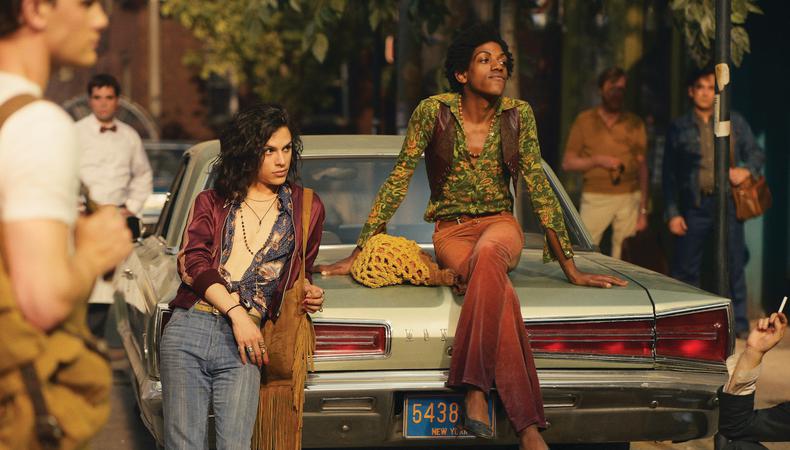
Emmerich and Baitz decided that the best way to highlight these issues was to make “Stonewall” the coming-of-age tale of Danny (Jeremy Irvine), a small-town boy who’s kicked out of his home for being gay. After moving to New York, he’s befriended by Ray/Ramona (Jonny Beauchamp) and a gang of fellow queer youth living on the streets. Danny comes into his own as antigay social unrest boils over into riots on June 28, 1969.
“Stonewall is such an interesting event because it was so spontaneous—it happened in a club,” Emmerich says. “It only later became this kind of political instrument for a lot of gay activists. They used the riots and commemorated the riots to kick-start the gay liberation movement. I have the feeling that a lot of young kids don’t know what Stonewall is, and they should.”
As is the case with any historical adaptation, the sets, fashions, and talents of “Stonewall” were essential to getting the vision right. The film’s production team quickly deemed it best to re-create the inn and the West Village’s cobblestoned streets on a set in Montreal, Quebec. Emmerich now laughs at his initial plan to film at the actual Stonewall.
“We went to New York and hired a location manager who just looked at us flabbergasted,” he says. “ ‘You want to do what? That’s probably the busiest corner in the village!’ We realized our budget would have exploded. In Montreal, we built this street indoors in a big warehouse. It was risky, because you don’t want it to look unreal, but I think we pulled it off.”
Then there was the question of casting. Emmerich employed real-life Stonewall vets like Stonewall Veterans’ Association founder Williamson Henderson to authenticate Stonewall’s cast of players through dialogue, costume, and more. And when it came to casting the film’s two leads, Emmerich says Irvine (best known for “War Horse”) was at the top of his list. “He has a wholesomeness about him,” he says. “He also comes from the countryside. He has that feel of a country boy.”
Casting Beauchamp—already widely regarded the film’s breakout star—came through traditional auditions with casting directors Kerry Barden and Paul Schnee. “We read hundreds of kids, and Jonny was just the perfect match,” Emmerich says. “[It was] very risky to cast him because he has never done anything before, but I had just seen an actor perform. I think that’s much more important than experience. He blew me away.”
Inspired by this post? Check out our film audition listings!