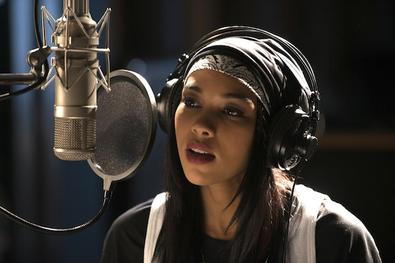
Bradley Walsh went from directing music videos to directing films about people who make them. His upcoming biopic “Aaliyah: The Princess of R&B” on the late hip-hop and R&B artist Aaliyah, who died in a plane crash in 2001 at 22 years old, is set to premiere on Lifetime this Saturday, Nov. 15, and stars Alexandra Shipp as the titular character. While the film was met with resistance from Aaliyah’s family and a casting change saw Disney actor Zendaya Coleman swapped for Shipp due to scheduling conflicts, fans and soon-to-be fans will get to relive some of Aaliyah’s milestones and get a refresher on some of her staple tracks.
Known primarily for the music career she launched at the age of 15 with the help of producer and mentor R. Kelly (who she illegally and briefly married), the singer broke out as an actor in films like “Romeo Must Die” and “Queen of the Damned” before her untimely death. Walsh’s film follows her from the beginning of her career singing in competitions, through her relationship with R. Kelly, on through her superstardom.
On what drew him to the project.
Aaliyah was interesting because she was one of the first people that had to do that in front of the media in a way that really hadn’t been done. She was a sensation when she first came out, which was a time [of] video cameras and people’s lives being documented in a way that we take for granted now because of reality television; she had to endure that at the very beginning.... She was this person who was really insistent on remaining Aaliyah, still being the young person who had dreams and goals, aspired to do well in school, and maintain friendships, and to be herself despite all of that. That’s why I think she was a mysterious character too; she kept all that very close.
On his controversial casting choices.
That’s been a weird, unusual process is listening to all the response to how we developed this film; it’s just so bizarre. You got your own opinion on how to make an Aaliyah film? By all means, go out and make your own Aaliyah movie. I’ve seen the strangest postings about what our film is without people having even seen it. One of the actors sent me an email with a link to article that said we recast our Missy Elliott and Timbaland characters because they were too dark. That was never a conversation anyone ever had; that really bothered me. I cast the two best people for those parts not because of ethnicity. It didn’t bother me in terms of getting the film made, it just became this weird anecdote that people who are feeling empowered sitting behind their computers are OK about when they’re spreading bullshit.... It’s an amazing group of people, talented people who are dedicated to this project and wanted to make sure the beats in the script were delivered as honest as possible to tell the whole story.... I was more worried about the script than making sure Timbaland was a 100 percent accurate in terms of having someone that looked exactly like Timbaland.
On auditioning for a biopic.
I just helped somebody audition for Marilyn Monroe and had some pretty interesting conversations leading into that like, ‘Do I need to look like that person?’ I said, you just need to play the beats of script. If you deliver on the emotion and the particular parts of the script as faithfully it’s written, in a way that’s interesting and evokes curiosity from the viewer, then you’re going to get asked back into the room. And then maybe they’ll ask you to do this or this. I have a friend who went in for an Oliver Stone film and was completely against the way it was written but he played the beats so strongly, that they went, ‘OK, maybe this character can be 20 years younger than it was written,’ because he brought the most interesting performance to this role, and he got the gig.
On what he expects from actors in the audition room.
Know your material and come in off-book. I want to make a connection like my viewers are going to make a connection with that performer. I want them looking at the person who’s reading across the room from them, I want them to be acknowledging and taking an artificial environment, which is the casting room, and trying to make it come to life. If you’re in a situation where there are other people around in the scene you’re doing, don’t be afraid to include those other people even if they’re not even there. Show us the room is bigger than just you and a mark and be engaged with the reader and draw us in.
Also, the better you can know the material the more you can make adjustments, and for me as a casting director, I’m looking to make adjustments, working with the actor, and making sure they’re willing to play. If they don’t, I call it a mirror read: they come in and they do what they’ve done in their bathroom 50 times. I ask them to make an adjustment and they give me that same perfect first time that they practiced in the mirror. I want to know I can play with somebody.
Don’t be afraid to ask questions. Nobody is going to be afraid of someone who wants a clarification. But to go into something and not be clear, there’s danger in that too.
Want to get on TV? Check out our television audition listings!