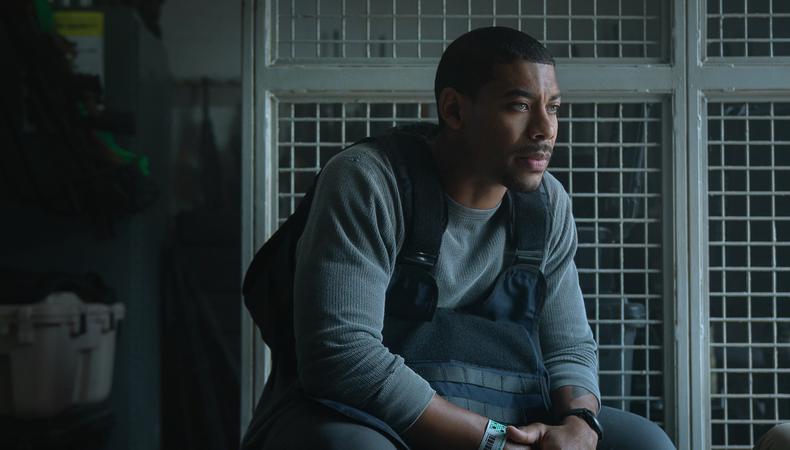
Last year, Aaron Pierre made waves in Jeremy Saulnier’s critically acclaimed “Rebel Ridge” as Terry Richmond, a former Marine who faces off against a corrupt small-town police chief. And that’s not the actor’s only recent success: He also voiced the title character in Barry Jenkins’ 2024 film “Mufasa: The Lion King” and is set to star on the highly anticipated HBO superhero series “Lanterns.”
Here, Pierre discusses his work in “Rebel Ridge” and explains why he isn’t resting on his laurels.
What drew you to “Rebel Ridge”?
For any project, I have a three-stage list [that I consider]: filmmaker, story, and role. “Rebel Ridge” got a big green tick in every department: Jeremy Saulnier is an extraordinary filmmaker; the script was unapologetic; and it wasn’t trying to adhere to what commercial film arguably requires. And then playing Terry—I’ve never been remotely that cool in my life. So I was like, That’ll be fun. Whether the character appears on a single page of the script or in every scene, it’s all about the substance.
I wanted Terry to have this perfect juxtaposition of being the quietest but also the loudest person in the room.
This was your first major leading role. Did that alter the way you approached the film?
I approached “Rebel Ridge” exactly the same way I approach every project: I poured myself into it. When I board that plane after wrap, as long as I can say that I did my best and that I earned my own respect, I’m satisfied. And I certainly did that on “Rebel Ridge.” Anything short of that doesn’t sit well with me.
What was the most challenging part of filming “Rebel Ridge”?
We shot the movie in Louisiana during the summer, and it was so hot. I’ve never been on a set before where heat breaks are called. The sound guy has sweat dripping in his eyes as he’s holding the boom. We’ve got Big Bruce maneuvering this enormous crane during these really complex fight scenes; at times, he’s doing even more than I am. We became really tight as a unit because we were all out there trying to serve this story. Now, when any of us sees one another, we have this moment of: You were there. It’s an example of how challenges can actually enrich the process.
How do you think you’ve evolved as an actor over the years?
One of the benefits of film and TV is that you have the opportunity to reflect on your work. Because I started in theater, it was quite hard for me to begin doing that. But I arrived at a place where I decided I would watch things once. It’s how I imagine a football player feels watching [game] tape: How can I be more available? How can I take a deeper dive into what I’m trying to convey? Which, in anything I do, is the complexity of what it is to be human and alive.
What’s one moment in your career that you’ll always remember?
In 2021, I experienced radio silence for an extended period of time. When you’re not working, you have to contend mentally with what that means for you, and also with the domino effect of not working, which is having very little financial means. Like, I couldn’t put fuel in my car. But I decided that I was still going to commit to this career endlessly—that I had something to offer regardless of whether I was employed. I doubled down and said, If I can get through this, then that tells me something about my character and the love I have for this craft. And I did; I weathered it. It gave me a sense of gratitude and made me work even harder than I had before.
This interview has been edited for clarity and length.
This story originally appeared in the June 12 issue of Backstage Magazine.