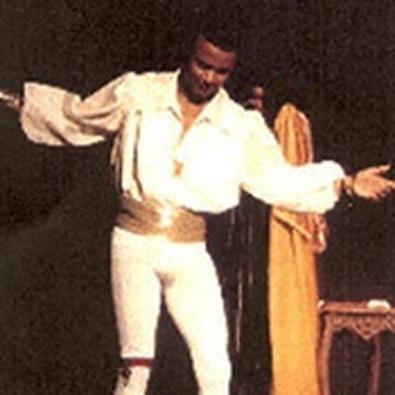
The multitalented Ossie Davis, who died in 2005, has made a posthumous contribution to theatrical and African-American history with the one-act play Curtain Call, Mr. Aldridge, Sir. With a big assist from the committed actor-director Eric Coleman, Davis relates the life of Ira Aldridge (1807-1867), a sadly undercelebrated black American actor who had to find his place and fame in Europe.
Aldridge was born free in New York, the son of a preacher. Able to sit -- in some theatres -- in a small section of the top gallery reserved for Negroes, Ira saw the great actors of his day, Edmund Kean and Mrs. Siddons among them. Thanks to the briefly thriving amateur African Theatre, Aldridge learned to act and played major roles; in 1825, at age 18, he left for London and never returned to America. At a progenitor of the Old Vic, he played Hamlet, Brutus, and Rob Roy. Kean himself became a major supporter of his career. In 1833, at the Theatre Royal in Covent Garden, Aldridge became the first black actor to play Othello. His acting was widely hailed, but his playing opposite the great white actor Helen Tree as Desdemona was controversial.
Davis and Coleman convey this essentially chronological biography with a touching passion, with three other actors, Angela Sims, Buddy Woodson, and Richard Kohn, offering able assistance in a variety of roles. Rightly focusing on his work -- if Aldridge had a private life, you won't find it here -- Davis and Coleman underscore the tribulations of 19th-century American Negroes without polemics or pleas for pity. Aldridge went to the Continent in 1852, spending most of the rest of his life in Russia and Eastern Europe. He played 300 more Othellos, was praised for the "unexpected realism" of his acting, decorated by Tsar Alexander II, and feted by Tolstoy. His proudest moment came when he played Shylock in the Ukraine, summoning up the collective experience of slavery ("If you prick us, do we not bleed?"). The beleaguered Jewish community of Kiev, led by its rabbi, came on foot to praise his portrayal. If you care about theatre history, don't miss this one.
On the other hand, the second half of this double bill, A Song for You‌the Civil Rights Journey of a Negro Woman: Lena Calhoun Horne" is too clearly a truncated one-act version of a longer piece. Wendi Joy Franklin, who also authored both versions of the play, bears an uncanny resemblance to Horne, particularly in her speech patterns. She lost the play's original director, Lillie Marie Redwood, somewhere along the way, but continues to tour with it director-less. This version, at least, is also virtually show biz-less.
Most of us know Lena Horne as a singer -- above all, of "Stormy Weather." Franklin creditably sings this song, finally, as almost an afterthought, an encore following an affecting rendition of her title tune, "A Song for You." This Leon Russell number seems entirely inapt to Franklin's thesis, however, as the point of the song is that after entertaining audiences, the singer is finally one-on-one with his or her beloved, whereas Horne is meant to be rallying for civil rights for the masses.
Here, Franklin as Horne is delivering a talk to the youth branch of the NAACP in Atlanta, where she spent part of her troubled childhood. Because this is a one-woman show, prerecorded questions from the student audience blare into the proceedings; the plot, such as it is, would advance far better with a straight narrative by Horne. She talks of being torn as a child between her paternal grandmother in Brooklyn and her mother, a Southern-based, itinerant, and largely unsuccessful singer who left Lena with foster parents most of the time.
The show leaps from this youthful litany to Lena Horne, civil rights activist. For those unaware of her standing with Sidney Poitier and Harry Belafonte as major entertainers in the movement, this is a giant leap indeed. While we'd like some explanation of why she became a singer and what she encountered as one, in spite of her success, a simple line of dialogue could close the chasm -- something about how the studio cut her scenes in movies when they played down South, for example.
We can't get a whole life story told in 45 minutes, but, as Aldridge proves, you can achieve its essence.
Presented by the H.A.D.L.E.Y. Players
at North Presbyterian Church, 529 W. 155th St., NYC.
June 8-29. Fri. and Sat., 7:30 p.m.; Sun., 4:30 p.m.
(212) 368-9314 or (212) 926-0281.