In the Envelope: The Actor’s Podcast features in-depth conversations with noteworthy actors and creators. Join host and senior editor Vinnie Mancuso for this guide to living the creative life from those who do it every day.
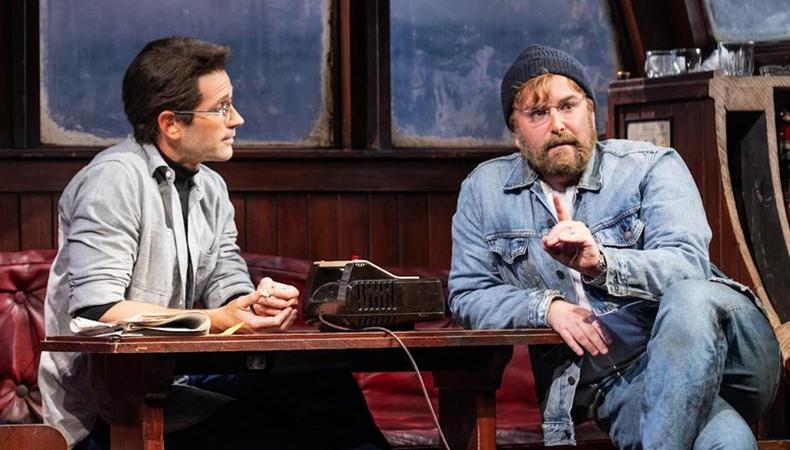
Alex Brightman is no stranger to diving headfirst into Broadway shows based on beloved titles. After all, he’s a two-time Tony nominee for leading turns in “School of Rock—The Musical” and “Beetlejuice.” But his latest project is in a bigger boat altogether: Ian Shaw and Joseph Nixon’s “The Shark Is Broken,” which captures the behind-the-scenes turmoil of Steven Spielberg’s 1975 blockbuster “Jaws.” The production opened earlier this month and is set to run through Nov. 19. The show sees Brightman donning the sweater of ‘70s-era Richard Dreyfuss alongside costars Shaw (as his own father, Robert Shaw) and Colin Donnell (as Roy Scheider).
“You can’t turn your head in any city without seeing some [‘Jaws’] shirt, hat, or license plate,” Brightman tells us. “So I know that’s a big deal, and the added pressure for me is that I’m playing the one [lead actor from the film] who’s still alive who has a chance to see it. ‘Pressure’ is the right word, but it’s not a pressure that terrifies me. It’s interesting, and I’m always excited about doing new things. This version of a new thing is like tightrope-walking with somebody’s child.”
On this episode of In the Envelope: The Actor’s Podcast, the actor gives us a glimpse into his intensive character-creation process, as well as a behind-the-scenes look at the most emotionally fraught moment in “The Shark Is Broken.”
Brightman took a 4 a.m. train from Washington, D.C., to New York for his “The Shark Is Broken” audition—and he wasn’t afraid to use the experience.
“There are a lot of these cliche things [for new actors], and one of them is: Don’t bring your baggage in the room with you. ‘Leave your baggage at the door’ is the phrase. It’s never worked for me. It always felt very fake [and] really phony to put on this ‘everything’s fine; I’m at a total zero at this audition’ attitude. I just don’t buy it, and I don’t think people would buy it from me.
I remember I went to an audition once where my fire alarm went off and I couldn’t shower, so I was disgusting. But I still went. [The casting team] said, ‘How’s it going?’ I said, ‘I gotta be honest—I’m out of my mind right now.’ It just made the audition more personal and memorable for them—not even in an actory kind of way. I’m not saying [that you should] come up with a story for your auditions. But I believe in bringing some of [your real life] into the room with you, because that’s what makes you you.
I imagine that the frazzled Alex Brightman who walked into the room that morning [after the train ride] couldn’t have hurt [my audition]. They were able to see an actor—which Richard Dreyfuss is and was—at his weirdest and at his most tired. Dreyfuss, you know, notably did drugs and was out of his mind and constantly bleary-eyed. I think it all—whether I wanted it to or not—came out, and they saw something in there that they could work with.”
 How Jodie Comer Crafted Her Intense, Tony-Nominated ‘Prima Facie’ Performance
 The actor learned an invaluable lesson from his first Broadway experience: understudying in Nick Blaemire and James Gardiner’s 2008 musical “Glory Days,” which closed the same night it opened.
“It really set a fire under my ambition. I was like, Well, that was fun; I’d like to do that for a lot longer—so how do I do that? After [‘Glory Days’] was over, I probably did more open calls and in-person auditions by my own volition than the people representing me, at that point, because of how inspired I was to get back to work.
What I learned from that was to go and to get hungry. Stay hungry, and go do theater. Broadway was never the goal after that. Broadway was never the goal, to be quite honest; I just wanted to be onstage. So the fact that I get to do it at this level is a huge bonus; but I’m well aware that this is not one of those careers that just continues to rise and rise and rise. I have no illusions about the idea that someday I might be applying at Shakespeare & Co. to be a bookseller, and I have no problem with that. That’s what I learned early on, thankfully, is that this business is about being hungry.”
Brightman brings a lot of physicality to his performance in “The Shark Is Broken,” and it’s the result of hours and hours of work.
“All of the physical twitches—or [Dreyfuss] has a bit of a cocaine quirk, even a licking of the teeth. Anything like that I have now worked on so much extracurricularly, not just in the room—just with myself in front of a mirror. That whole layer of things runs in the background, like an app. It runs like a weather app. So it’s always running in fits and starts. I don’t have to think about, Oh, I’m going to do this now with my nose. In the 90 minutes of the play, I’m able to be current and make choices. And my hand, every once in a while, just hits my face and does that [Dreyfuss quirk]; that’s just because I’ve done so much work [beforehand] to make it feel natural.”
In playing Dreyfuss eight shows a week, Brightman has to reckon with his own personal obstacles.
“What surprises me, truly, is that sometimes I’m doing something [onstage] that I think is more [Dreyfuss]—but honestly, if I’m really looking at myself, I’m like, That is a pretty genuine me moment. There’s something pretty vulnerable about seeing the weirder, darker sides of yourself in someone who you may or may not resonate with; but you have to accept that that’s who you are.
There’s a pretty drastic, big panic attack that I go through in the show—a very lengthy, real panic attack. What surprises me about that moment is how much it affects me after the show is over, mainly because I’ve done a lot of hard work in my own life to quell bipolar anxiety with meds and therapy. I’ve done a lot of really hard work to get my brain wired in a better way than it has been in the last 10 years.
To deconstruct it onstage every night is its own weird thing that I’m still working out—because [that moment does] take more out of me than I would hope. It brings me to a really strange spot. It’s vulnerable enough to cry onstage, but it is way more vulnerable to have a full-on panic attack in front of 800 people a night—including two friends of yours onstage.
So that surprises me, because I think I’m very good at putting on a character and then taking it off. [But Dreyfuss] sticks with me. Midway through the week, I feel a bit lower because of it, so I’m trying to figure my way out of it. It’s cool, nonetheless. There’s something interesting about it, so it’s not going to drive me into the ground. But there is something [there].”
Subscribe to In the Envelope to hear our full conversation with Brightman: