Family values get a good old-fashioned pummeling in these two classic Edward Albee one-acts, powerfully revived by the Cherry Lane Theatre under the playwright's direction. Although the plays no longer serve as shock therapy, as they must have in the early 1960s, their merciless exposure of cant and self-delusion remains painfully relevant to the Bush era.
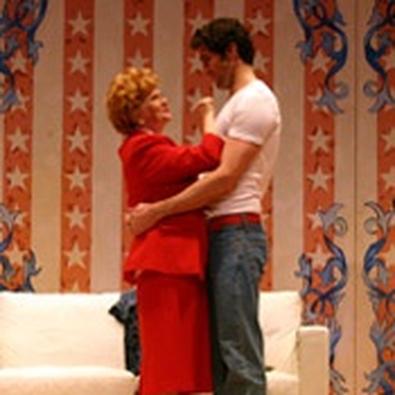
The American Dream found Albee breaking from the relative naturalism of The Zoo Story into a stylized nightmare comedy in which human communication is reduced to its most mechanical, infantile level. Mommy (Judith Ivey) and Daddy (George Bartenieff) live in an aggressively hideous upper-middle-class home -- heavy-handedly designed by Neil Patel in shades of red, white, and blue -- where they exchange euphemistic banalities with Mrs. Barker (Kathleen Butler), a member of the local ladies' club. Grandma (Lois Markle), the play's spiritual center, dispenses surreal witticisms and openly lusts after the handsome, immaculately chiseled Young Man (Harmon Walsh) who arrives at their door. ("I'm a type," he shrugs.) Young Man is not only a replacement for Mommy and Daddy's lost adopted child, but also a literal embodiment of the American Dream -- healthy and attractive on the outside but emotionally and spiritually dead.
The Sandbox, a much shorter work, serves as a kind of bitter postprandial, in which Mommy and Daddy lay poor old Grandma out in a coffinlike sandbox during a beach excursion. Again, a bare-torsoed side of beef (Jesse Williams) does most of the metaphorical heavy lifting, serving here as the Angel of Death, who delivers Grandma from her absurd domestic life.
As a director, Albee finds comedy in deliberate artifice -- at times it sounds like the actors learned their lines phonetically -- while keeping the grotesque situations recognizably human. Markle, a last-minute replacement for the ailing Myra Carter, makes for a wry and engaging Grandma, and her one or two apparent memory lapses were fully in keeping with the character.
Albee has shown quite an interest in his own past lately, having augmented The Zoo Story with a new opening act, Homelife, which bears more than a passing resemblance to The American Dream. The motivation for staging these early works is clearly not nostalgia, or even perfectionism, but a desire to reinvestigate themes and characters still very much alive to him. As this production demonstrates, Albee's lasting achievement in The American Dream and The Sandbox was to take the innovations of Ionesco and other proponents of what would later be dubbed the Theatre of the Absurd and translate them into a distinctively American idiom.
Produced by and at the Cherry Lane Theatre,
38 Commerce St., NYC.
April 1-May 3. Tue., 7 p.m.; Wed.-Sat., 8 p.m.; Wed. and Sat., 2 p.m.
(212) 239-6200 or (800) 432-7250 or www.telecharge.com.
Casting by Hopkins, Smith & Barden.