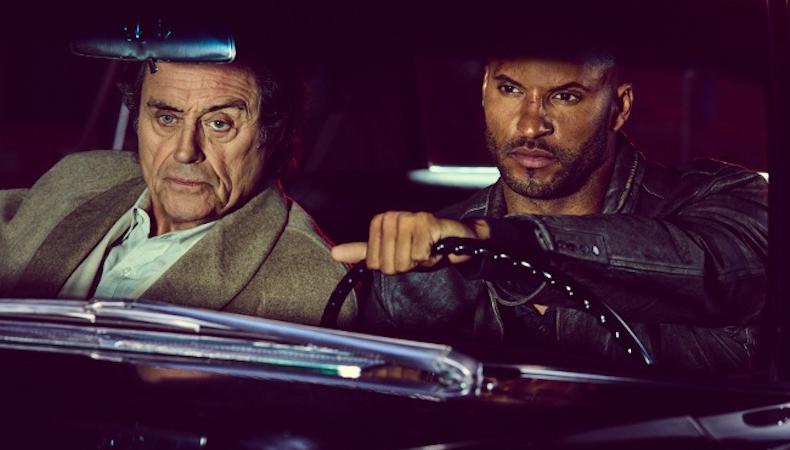
Bryan Fuller and Michael Green, co-showrunners of the new Starz series “American Gods,” leaped at the chance to adapt Neil Gaiman’s 2001 novel for a 2017 audience.
“It seemed like a wonderful opportunity to tackle themes we find interesting in our own lives that are serviced sparingly in the TV landscape,” Green says over an early April call with Backstage.
“The notion of where people place their energies and their lives, where their belief goes, where that takes them—these are all things that [we], as people who were raised with religion, enjoy discussing,” Fuller adds.
“American Gods” depicts the dramatic quest taken by Shadow Moon, whose quiet, grief-haunted character is brought to life by English actor Ricky Whittle. Shadow, a convict released from prison just after the death of his wife, is hired as a bodyguard by the mysterious Mr. Wednesday (played here by Ian McShane of “Deadwood” fame), who turns out to be an incarnation of the Norse god Odin. With Shadow’s help, Mr. Wednesday must travel across America rallying present-day manifestations of other “Old Gods” from various mythological traditions—Slavic, Egyptian, Irish, and Native American, to name just a few. Together they’ll battle the “New Gods,” who represent dominant contemporary cultural forces such as the internet and mass media.
Fuller and Green brim with enthusiasm when they talk about putting together an adventurous cast of performers to tackle this material.
“I was very much inspired by Bryan’s philosophy: It’s not just about casting a role, but about putting together an old-timey troupe of traveling actors,” Green says. “You’ll be listening to them as much as they’ll be reading your words. And we needed people who were unafraid to burst out of conventional expectations of what their own looks give to them—live actors playing dead, straight playing gay, demure actors playing sex goddesses.”
READ: The Second Act of Gillian Anderson
Fuller cites Gillian Anderson, who plays one of the New Gods, Media, as an example. “It was wonderful for us, seeing how Gillian allowed herself to inhabit this range of characters: Marilyn Monroe, Judy Garland, David Bowie, Lucy Ricardo. When we saw her inhabit mass media, we were all blown away by the astuteness of her impersonations, but also the quality of hybridizing those with who Media is. It was nice to see her go there so fearlessly.”
As much as they were “looking for people willing to bend,” however, it’s the essential nature of the actor that comes through over time.
“Whittle, our lead, was certainly put through the paces in the audition process, but the more we met him, the more we grew to enjoy the guy he was when he wasn’t reading lines,” Green recalls. “We felt that was a quality we wanted to imbue the character with. The personality behind the actor becomes very relevant to the decision to cast.” Being an optimist matters a lot, too, he says. “It’s important to show up ready and prepared, and we ask ourselves if they can maintain that great attitude when the crew is working around them very hard and very, very late—there’s a buoying effect to a great attitude.”
Asked for an example, Fuller immediately recalls the impression Peter Stormare made when showing up to play Czernobog, one of the Old Gods.
“Peter stepped up onstage and proclaimed, ‘Czernobog is here!’ He certainly was,” he says. “A big personality and a joyful presence onstage at the point when we’re just starting shooting, struggling with production issues—in walks this beam of light and fills the room with such infectious fun. Michael and I looked at each other and said, ‘We have to bring him back as a series actor.’ ”
So, actors, take note: A positive, all-in attitude paired with your natural on-camera chops can get you further than you may think!
Want to star in TV’s next big thing? Check out our TV audition listings!