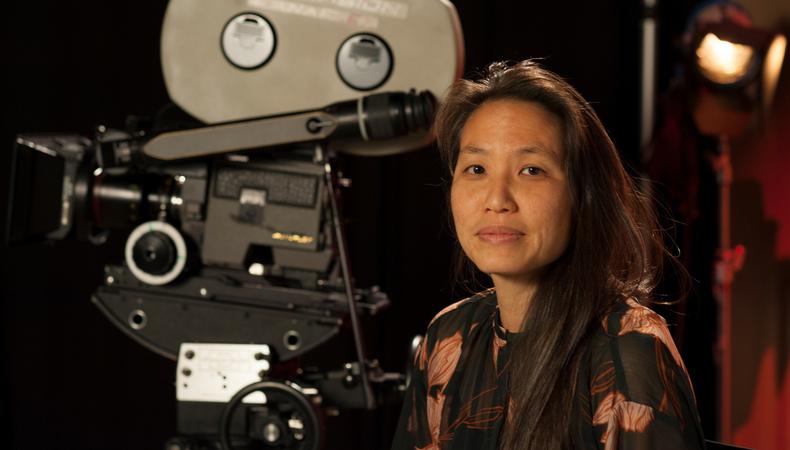
“Genius” isn’t in Annie Chang’s official title, but it might as well be. As Universal Pictures' vice president of creative technologies, she has worked to develop an industry-wide program to improve the film production process for all. Here’s how she’s helping push the industry forward, and what she predicts for the next decade of filmmaking.
Your official title is vice president of creative technologies. What does that mean?
It is an intersection of creativity and technology. My group is bringing new technologies and new workflows to the creation of our content from the creative side, from creative development all the way through to the finishing of the movie. Nowadays, even with this pandemic, everyone needed to get a little bit more tech savvy, right? There’s a lot of technology that’s helping us out here. It’s the same thing in our film production: We’ve been doing film production for the last 100 years. Even with the advent of digital, we’re still working in a lot of the old film ways of doing things. But it’s 2020; it’s time to actually start injecting new technology and innovation into the production process.
There [are] a whole bunch of new things—just like there are on the consumer side, there [are] a whole bunch of new opportunities for production to take advantage of when it comes to technology. Because of the period that we’re living through with COVID-19 and the new safety guidelines, there are ways that technology can help mitigate some of the health and safety concerns. And so my group really looks at how we can inject new technologies into the creation of content.
READ: 10 Tech Terms Every Actor Should Know
How did you come to this role?
When I started 25 years ago in this industry, I had actually fallen into DVD when it was new and nobody knew what it was. And then around 2012, Disney started shooting movies on a digital camera, which is when I made the switch over to production technology. There was a whole new world of problems to solve, and I was really happy to solve them. There was this whole new world of workflow and [figuring out]: How do we do this? Why does my image not look the same between production and editorial? Those kinds of questions came up, and I just happened to be the right fit to help answer them and try to put some sanity around those pieces.
Through SMPTE, the Society of Motion Picture and Television Engineers, I was working on a new file format called IMF, which is the Interoperable Master Format—I’m like the mother of that file format. Working through standards efforts really gave me more skills in understanding: How do you work with [the] industry? How do you actually get projects that are industry-wide moving? How do you get past individual agendas and work more toward a common goal? In the past eight years, I’ve basically been in the creative technology space.
You were also vice president of technology at Marvel Studios. What did you learn about creative tech there?
That was a really good glimpse, for me, into the trials and tribulations of production in a super secure environment. And that actually was the impetus of my thinking about where we needed to go in production as far as the cloud and the future of filmmaking. It all started at Marvel. What ended up happening is this role at Universal came up; they had this project called Production 3.0, which was their future of filmmaking project. And they were like, “We’re not really sure exactly what this is, but we would love for this role to figure it out.” When I got there almost three years ago, they let me basically dive into Universal and understand the problems of production there. It was very similar to what I had experienced at Disney and Marvel, so I knew it was an industry problem. There were a lot of inefficiencies there. Part of my role here now at Universal—now that we’ve figured out what Production 3.0 is—is, let’s get it going. There’s a huge industry component related to it. How do we get the entire industry involved and moving forward toward the same goals?
 Crew 101: Everything You Need to Know About Getting Your First Job On Set
 And what exactly are those goals?
Production has been doing things the same way for a really long time, and there are inefficiencies and a lot of manual labor involved with the production process. I started to look at those areas and witness firsthand those problems that existed. One of the key things I always say is: Innovation doesn’t happen with one person. It’s a team of people, and you have to brainstorm and collaborate with others, because if you just try to come up with a solution by yourself, most of the time, it’s going to be wrong. [I] and a few others at Universal started talking about: Could there be a better way?
Everything’s digital now, right? Even if we shoot on film, it turns into digital files right away. So if you embrace everything being digital-native, you could then start thinking about the possibilities. If we could just relay all of our data together, including notes from the assistant director and from the script and from the editorial side and visual effects side, that’d be amazing, because then you could pick out patterns and start using machine learning and all that cool stuff. But you’ve got to get it first in this organized fashion. And our question was, How are we going to do that? Because there isn’t a system that you can just buy off the shelf.
We were super lucky because we were talking to our DreamWorks counterparts, and there’s a guy over there named Doug Sherman who oversees the software development side. They were building a platform for their artists called the CorPS Platform, and what it does is it creates these workspaces for their artists. It allows you to have related assets that maybe an animator needs versus texture artists; each person gets this personalized workspace with the assets they need for the day. I was like, “Wow, can we use that for live action? Because that would be awesome.” To DreamWorks’ credit, they were like, “Sure, I don’t see why not.”
What, to you, are the biggest hurdles the industry will face in the next few years?
The biggest issue [of] trying to get [this technology implemented across the board] is really the fact that the tools don’t exist to get there yet. COVID-19 was good in that way because it helped people realize that, oh, look, you can work from home. Don’t be scared of this remote workflow thing. Now, people are getting it. That was one of the hurdles, actually, we had with this concept of anyone working from anywhere, because people were like, “Oh, no, that’s never going to work.” And so a silver lining of COVID-19 was the fact that we realized, Look, this can work now. But the problem is we’re just using today’s technology to ram through the [movies]. We just have to get these movies done, so we’re just using whatever is available right now to do it, so it’s not necessarily super innovative as far as how we’re actually approaching it. This concept of the future—that’s the innovation where you’re looking at [it] and saying, “We have to develop a lot of new tools, procedures, platforms, policies—all these things have to be put in place in order for the new future to be enabled.” That’s a blocker right now, but we’re working through it. And I think with the amount of collaboration in the industry that’s going on, we’re going to get there, and these tools will start slowly coming out.
What do you predict for the industry in the next 10 years?
What I see for the future—Horst on my team came up with the term—is it’s going to be like a marketplace. Looking at the dailies process, for example, there are a few different vendors out there right now. Let’s say you’re using a certain dailies vendor now, but you’re like, “VendorB came out with something very cool, I just want to plug into their system and see how it works, if it’s a better solution for me.” Instead of having to rejigger everything and build a connector into VendorB, you’ll just be able to swap them out and try it. This whole marketplace idea is so vendors can compete and [you can test] the quality of their services, which you just plug into. That’s the future as far as making productions more efficient and being able to have relationships between all the different data pieces. That’s what I see as the future: finally getting to this point where we have all of the production assets and data connected together and related to each other so that we can do really cool things with it—and it can help us make better decisions in the future.
This story originally appeared in the Nov. 26 issue of Backstage Magazine. Subscribe here.
Looking for remote work? Backstage has got you covered! Click here for auditions you can do from home!