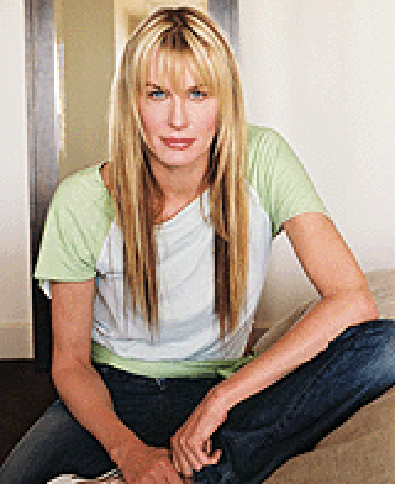
This was my first reaction when I learned that I was going to be moderating a recent acting panel on which Daryl Hannah was to be a participant: Daryl Hannah? Sure, she was great years ago, but what has she done lately? As much as I admired Hannah's work in Blade Runner, Splash, Steel Magnolias, and Roxanne, I, like many people, believed she was a washed-up actor.
Boy, was I wrong.
Hannah has been working these past few years under the mainstream radar in such films as Michael Radford's improvisational Dancing at the Blue Iguana and the Polish Brothers' second feature, Jackpot, which won a 2002 Independent Spirit Award. Three years ago, she made her stage debut on London's West End in The Seven Year Itch, for which Radford convinced her to take to the stage in the role made famous by Marilyn Monroe in the film version.
In the next few months Hannah will be highly visible, playing three distinct, demanding, juicy parts in anticipated films: the Polish Brothers' Northfork, a complex, visually stunning low-budget epic, which hits theatres this week (she plays a hermaphrodite gypsy angel), and, coming this fall, John Sayles' Casa de Los Babys, about white women trying to adopt South American babies, and Quentin Tarantino's Kill Bill, for which Hannah trained extensively with a martial arts expert to play a one-eyed samurai assassin. Each of these filmmakers wrote the scripts and offered her the parts?no audition required.
"Honestly, I have no clue," said Hannah when asked if she considers her recent work the mark of a career comeback. "I just feel lucky, and I'm thrilled because I think there was definitely a long stretch of time when people felt I was [finished]. The thing is that the business wants you to do the same thing over and over again if you've had any kind of success, so that they can wring more money out of that stone. Of course as a performer, you just want to do something different that's challenging and interesting. You don't want to repeat yourself, but it's really hard to fight. I got stuck in that quagmire for a while, and I think that's just because I haven't had an agent for a long time. I still don't. I just think that I was fortunate, and people saw something in me and thought that I had more to give."
What most surprised me to discover about Hannah--besides that she hasn't had an agent for years--is that she's one of the most candid celebrities you'll ever meet, if you can get her to talk. In the past, she has notoriously shied from doing press, and the recent panel discussion we did together at the L.A. Film Festival marked the first time Hannah had ever spoken about her work in front of an audience of strangers.
"I was really scared to do that, but it was so much fun," said Hannah when we spoke again a few weeks later at Northfork's press junket, another surprise appearance for Hannah. As she shared, she was long been crippled by shyness--a phobia that has hurt her career until now. She acknowledged the irony of choosing to become an actor, a profession fraught with rejection, judgment, and public scrutiny.
Said Hannah, "My instinct for wanting to act was to hide behind a character--to be able to express myself creatively, not with my own voice but through the voice of someone else's words and through some other character. When I decided to become an actor, I really didn't take into account the whole aspect of promoting films and doing publicity.
"I think, to a large extent, it's what's to blame for the fact that I haven't been constantly working in really great films," she continued. "After a lot of the studios realized that I wasn't doing promotion--that I never went on any talk shows and never did PR tours, because I was literally impaired by my shyness and paralyzed by it to a large extent--they blacklisted me. While I'm still battling [my shyness], I'm really trying hard now because I want to be able to keep doing cool parts in cool movies, and the only way to do it is promotion."
Landing in Oz
Hannah is not only a shy adult; she was a shy child--so shy that she was at one time mistakenly diagnosed as mildly autistic. Then, at age 11, she found acting, and it became her sanctuary.
"I wanted to live in a fantasy world all the time in real life," recalled Hannah of her childhood in Chicago, where she began acting. "I figured that was the job I could do it in. I had insomnia as a kid, and instead of sleeping I would always sneak into the TV room and watch movies. In those years, there used to be a thing called The Late, Late Show, and they'd show movies from the '30s and '40s, and I became infatuated with them. At school, during my free time I would go into the library and read books about movies and actors. When I was 11, I was reading a book about Judy Garland and how she started working and how she went and got an agent. So I looked in the Yellow Pages under 'A' for 'Agent,' and I took the bus after school to all the agencies in Chicago and started working."
After graduating from high school, Hannah drove west by herself to Los Angeles. While she had a few credits under her belt (including Brian De Palma's The Fury) and a famous uncle, cinematographer Haskell Wexler (Who's Afraid of Virginia Woolf?, One Flew Over the Cuckoo's Nest) and a professional actor for an aunt, Wexler's wife, Rita Taggart (Coming Home, Straight Time), Hannah was as green as they come.
"I expected to come out here, go to Schwab's [Drugstore]--which actually still existed when I first moved here and I went to--and get discovered," she admitted. "I'd sneak onto the MGM lot and walk into every sound stage hoping to find somebody to discover me. I would walk down La Cienega Boulevard, bouncing my basketball. I would walk around Sunset thinking someone would just discover me on the street. People used to pull over and go, 'Can I give you a ride?' and I would be like, 'That's so nice of you, but no thanks. I just want to walk.' I didn't realize they thought I was a hooker, because nobody actually walks on Sunset Boulevard, at least not in those days. I was ridiculously naive and I went to ridiculous ends. Then I met my manager."
Fortunately, Hannah soon signed with manager Chuck Binder, who at the time was working as a tennis instructor, but who had ambition to become a talent manager. Hannah was his first client, and she's still his client.
Recalled Hannah, "Chuck would look in things like Drama-Logue for casting notices. He would send me out on open call auditions. Because I was so naive, he would really look through those things and know which ones were for porno films or just for sleazy guys to meet girls. He protected me from those things. Sometimes big-name producers or directors would call him up and say they wanted to meet with me, and instead of him getting star-struck by that type of thing, he would decipher when it was the kind of thing where they just wanted to go out with me. So he would prevent me from going to meetings like that, which was really lucky for me because I was just about the most naive thing in the world. It was really frightening. I mean, I could have so easily wound up a Moonie, or in porno or something--not that I would have went that way, but who knows? I was so gullible."
After many auditions and rejections--"I came close on a bunch of things that, thank God, I didn't get," she said--Hannah's first job in L.A. was the 1981 film Hard Country, in which she was cast as Kim Basinger's sister. That was followed up with a forgettable horror movie, The Final Terror, and then the stroke of luck she'd been hoping for, although she never could have predicted its success--Ridley Scott's Blade Runner, in which she wowed audiences as limber android Pris. While it was a great experience for Hannah, it was not without humiliation.
"I auditioned three times in a trailer on the 20th Century Fox lot before I got a screen test," explained Hannah. "I really loved the script and I really loved the character. I wanted that movie so badly. The process of the screen test was extremely elaborate. We had one day to do hair and makeup. We had one day to do our costumes. We had basically three days of preparation before the screen test, which is unheard of. Each actor they were testing got to design their own look, and then the costume designer would help you achieve that, and the hair and makeup people would design it in whatever direction you felt you wanted to go.
"I had been inspired by [the 1922 silent horror film] Nosferatu, and so I had them putty out my eyebrows and make big black eyes," she continued. "I found this punk rock wig in the bottom of a box. It looked like yak hair. I wore these ridiculous, sparkly black culottes and ripped-up fishnets and big old chunky boots. I had a black slicker on. I just made myself into a giant freak show. I didn't think so until I got to see the other actresses, and then I just burst into tears because everyone else looked so beautiful. One woman made herself into a plastic space mannequin woman, and she looked extraordinarily sexy. This other girl had little lightning bolts on her face and a silver jumpsuit and she looked like a little space pixie. I felt like I had made myself into Frankenstein."
Her futuristic, punk rag-doll look, combined with her gymnastic skills and ability to roll her eyes into the back of her head--both used in the film--gave her the edge she needed to book the job. As humiliated as she felt that day, she learned a crucial lesson.
"I followed my instincts, and I'm glad I did," summed up Hannah, whose instincts have always been her guide. Instinct told her to leave her last agent more than a decade ago, after years of being pressured to take roles that paid big but left little to challenge her. She has not worked with an agent since. "While my manager can't directly submit me for jobs," she pointed out, "lawyers can do many of the same things that an agent can."
What Method?
Her acting technique has also been driven by her instincts. Hannah spent years feeling her approach to acting was inadequate. It wasn't until years into her success as an actor that she finally found a teacher who provided her with the environment she needed--one that was nurturing and validating.
She said, "I took classes in Chicago, but I could never really figure out what everybody was doing. I felt like I didn't understand anything. I also was trying to take classes out here, but I would usually quit after a couple of days because they would always make me feel like I didn't know anything--that they had a secret that I didn't know. Then after the first interviews that I ever did, I started taking all these classes because people would ask me, 'What is your method?' And I was like, 'I don't have a technique. I just pretend.' I began to think that I needed to get one. That was a disaster.
"I was only secure in myself until people started asking me how I did it, and I couldn't explain. I just was pretending, and it made me feel inadequate when that didn't seem like enough of an explanation. So I actually lost my confidence for quite a while, and I only gained it back when I found Harry."
About eight or nine years ago, Hannah's aunt, Taggart, had recommended that her niece look into classes taught by Harry Mastrogeorge, whose students over the years have included Robert Redford, Ray Liotta, Melanie Griffith, Heather Graham, and Djimon Hounsou.
Continued Hannah, "He was the best teacher I ever found. He basically told me that acting is pretending and using your imagination and that you just have to strengthen that muscle, which is exactly what I was doing in the first place. He doesn't judge you. He doesn't pretend that he knows something that you don't know. He just teaches you how to do your homework, so you can be moved by your character's circumstances. So you're not substituting the time you were spanked when you were 7 so that you can cry because your husband is supposed to be dead in the scene. You're actually crying because your husband is supposed to be dead in the scene, and you are upset about it because you believe you're that character."
Life After 35
Confidence has not been Hannah's problem over the past few years. It's been other people's doubts about her abilities, although that perception seems to be quickly turning around. Still, she's been hearing since the age of 35 (she's now 42) that she's too old for roles. She's learned not to take such dismissal personally and recommends that any actor find a way to cope with rejection, because it's a constant factor, no matter the career level.
Said Hannah, "The best thing you can do is to not take it personally when you get rejected, and it's really hard, because who else do you have but yourself to blame? You have to figure out a way to get around that because it will destroy you. It's not healthy to live with a lot of rejection, but you get it even if you're successful, and you still have to deal with it. You have to find a way to deal with it and get your self-esteem from some other area of your life, not from how you're doing work-wise."
As she continues to pursue acting, Hannah is looking for other ways to satisfy her creative needs. She is currently writing a feature-length screenplay she plans to direct. (She thought it bad luck to talk about it, so she declined to share the details.) She previously received the Berlin International Film Festival's Jury Award for Best Short for The Last Supper, which she wrote, directed, and produced. She also directed, produced, and shot the documentary Strip Notes, which she was inspired to make after meeting real-life strippers while researching her role in Dancing at the Blue Iguana. Directing is something, Hannah said, that gives her as much satisfaction as acting, if not more.
"Unless I keep getting really fascinating roles, which I don't know if I will," she said, "I still want to be doing something that challenges me creatively." BSW