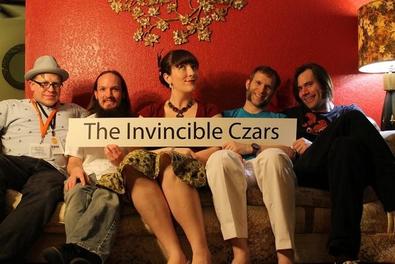
When the Alamo Draft House started screening silent films in Austin, Texas, with live music in the 1990s, guitarist Josh Robins saw potential. “Bands were playing their sets in front of an old movie,” he recalls. “I knew it could be a cool experience.”
For Robins and his band, The Invincible Czars, that notion has translated into a half-dozen wildly eclectic film scores since 2006 and live performances for a spectrum of venues and audiences from New Mexico to Florida.
“After the first couple of times we played for silent films we realized: We don’t have to worry about whether people want to dance to this,” he recalls. “This is an opportunity to compose music in the way of the composers of yore.”
Though he cites Verdi and Beethoven as role models, the band veers from those great footsteps. As with their club gigs and popular annual “Nutcracker Suite” programs, the Czars take an exuberant cross-genre approach, drawing on Frank Zappa, world music, metal (“but not Cookie Monster-vocals metal”), classical, klezmer, space-age lounge, polka and punk—to name a few.
Each score is a collaboration. The first person to watch a film (“usually me, with no sound”) sets the tone, then parcels out scenes. The instrumentation has varied with the band’s line-up changes over its 13 years. Currently the core consists of guitar (Robins), bass (Jeff Grauzer), violin and keyboards (Phil Davidson), and winds and vocals (Leila Louise Henley).
The cross-genre approach suits the Invincible Czars to wide-ranging movie styles. They went “spooky” for John Barrymore’s “Dr. Jekyll and Mr. Hyde,” “Morricone-esque” for the lesser-known “Martyrs of the Alamo,” and all-acoustic for Lillian Gish’s classic, “The Wind.” The last two were commissioned by The Bullock Texas State History Museum, milestones that Robins considers “very validating.”
Playing at screenings is a different experience for the band from their usual club gigs. They perform with a metronome and a score rather than from memory, and watch the movie for visual cues. “The most important thing is timing,” he observes. “We’re relying a lot on muscle memory and knowing the movie.”
Live performances have changed the band’s following, too, expanding it to “a major mix of demographics, from 21 up to 81,” Robins estimates, with audiences ranging from those in intimate art galleries, to 600-seat theaters, to 2,000 at Houston’s Discovery Green.
The band’s path has borne out the vision Robins had for silents and rock 20 years ago. “I still continue to go see other bands doing this,” he says. “It suits the kinds of music that we do and that we like.”
Next up: By popular demand, “Nosferatu,” which Robins calls, “perhaps the most frequently scored silent.” He plans to workshop it in August in time for a Halloween debut.
To hear the band in action, visit InvincibleCzars.com for clips of their films, CDs, downloads of their soundtracks, and their calendar (including a CD release party for “The Wind” on July 25 at the Bullock Texas State History Museum in Austin).