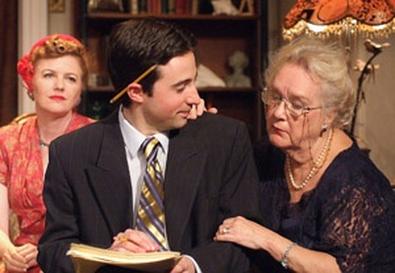
Photo Source: Ed Krieger
In September 1949, longtime friends convene for a visit at the guesthouse of lonely spinster Constance (Shannon Holt and Lily Knight), near New Orleans. Constance is nervous but excited about seeing Nicholas (Jeffrey Nordling and Stephen Caffrey), the ever-flirtatious man who got away, arriving with his sophisticated New York–bred wife, Nina (Kitty Swink and Jane Kaczmarek). Unrequited love is also on the mind of alcoholic guest Edward (Josh Clark and Stoney Westmoreland), who has long pined for the elusive Constance. Also suffering emotional pain is self-deluded Rose (Rhonda Aldrich and Faye Grant), who acts and dresses like she's 20 years younger and can't accept the announcement from her insensitive husband, Benjamin (Kurtwood Smith and James Sutorius), that he wants a divorce. The engagement of a younger couple—Constance's French niece Sophie (Jeanne Syquia and Zoe Perry) and Frederick (Josh Zuckerman and Joe Delafield)—is problematic, what with Frederick's more fervent interest in an opportunistic male companion. Additional characters include Frederick's controlling widowed mother, Carrie (Eve Gordon and Jeanie Hackett); Carrie's bluntly sardonic mother-in-law (Dawn Didawick and Anne Gee Byrd); a German au pair (Susan Boyd Joyce and Reba Waters); and an African-American housemaid (Saundra McClain).
The two excellent ensembles bring out different nuances while remaining true to the playwright's intentions. In the role closest to a central one, Holt emphasizes hostess Constance's forlorn quality, while Knight comes across as slightly more resigned to the woman's lot in life. Nordling's take on the stridently self-centered artist Nicholas suggests more of the charm that Nina and Constance found in this man, prior to his second-act descent into reckless drunkenness. In Caffrey's interpretation, the man seems insufferable from the outset, though his ultimate flash of contriteness proves convincing. As the sage matron Mary, Didawick puts more of a tough-love spin on the bemused elder guest; Byrd gives her a brittle sophistication, her acerbic comments stinging a bit more. Both actors playing Sophie capture the pluck and vulnerability of this pivotal character. Delafield brings more color to the small but interesting role of Carrie's respectful but subtly rebellious son than does Zuckerman.
Tom Buderwitz's beautifully textured scenic design is dominated by autumnal burnished browns. Costumes by Tina Haatainen-Jones and lighting by John Eckert are exemplary.
Presented by the Antaeus Company at Deaf West Theatre, 5112 Lankershim Blvd., North Hollywood. Oct. 28–Dec. 19. Thu.–Sat., 8 p.m.; Sun., 2:30 and 7:30 p.m. (818) 506-1983 or www.antaeus.org.