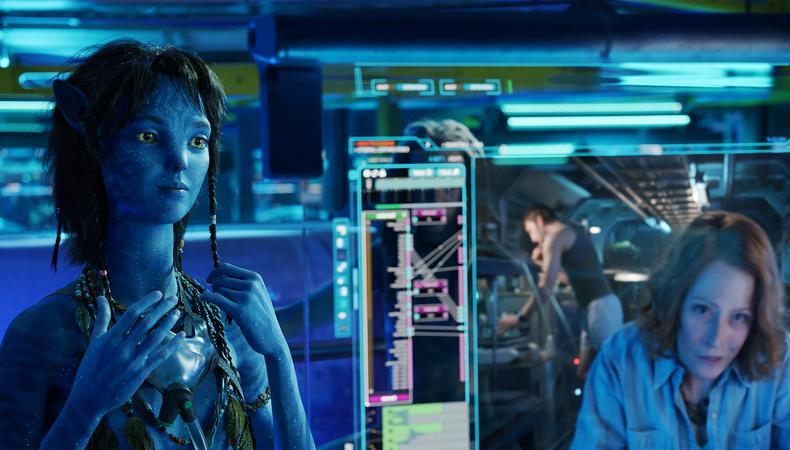
Cinematographer Russell Carpenter worked with director James Cameron on 1994’s “True Lies” and 1997’s “Titanic,” the latter which won him an Oscar for best cinematography. He’s looking to repeat history with Cameron’s latest box office hit, “Avatar: The Way of Water.” Here, he talks about the rigorous process of bringing the world of Pandora to life and the cutting-edge technology that helped him and his team pull it off.
“Avatar: The Way of Water” is an outlier in terms of how movies are normally made. Where does the cinematographer fit into the process?
The film is kind of built in stages, like a layer cake. So one thing launches at the bottom of the layer cake, and then a few months later, even a year later, another thing launches. First, the script has to get written, and they’ve written four films for the whole series. While they were doing that, production designers were invited in to start coming up with concept art for all these new locations for the Pandora world and the world of the RDA, [the film’s antagonists]. Now, a whole team of CGI designers has to come in and make those worlds exist. Then Jim [Cameron] enters those worlds with his virtual camera, and he starts to scout them and make changes. Then, he has a team of people called his troop that pretty much stand in for the actors, and he uses them before the actors arrive to work in what we call a “volume,” which is basically an empty stage [with] these big monitors all over. Then he works out the basic blocking for each scene. After he’s got that and he’s cut versions of those scenes to his liking with his editors, the actors are invited in, and they get [into] the motion-capture suits, they get into positions, and they act the scene. When Jim’s happy with what he’s got with the actors, he starts to edit the scenes.
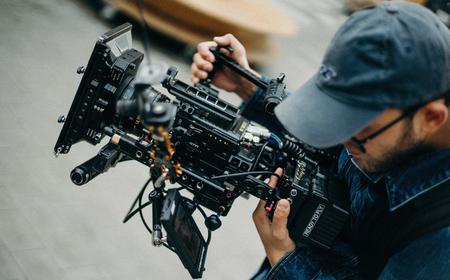 How to Become a Cinematographer
 Then, finally, my team and I get invited into the process; because now that we’ve got enough to work with, we can see enough to say, “Oh, this is what our real-world lighting will be matching to.” I got involved in virtual lighting in 2018 all the way up into May 2019. It wasn’t until May 2019 that we were actually shooting in Wellington, New Zealand. So you can see how lengthy this process is.
One of the film’s main characters is a human teenager named Spider, played by Jack Champion. What challenges did you face in having to film real humans against an all-digital world and digital characters?
The people at Lightstorm Entertainment had given me a tremendous ace up my sleeve in the sense of the virtual world. It was something that had been worked on for several years. They’d used a version of it, and it’s called Simulcam. This is basically the technology that Jim [uses when he] goes onto the volume. Because there are motion cameras everywhere, they know exactly where his camera is, which way it’s pointed, which way it’s tilted, and how fast it’s moving. Then the computers know what the rest of the environment is. So if he’s pointing over here, the computers say, “We’re gonna show him the waterfall over here, and if he points his camera this way, in real time, we’re going to show him the part of the forest that he’s interested in over here.”
Once we’ve got our live-action camera kind of fused together with where Jim’s virtual camera was, the camera says, “OK, these cameras line up. From now on, where the live-action camera is pointed, we’re going to give the correct background.” The amazing thing was that not only did it give you the correct background, but now it had a new depth-sensing component to it. So it would point the camera where the Na’vi [were]; but because it knew exactly where Spider and everybody else were, it could make a composite that was very fine—much better than had ever been done before. So it actually looked like Spider was there in the forest, and Na’vi could step in front of him. [The camera] totally knew where the depth was, and that was crucial in terms of making last-minute adjustments to the lighting. We would have our lighting exactly where it’s supposed to be, in the right direction with the right color and the right quality. It was extremely helpful.
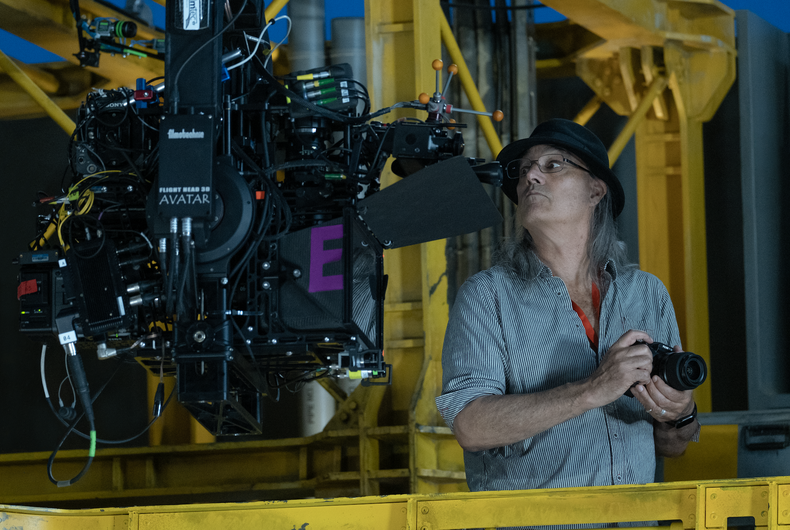 Russell Carpenter on the set of “Avatar: The Way of Water” Credit: Mark Fellman
Did you bring the fundamentals of classic cinematography into shooting this film?
Yes and no. First of all, you go through a very technical dance at the beginning of the day in terms of lining up the camera and making sure all the 3D systems are working. You’re looking at the set and then you walk around to the back of the set, and in the stage you have, let’s say, different tribes of computers. Like, here are 12 computers over here and they have this task, and you have 12 more computers in another group over here, and six computers over here just watching the 3D elements. It starts to feel a lot like a rocket launch rather than: “OK, roll ’em.” You have a very different rhythm to that. It’s weird because on a real set, you’re lighting the scene and you can do whatever you want. As a cinematographer on a virtual stage, you have to be very precise—there’s not what I would call an improvisational workflow.
Which was a toughter shoot for you—“Titanic” or “The Way of Water”?
They were both difficult in different ways. Physically, “Titanic.” A lot of that film was shot in moving water and in tanks, and people were either walking around in wetsuits or dry suits. Things go amazingly slowly—not only because you’re working through water, but because there are safety issues always; and on that set, safety was really at the forefront. But “Avatar,” for me, was mostly just thinking, What could go wrong? What do I need to have ready to go? What do I need as a backup system? Just working out the logistics with all these different departments became more like a real brainpower exercise. When I left “Avatar,” I was mentally exhausted more than physically exhausted.
What are some important lessons you’ve learned over the course of your career?
A lot of them don’t have much to do with the technical [aspects], because the technology is always changing. And now it’s changing faster than ever. But one thing I had to learn, because I wasn’t a very social person, was that by going into interviews, I would just get better at communicating about myself. I think directors of photography are in the same position that actors are in. You go in for a lot of auditions, and you have to develop a thick enough skin to realize that if they don’t pick you, it’s not about you. Don’t internalize it—just keep having persistence.
This story originally appeared in the Jan. 26 issue of Backstage Magazine.