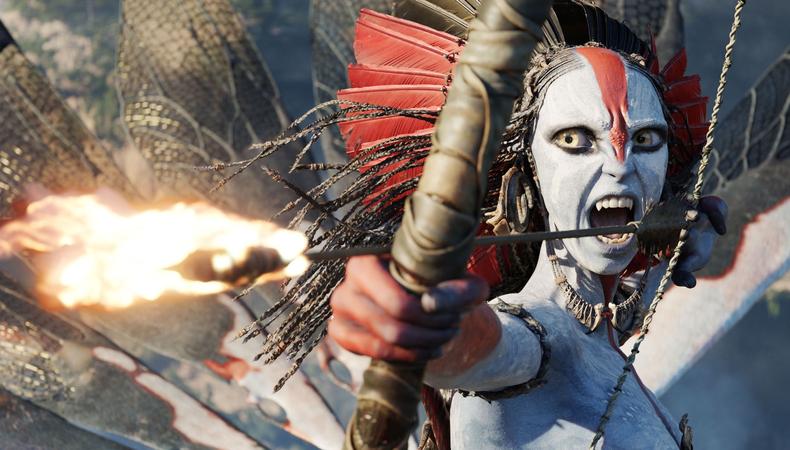
James Cameron’s epic sci-fi saga “Avatar” has pushed the boundaries of the industry ever since the filmmaker introduced his performance-capture technology in 2009’s Oscar-winning original film. Now with the franchise’s third installment, “Avatar: Fire and Ash,” hitting theaters Dec. 19, audiences will once again be transported into Cameron’s immersive Pandora universe.
“Avatar: Fire and Ash” was filmed simultaneously with 2022’s “Avatar: The Way of Water,” allowing significant production overlap across the sequels, including the capture of some material for the currently titled “Avatar 4,” planned for 2029, and “Avatar 5,” coming in 2031. Given that the saga continues to set new standards, we wanted to know how such a massive production casts its talent.
We sat down with esteemed casting director Margery Simkin (whose résumé includes hits like “Top Gun,” “Field of Dreams,” “Bowfinger,” and “Erin Brockovich”) to learn exactly how the “Avatar” franchise finds its stars. From what it’s like working with the legendary filmmaker to the importance of raw performance over the mechanics of camera systems, Simkin delves into the nuanced casting process for “Avatar,” highlighting its evolution from 2007 to the present day.
Is the casting for a performance-capture film like “Avatar” different from casting for traditional live-action movies?
Essentially, it’s exactly the same: We’re casting for great actors. It’s about performance. Jim has never called this motion capture; he’s always called it performance capture. So it’s really about great performances.
It’s a great misconception that everyone thinks about him as this visualist, but honestly, I’ve never met any director more devoted to the performance of performers and appreciative of what they bring. I think it’s sort of the secret sauce to what he does. He’s a great storyteller, but he understands that no matter how great the story is, it isn’t going to matter if you don’t have people performing it beautifully. And that is something I think people don’t get about him. So he is incredibly as rigorous, if not more so, than anyone I’ve ever worked with.
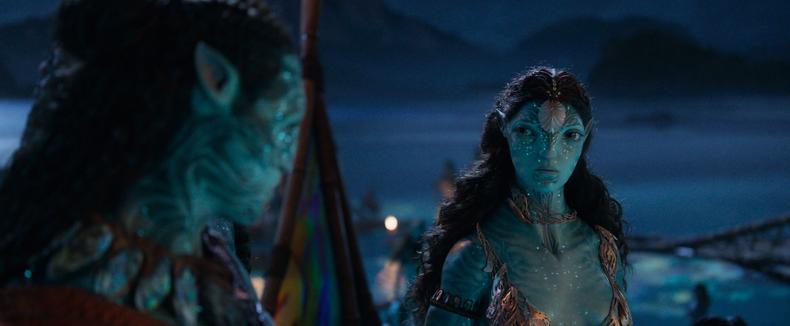
What is your creative relationship with James Cameron like?
It’s really, actually fantastic. He’s very collaborative, and he knows what he wants. He’s incredibly respectful of my knowledge base and my opinions, and it’s terrific. I mean, the hardest part is getting his time to sit down and do it.
This may be a bit arcane, but there’s a film called “Day for Night” [dir. François Truffaut, 1973] with a scene where the director’s coming onto the set, and all the department heads are saying [to him], “Look at the costumes,” “Look at the set.” You know, everybody’s trying to get his attention. So there’s a lot of that [with Cameron] because he’s got so much going on. But when we sit down, it’s very energizing for me because he’s challenging, which I appreciate because it makes me up my game.
People always ask me: What are some things people don’t know about him?
How amazingly respectful he is of actors; he’s totally in awe of them. It just really makes me laugh, because as soon as we started [“Avatar”], we started getting phone calls [from well-known actors] who were huge fans. He’s always like, “Do you think so-and-so would really be in the film?” And I’m like, “Uh, yeah!”
I know people think of him as this hard-ass guy, and I’m not saying he can’t be tough and challenging, but I always find it very charming that everybody has their insecurities.
When casting a film that uses performance capture, is there anything specific you’re looking for from an actor?
I think the most important thing is that they are able to be imaginative without anything around them. In a weird way, the actual filming is close to the audition. [An actor might think:] You know, if I were on the set for “Marie Antoinette” and I had that corset and the outfit on, I would be different than standing in the audition room, right? Well, the “Avatar” set is just a very large version of my room. I mean, the actual place where they film is just this gigantic empty room with gray boxes in it. So if you’re not someone who can perform fully in that context—and this is in no way knocking people who need all those other things around them and can do amazing work—but if you’re not someone who can go full out… I mean, it’s closest to being in a rehearsal for a play, just in a rehearsal room without a set. So you have to be comfortable with that and be imaginative. The kid [actors], it was easy for them because they were close to pretending, but you have to just be able to go full out.
What should an actor know about auditioning for a performance-capture project? Is there any resource they can look at?
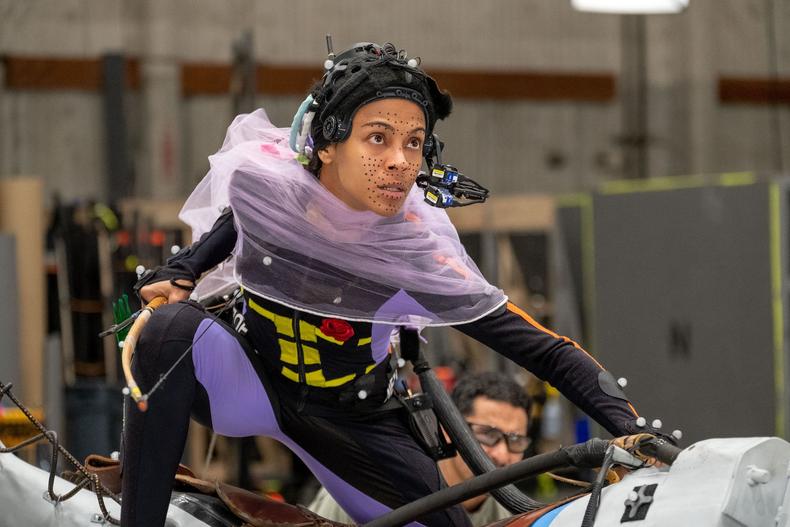
There were side-by-sides done of Zoe Saldaña after the first [“Avatar” film], where you saw the finished product [Zoe as the lead Na’vi character], and then you saw her doing the performance capture. But you saw her [only in the equipment]. You have to be able to blank that out. It really is incredible when they’re one-on-one with each other. I mean, you’re doing a love scene with an actor who’s got dots all over their face. There is a purity to this work and a simplicity. It’s just about the performance. It isn’t about other stuff.
When you get in the audition room, they’ll hand you a stick; or they’ll put a cape on, so you have the [proper] weight. They realized they had to put tails on because they realized you walk differently if you’ve got this [tail on the back of you], so they had to capture that.
And then the crazy headset. There was one camera [when filming the first “Avatar”], and now there are two. So it’s really capturing every emotion, and it’s like a super close-up. So again, if you’re too broad, that kind of doesn’t work either. You know, it really is realistic within its own dopey context.
Credit: Mark Fellman
Is there anything you’re really excited for people to see in “Avatar: Fire and Ash”?
Oona Chaplin [who plays Varang, the leader of the Ash People]. That role was really the next introduction of a big character. In “The Way of Water,” we had fantastic people, obviously, like Cliff Curtis and Kate Winslet. But we got to add some really great characters in “Fire and Ash.”
And with Oona, it’s everything I’d hoped it would be. Because when you go into [casting], in a weird way, you’re guessing, and you don’t ever quite know how people are going to adjust to this process. You have a guess, but you don’t know how it’s going to turn out. So I’m really thrilled. Oona’s extraordinary. I thought she would be, but it’s always nice to feel right.
And David Thewlis is also in the film [he plays Peylak, the leader of the nomadic Wind Traders,] and he has been on my personal bucket list of somebody I’ve always wanted to put in something. So when this role came up, I put together a list. Jim did know who he was, but he always likes to meet people. And I thought, Alright, how are we going to do this? Because David lives in London. But he happened to be passing through L.A., and I was so excited to get him in.
I remember him in Jim’s office. I’ll be honest, it was seven years ago. But I remember Jim taking him through and showing him the volume. And, you know, some people go in and look at it and just go like, “Oh, what’s that?” Especially older actors. And I think David just thought: Well, this will be cool. This will be a cool challenge. And I think he had a ball.
Is there something specific Oona Chaplin did that made you feel like she would be perfect for her role?
Bravery. Honestly, with both Zoe and Oona, there was incredible bravery. It’s a weird thing coming into these rooms, right? I acknowledge it fully, and I try my best to make it as comfortable as possible. Because I know everybody thinks we’re the scary people saying no. But we’re actually the people trying to put you at ease so that you can give your best performance and, selfishly, we can solve our problem. Our problem is finding the right person. And I have to say, for Oona’s role, there were some extraordinary people who came and did really terrific work, wonderful work; but there is a freedom to her that fits in with the bravery, and then a potency.
I first saw her in [FX’s] “Taboo,” which she did opposite Tom Hardy, who is a very potent presence, and she was able to hold her own. So I knew, in this context, that this character would have to hold her own with Stephen Lang [who plays Colonel Miles Quaritch], and he has a real presence, which is why we cast him. So the actor had to be strong enough to sort of balance that.
What advice would you give to an actor who is auditioning for both a live-action and a performance-capture piece?
I would say it’s important to show different colors. I’m a big fan of people doing multiple versions of a scene. It may not be the right thing, it may not be what we end up filming, and it may even be wrong for the scene. But if it’s another version, then I see you have range, and that’s a really important thing to show to us these days.
And again, you have to look at what the scene is. There’s always different ways. I’ll never forget: John Cho came in for [1999’s] “Bowfinger.” He had one line, and he did it 10 different times, 10 different ways, and they were all valid. That sort of was this tip-off, like: Whoa, this kid’s something.
For someone who’s just starting out and trying to get in front of a CD, what’s your best advice?
Just keep working. And now today, you can get together with a bunch of friends and do something on your iPhone. Keep creating. It’s almost like a gym to work out. You have to keep working out. You may not always have remunerative opportunities, but you create other opportunities for yourself. Get together with other actors and read through scripts together, or just do a scene study with each other. But use those muscles. It’s just as important as going to the gym.
And that’s how I think you get noticed. Everybody asks, “How do you get an agent?” It’s very hard. The reality is, I cannot see everybody, right? I cannot meet everybody. To me, one of the great pluses of what’s happened with taped auditions is that I get to see so many more people for roles. It opens it up so much.
This interview has been edited for clarity and length.