What exactly makes for award-worthy television? Relatable yet surprising performances? Sharp, truthful writing? A cohesive design and directorial vision? Great filmmaking is some combination of all three, plus so much more; in this era of TV’s renaissance, there are countless examples of storytelling firing on all cylinders, so we at Backstage are pinpointing those precise moments where the stars aligned on our small screens. The series below, all nominated at the upcoming 70th Primetime Emmy Awards, delivered unforgettable seasons worthy of attention from Television Academy voters. But these specific scenes exemplified the best of what scripted TV can do.
Barry’s backstage breakdown, “Barry” (HBO)
If you’re a good person who does bad things, are you still a good person? Bill Hader and Alec Berg’s “Barry” ponders that question as its protagonist stumbles down a dark path while using an L.A. acting class to relieve the stresses of his day job: killing people. In the stellar first season’s seventh and penultimate episode, Hader’s nice-guy wannabe actor reaches his breaking point seconds before he’s due onstage to utter a single line. Barry can no longer manage the emotional repression that his livelihoods, first as a soldier and then as a hired gun, require of him.
His loss is his audience’s gain. We watch him in the backstage shadows pacing, grinding his palms into his head, trying to stifle visions of what he’s had to kill, including parts of himself, to survive. But Barry’s grief, guilt, and anger demands to be felt. He emerges onto the stage shaking, tears streaming down his face, his trauma fully on display, to quietly tell Sally’s (Sarah Goldberg) Macbeth, “My Lord...the queen is dead.” Gone is the scenery-chewing “actor” from earlier episodes who couldn’t deliver a line to save his life. Barry’s had to pay the price to get to this part of himself. He’s not a good guy, and maybe he never was. But the man is an actor. He got what he wanted. Right? —AJ McDougall
The epic paintball duel, “Curb Your Enthusiasm” (HBO)
Today, admitting you don’t like the award-winning Broadway hit “Hamilton” is like saying you don’t like Beyoncé or haven’t watched the new “Stranger Things.” It’s announcing to the world that you have neither culture nor any desire to become cultured. That’s why, in the newest installment of Larry David’s “Curb Your Enthusiasm,” which returned after a six-year hiatus to continue following the onscreen Larry’s interactions with celebrities, it’s so refreshing when he sleeps through the entire musical.
But the offscreen David’s preternatural ability to get famous stars to play caricatures of themselves is more than just refreshing; it’s hilarious. The real gem of HBO’s new season is its final episode: after tense weeks of working together to produce a musical called “Fatwa!,” Larry and “Hamilton” creator Lin-Manuel Miranda finally face each other—in a paintball duel.
For once, Miranda isn’t putting on his front of chill hipster genius; he’s being that smug humble-bragger that we all suspect he really is. The show is self-aware in a way rarely seen on TV, somehow completely absurd yet intensely realistic at the same time. Most importantly, “Curb” reminds us yet again that being able to laugh at ourselves is necessary. For anyone who (gasp!) is tired of all the “Hamilton” hype, or who actually may be a “Hamilton” snob themselves, Larry and Lin-Manuel’s final showdown is undoubtedly the TV moment of the year. —Audrey O’Byrne
Eleanor passes a moral test with flying colors, “The Good Place” (NBC)
“The Good Place” skips the small talk of most sitcoms and leaps deep into the depths of the human psyche. You think you know the rules of the universe when Season 2 begins, but guess what? Each episode continues to keep you on your toes, both by making you invest in these characters as they navigate through afterlife obstacles and by forcing you to question the moral values that drive your everyday life. In the season’s penultimate episode, protagonists Eleanor, Tahani, Jason, and Chidi (Kristen Bell, Jameela Jamil, Manny Jacinto, and William Jackson Harper, respectively) enter a portal into a remote judgment zone where a zany but all-powerful judge, played by the Emmy-nominated Maya Rudolph, decides the collective fate of our now beloved underdogs through four tests of personal growth.
While Eleanor’s test is undoubtedly the most difficult—resisting temptation that her previously self-interested self wouldn’t have resisted—she winds up with the only passing grade. Instead of choosing to revel in that glory, she gracefully hides her accomplishment and accepts her fate alongside the others—actions that would have been inconceivable had she not learned to be selfless and vulnerable with her unlikely friends. I mean...that’s beautiful stuff. Jean-Paul Sartre said, “Hell is other people.” But Michael Schur’s divine comedy offers an alternative take: Heaven is learning and growing from being with other people. —Jordan Allyn
“They do not own you and they do not own what you will become,” “The Handmaid’s Tale” (Hulu)
There was a scene early in the second season of “The Handmaid’s Tale” after which I said out loud, to absolutely no one, “That’s Elisabeth Moss’ next Emmy.” Her June/Offred spent Episode 5 conflicted: She assumes she’s miscarrying the child that does not belong to her, freely hemorrhaging rather than seeking help. She hasn’t allowed herself to love this baby fully, though everything within her aches to do so. At the same time, the baby is the only thing keeping her from being killed, so she evidently may prefer dying to bringing this child into the hellscape that is Gilead.
The episode ends with June (that’s her only name, dammit!) waking up in a hospital bed, incredulous to find the fetus’ heart still beating inside her. It’s an important turning point that marks June’s bar-none commitment to this child as hers, and it prompts her to steal a private moment. “They do not own you and they do not own what you will become,” she says, her fingers gently cupping her belly, her face lit beneath the blanket’s perforations. Finally, with her ice-blue eyes locked straight into the camera—and reader, I tell you, I gasped—she swears, “I’m gonna get us out of here.” —Casey Mink
Issa’s goodbye to Lawrence, “Insecure” (HBO)
The “Insecure” Season 2 finale provides exactly what its title promises: “Hella Perspective.” We’ve borne witness all season to Issa (series co-creator and freshly minted Emmy nominee Issa Rae) second-guessing, self-sabotaging, and unmooring herself by cheating on Lawrence (Jay Ellis) and misstepping her way through that relationship’s ashes and her unwanted singledom. A series of lovers’ quarrels, a trashed apartment, and a literal garbage fire later, it all comes to a head in this episode’s closing moments when, faced with hiked rent prices and fledgling job security, Issa decides to move out of Inglewood.
The final confrontation with Lawrence in their apartment’s empty kitchen is the kind of conversation that only two people who know each other, who love each other, and who’ve hurt each other can have: self-reflective, apologetic, heartbroken, and honest. And it’s not just Rae and Christopher Oscar Peña’s script that make it such a gut-wrenching goodbye. Like Issa and Lawrence onscreen, she and Ellis lay all their cards on the table, offering up raw weariness, pangs of regret, and hard-earned wisdom, a swell in their eyes just short of a tear. The scene becomes all the more impactful when Issa allows herself a brief reprieve, imagining in their last minutes the life she and Lawrence could have had: marriage, kids, success, happiness. It’s a montage of “what ifs” that anyone who’s loved and lost will be grabbing tissues to get through. —Benjamin Lindsay
Midge nails her season-ending set, “The Marvelous Mrs. Maisel” (Amazon)
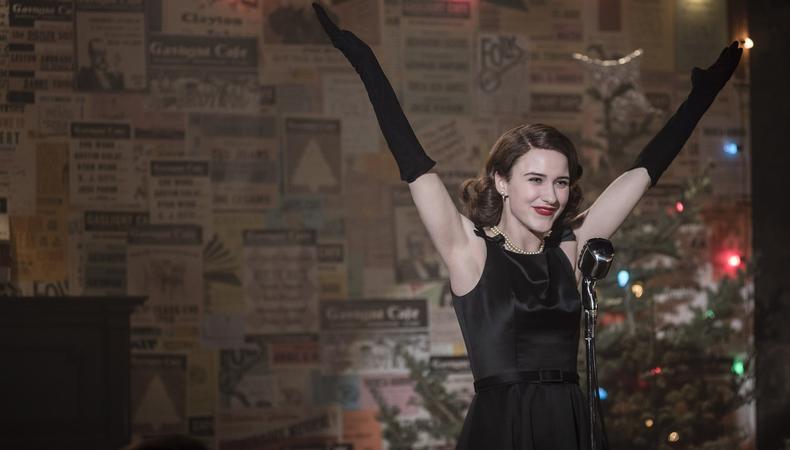
There’s nothing like seeing your hero get a win, and after a hilarious yet drama-filled season, that’s just what the audience of this Amy Sherman-Palladino tour de force gets. It’s not clear throughout the season if Rachel Brosnahan’s Midge will stick it out with her accidental foray into the New York City
standup comedy scene, but you end up rooting for her to defy the gender and societal constraints of the 1950s. Where the season began, the downtown club in which her now ex-husband, Joel, bombed performing stolen material, is exactly where it ends.
This time, we get to see Midge, perfectly styled (as always) in an unforgettable black dress, nailing the set she’s worked so hard to craft. The last thing we see before the screen goes black is Brosnahan, victorious, her arms raised over her head, making viewers feel like they’ve just accomplished something, too. It’s the perfect button for a TV season: It succeeded in making us want more without relying on a classic cliffhanger ending. —Elyse Roth
The Woodsman delivers a knockout radio performance, “Twin Peaks: the return” (Showtime)
If you’ve heard anything about Showtime’s resurrected “Twin Peaks,” it’s probably been in reference to that bonkers eighth episode—a baffling, mesmerizing hour that manages to encompass good, evil, and a musical guest appearance by Nine Inch Nails. It’s the fulcrum of this 16-hour film-in-the-guise-of-a-TV-show, and the moment you realize that you’ve never seen anything like this on TV before.
After a series of events, including a long journey through the hellfire aftermath of the Trinity nuclear test that births evil spirit BOB (this is what explaining any “Twin Peaks” plot point is like, incidentally), we are confronted with the Woodsman, a soot-covered spirit played by Abraham Lincoln lookalike Robert Broski, who appears out of the darkness to terrorize the denizens of a small New Mexico town by barging into a radio station, crushing the skull of the announcer with his bare hands, and growling a crooning, world-ending lullaby into the mic, sending listeners into a trance: “This is the water, and this is the well. Drink full and descend. The horse is the whites of the eyes, and dark within. This is the water...”
Over and over. Another show would pull back and give the audience some breathing room. But this is the “Twin Peaks” that had us watch a janitor sweep up cigarettes and peanut shells for long, uninterrupted minutes. It demands patience and rewards a willingness to suspend disbelief with the complex joys associated with a masterpiece, emphasizing that all art doesn’t have—or need—easy answers. —Rawaan Alkhatib
Jack comforts his gay grandson, “Will & Grace” (NBC)
David Kohan and Max Mutchnick’s showcase for TV’s funniest and most fabulous foursome swung for the fences in its comeback ninth season. Eric McCormack, Debra Messing, Megan Mullally, and Sean Hayes were given meatier material in addition to the pratfalls and deliciously sassy one-liners that made Will, Grace, Karen, and Jack so beloved. Nowhere was this truer than in the episode “Grandpa Jack,” in which Jack discovers his estranged son (Michael Angarano) has a son (Jet Jurgensmeyer). It’s soon revealed that, like grandfather like grandson, little Skip is gay (“Jesse Tyler Ferguson, she is fabulous!” he exclaims of Karen) and on his way to a conversion camp. In a heartwarming, award-worthy moment, Jack infiltrates Camp Straighten Arrow to comfort and advise his new protégé, teaching him about chosen families and assuring him, “It gets better.”
LISTEN: Sean Hayes on ‘Will & Grace’ & What He Wishes Actors Knew
It’s a beautifully written speech by Alex Herschlag, a reminder that Jack isn’t all flowery theatrics and shallowness; he’s someone who can care deeply, and about things he didn’t necessarily expect. Hayes calibrates its rhythms wonderfully, too; you feel Jack both resisting that signature Jack-ness, discovering a new part of himself with each word, and emanating a fatherly warmth that’s entirely characteristic of him. The line “You are exactly who you’re supposed to be”—delivered as Jack reaches out and cups his grandson’s face in his hands—is all the more tear-inducing coming from such a wacky character and series. —Jack Smart
Check out Backstage’s TV audition listings!