For writer David Nicholls, penning the scripts for Showtime’s five-time Emmy-nominated limited series “Patrick Melrose” was like a dream come true. Working in a bookshop as an unemployed actor in the ’90s, Nicholls got his hand on the first volume of the “Patrick Melrose” novels and fell in love. “I leapt on every volume as it was published over the next 20 years—and during that time became a screenwriter,” he says. "And when people asked me, ‘What’s your dream project?’ I always said, ‘Well, the “Patrick Melrose” books.’ I’d been thinking about them for 20 years before I actually got my hands on them.”
The series of five semi-autobiographical novels from author Edward St Aubyn follow Patrick Melrose as he struggles inside a dysfunctional, high-class English family, beating back the memories of his troubled childhood with substance abuse. “They’re terribly challenging to adapt,” confesses Nicholls. “They’re not obvious at all. When I had the meeting to adapt them, I had to persuade both the executive producers and Edward St Aubyn himself that I was the right person for the job.”
They originally began as four 90-minute movies, each with a different director, cast, and style. Eventually, however, they landed on the idea that the episodes would have to be more intricately woven and would share a cast and tone throughout. Edward Berger landed at the helm of all five episodes of the series, named after each of the five novels. “There were a huge number of radically different versions before we finally settled on this idea of five connected but separate stories. We went back to the novels and tried to keep the satisfaction of five episodes, five key moments in the life of Patrick Melrose,” says Nicholls.
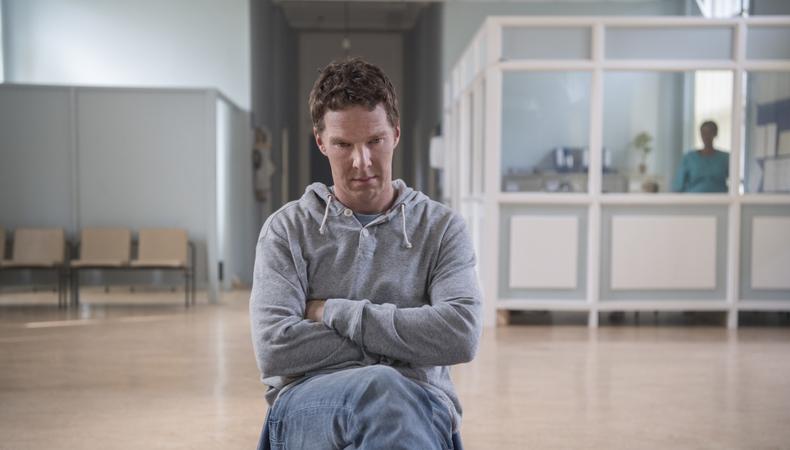
As for Emmy nominee Benedict Cumberbatch in the titular role, the part was never anybody else’s to have. “I don’t think we ever talked about anyone else. It was always our dream casting and it so happened he knew the books. I was writing with his voice in my head,” remembers Nicholls. “He’s always playing this role of someone who’s rather cynical, tough, and pessimistic. But we did want to make it a story of recovery and redemption. That was emphasized in the script, which Benedict acts brilliantly. He brings with him great charm and appeal.”
READ: This Year’s TV Movie + Miniseries Emmy Nominees
The character of Patrick is a spiky one, perhaps even unlikeable, but for Nicholls, he appreciates when an actor can find the humanity in even the most villainous characters. “Both as a writer and performer, I think digging deep and—not forgiving or excusing terrible actions—but trying to find a reason for the behavior, whether it’s good or bad.”
Going from script to set, however, Nicholls leaves it to the crew and rest of the cast (which includes Jennifer Jason Leigh, Hugo Weaving, Allison Williams, and Blythe Danner). “I’m aware on set that a screenwriter is often a distraction to make the actors self-conscious and can invite changes to a script that’s working really well, so I tend to stay away,” he says. For him, his relationship with actors starts and ends with trusting what they can once casting decisions are made. And with Cumberbatch and the rest of the “Patrick Melrose” cast, having that trust was no problem. “It’s often quite a frustrating experience, but I love this cast, and it’s been one of the great pleasures of the production to work with,” he says. “That’s been a great treat for me, to see these actors bring it to life.”
Ready to win your Emmy? Check out Backstage’s TV audition listings!