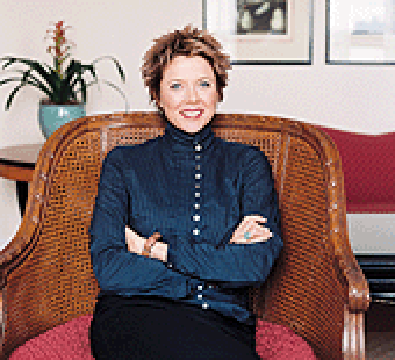
Actors love to play actors. Whether it's the opportunity to extract a little revenge on former collaborators or the chance to slip into the skin of someone naturally disposed to dramatics, there's a long history of performers skewering their craft onstage and on-screen. Or maybe playing troubled thespians is just a great exercise in schadenfreude--a way for actors to say, "Thank God I'm nothing like that."
In the biting period comedy Being Julia, Annette Bening has a ball as Julia Lambert, a grande dame of the London stage who abruptly finds herself facing the realities of aging, professional and personal competition, and the choices that have led her to a rather unhappy existence. A perfect match for Julia, the theatre-trained Bening has always had a passion for the stage. "For me, the theatre was my real romance with acting and the spoken word," she says, "the sound of the human voice, the sweat on people's faces, the larger-than-life yet very much lifelike thing that was going on simultaneously, the ordinariness and yet the hugeness of it."
No one would question Bening's abilities as a serious actor; her roles in films such as Bugsy, American Beauty, and Open Range have established her as one of the best actors working today. But audiences might not be as familiar with her comedic skills, which are on welcome display in her new film. Watching her regal portrayal of Julia, one is reminded of her crafty con woman in her breakthrough film The Grifters or the flawless timing she showed as a Washington lobbyist in The American President.
If audiences have one complaint about Bening, it's that they want to see her do more. She can go years between films, sometimes by conscious choice and sometimes by waiting to find the right material. Married since 1992 to Warren Beatty, she has made raising their four children her priority. It's always a welcome experience to have the actor back on-screen. She has never looked more beautiful than in Being Julia, based on the novel by W. Somerset Maugham and directed by Sunshine helmer Istvan Szabo.
Back Stage West: You started acting in high school. Did you know then that this is what you wanted to do with your life?
Annette Bening: I had a high school drama teacher that was great. She was an actress, and she was a real character and a pretty serious theatre person. She was young and a single mom, and she was very inspiring to me. We did sort of Joseph Chaikin, Viola Spolin exercises that were pretty sophisticated for a high school crowd. I really liked all of that stuff and was very much inspired by her. So that helped. But, yeah, I did want to be an actress at that time. I knew very little about it; I'd never met an actor. She was probably the first actor I knew. I never thought of it that way, but she probably was. And she was just a local theatre actress in San Diego.
But I didn't think about movies. I didn't go to the movies and think, "Oh, that's what I'd like to be." I thought about the theatre. It wasn't until I was older that I began to look at movies and think, "Wow, that was really powerful." I remember thinking, "Well, somebody has to be in them." And then, "I wonder if I could ever do it."
BSW: Did Hollywood come to you with movie offers, or did you pursue film work?
Bening: Oh, no, they did not come to me, not at all. They had no idea who I was. I was doing theatre in San Francisco. I had trained there, and I was in a company, and I remember visiting L.A. once. I had a friend who had a manager, so I met him, and then I sort of went around and met a few people. They kind of looked at me like, "You have a chipped tooth, and your hair's really, really long." I didn't know anything about the business, and I didn't know anything about what I was doing there. I felt very funny. And I didn't understand about the camera or anything. So I ended up thinking I wanted to do the classics, and I was in this theatre company. So I stayed there a few years.
And then I thought, "Well, if I go to New York, maybe I could be seen in something. If I was doing a play, maybe that would give me a step in the right direction." I had met an agent through a showcase in my theatre company where all the theatre schools from around the country would send the graduates to New York for a showcase weekend, and they would invite casting directors and agents to come and see these new people. So I had done that and met an agent who liked me and that I liked. I said, "I'm not going to come to New York now because they're asking me to do the classics, and I'm going to go back and do that. But eventually I'm going to come, so can we stay in touch?" We did stay in touch, and about three years after that I called him and said, "I'm coming!" He said OK and signed me, and I started going out and auditioning for anything I could get my hands on. I got into an Off-Broadway play [Coastal Disturbances] that moved to Broadway. Everything sort of took off from there.
BSW: I think some people in the industry were surprised that you turned down the coveted role of Catwoman in Batman Returns to start a family. Was that an easy decision for you? Did you always know there would be other opportunities?
Bening: You know, I've had moments through the years when I was having babies and not doing things because of having babies that I would think, "Wow, will I go back?" Yeah, there were moments where that was a concern to me. But never enough to stop doing it--I had four children. And I always wanted kids and a big family. So it was something that came very early in my life, before acting and before thinking about acting. Especially as the years go on, I see that as being more and more of a gift because it gave me a kind of way of being in the world that didn't only involve acting. And I love acting, and I love my work, and I tell my kids that all the time, and they know how much it means to me. But I don't think I'd be good at only being able to do whatever I wanted in life. I don't think it would ultimately be very satisfying.
BSW: Has there ever been a time when you didn't love acting, and how did you persevere through that?
Bening: I have had moments. I certainly lost interest when I was in the midst of my baby-ness and my pregnancies. It's such a huge experience, having children; it's such an all-encompassing experience. It's not all good, and it's not all virtuous; I don't mean that. I just mean it's huge. And it changes you and touches you physically, emotionally, and spiritually. So the first time it happened, that I had a baby and kind of lost interest in work, I was a little bit disturbed by it. I thought, "Is something wrong with me?" Because I was very lucky, I had always gone from thing to thing, and I was always working. And I no longer was on a "thing." What, of course, I learned is that it's a cyclical thing. That need, that hunger, it ebbs and flows, it comes back and goes away. But so far the hunger's never completely gone away; it's always come back. Maybe someday it will, I don't know. But I think it's a good hunger, it's like a heartbeat. It's necessary.
BSW: Did you relish portraying an aging actor who extracts revenge on the world of show business in Being Julia?
Bening: Oh, yeah, it was fun. Because she was such a diva and had that wickedness and theatricality about her that is such a joy to try to get across. But I also saw that as being somewhat tricky because it's a showy part, it's an actress-y role. I thought, "That's going to be interesting for about two seconds if that's all I can find." It's really the stripping away of the mask that I think is more interesting about the story, and that you get to see her triumphing at her best onstage with the makeup and the wig, but you also get to see her kind of taken down to zero in love, like a dog-having-a-bath kind of a feeling, where you're down and exposed. And I think that's what movies can do. It's an important part of acting, and it's not always easy, and I don't like to think that it's painful, but it is sometimes. Your body doesn't always know what's real and what's pretend. It's funny, because your body's going through it. Those stripped-down moments were really important for me to try to find. The theatricality of her was fun, but if it had only been that, it could have been kind of a trap.
BSW: Do you find the parts you're being offered now are better or more interesting than the roles you were offered early in your career?
Bening: I don't know, I was offered some really good parts. I've gotten to play really great parts from when I started. So I just think that this woman is particularly interesting because she is not a kid. She's been through life, she's had some life experiences, and she's dealing with having to confront not having the energy that she's always had. It's just not there, the energy to do eight shows a week. Suddenly she's asking herself, "What am I doing, why am I doing what I'm doing, who do I really love, who do I need?" She's not a terribly introspective woman, so this is something that happens to her and she doesn't even know it's happening. But I like that about the writing; I think that's very human. I think a lot of us are going through crises where we don't even see it coming. Whereas if you look back and analyze it, you can say, "Of course." But if you're just living your life, stumbling around, and all of a sudden you're madly in love, you're thinking, "What happened to me?" I love that she's flawed and makes mistakes and has to go through being humiliated and all that stuff. It makes for an interesting character, and a true character.
BSW: I've heard you described as "Method."
Bening: [Laughing] What does that mean?
BSW: I was hoping you'd tell me. It conjures images of someone who stays deep in character while on the set.
Bening: I don't see myself that way. I normally like to goof around, have a good time. But on days where I have a lot of stuff that I have to do, and I have to be ready when they're ready, it's different. That's the thing about movie acting; you've got to really be ready. You don't get any points for acting when the camera's not rolling; it's not like it makes you a better actor. But I tend to be more quiet and less social. I just kind of want to stay somewhere in that realm emotionally, so when they say, "OK, ready," I don't have to suddenly climb a mountain to get there. But I don't stay in character all the time. I get very immersed in what I do, for sure.
BSW: You appear to be choosy about the roles you take, not doing more than a movie a year. Is that a conscious choice, a luxury you take advantage of?
Bening: I work hard at developing material that I love and that means a lot to me. That's usually in conjunction with other people. And that often takes a lot of commitment and work. So I don't sit back and wait. I'm fortunate enough that people do sometimes just come to me with things they're ready to make and maybe even have funding to make. But sometimes people come and say, "Well, I don't really have this set up, but I'm interested in this material. Would you like to be associated with it?" Then the job is to get it made. And sometimes I'm part of that process.
Like when you were talking before about do you ever lose the desire, it definitely comes and goes. There have been times that I've really been chomping at the bit ready to do something, and it's like that thing isn't going to happen for a while. Or sometimes just putting things together takes awhile, especially if they're independent. Then you're trying to gather in a lot of elements at the same time, get everyone in the same spot at the same spot schedule-wise, and sometimes it's complicated to make things happen, especially if it's difficult material, if it's material that's challenging.
BSW: Is there anything you would like to impart to those who are trying to make their ways in the world as actors?
Bening: I think it's important to work, and I know that sometimes you can afford to be more choosy than others, but I think there's a lot to be said for just doing something. Whatever that is, take it. Or find a place to do a play or find an acting class or find something where you can participate in it and feel like you are a part of something. That means a lot. In every circumstance, I think it makes a difference if you conduct yourself well and are really professional. Be prepared. You'd be surprised at the people that show up and aren't necessarily on time or prepared. I'm embarrassed when it happens, but it happens. I always think, "I can't believe there are so many actors that would just die for this role, and you're taking it for granted." If you're out there and auditioning, really prepare for what you do, be more prepared than you need to be. Show up early, because it makes a difference. People want to be around you if they know they can depend on you.
Be a self-starter; don't depend on anyone else to do the work for you. Don't depend on the director, don't depend on anybody else. You do the homework, you do the work, and you show up ready to go. If no one's said anything to you, you can just do it on your own. If you're up for something, work on the role. When I was up for something, even if I eventually didn't get it, if I'd worked on it I felt like I would get something out of the experience. And you just have to take care of yourself as much as you can, emotionally and physically. Because it is hard and humiliating to get rejected, and you're putting yourself out there. I think that having a life that is rich, that involves more than just your work, also makes a huge difference. Travel, move to a different city, all those things. Educate yourself. All those things that make you who you are, so that, when you walk in the room, you have some life experience and a frame of reference, that people see that you have something to offer. BSW