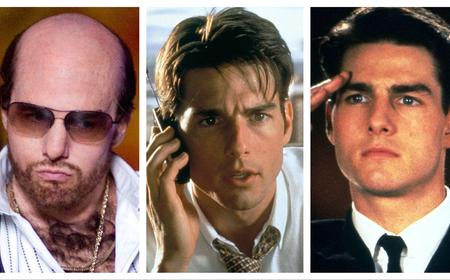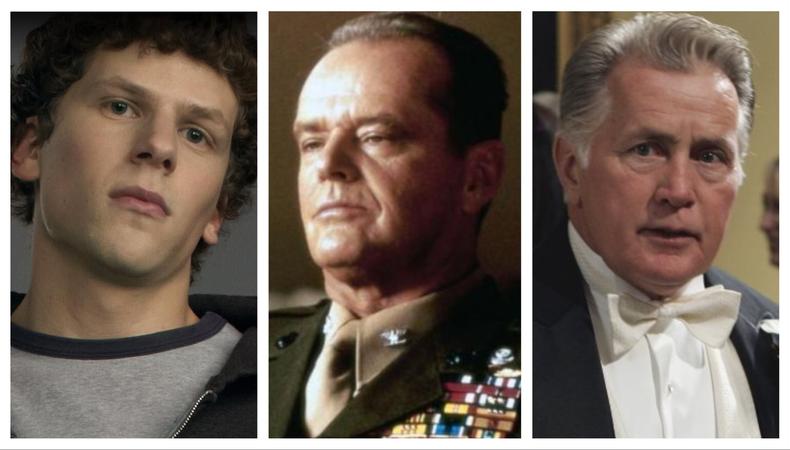
Jeff Daniels told a college auditorium that America isn’t the greatest country in the world anymore, Jack Nicholson informed Tom Cruise that he couldn’t handle the truth, and Rooney Mara read Jesse Eisenberg to filth—all in words written by Aaron Sorkin. Here are top contenders from the iconic writer-director’s catalog of verbal fireworks so you, too, can practice your walk-and-talk skills.
1. “A Few Good Men”: Col. Jessep takes the stand
Sorkin adapted “A Few Good Men” (1992) from his own 1989 Broadway play, and its climax remains one of the most quoted courtroom showdowns in movie history. Navy lawyer Lt. Daniel Kaffee (Tom Cruise) goads Col. Nathan Jessep (Jack Nicholson) into admitting he ordered the “code red” hazing that led to a young Marine’s death at Guantánamo Bay. Nicholson earned an Oscar nomination for the role, and the speech remains the gold standard for villains who believe they’re the hero.
The trick to performing this scene is restraint: Jessep spends most of the speech lecturing a man he considers a child, and his contempt comes across as seething silence. Although this one is a duologue, you can play it as a monologue—just remember to save the volume for the famous line and let the rest simmer.
NATHAN JESSEP:
I’ll answer the question! You want answers? You want answers?
[Kaffee: I WANT THE TRUTH!]
YOU CAN’T HANDLE THE TRUTH!
Son, we live in a world that has walls, and those walls have to be guarded by men with guns. Who’s gonna do it? You? You, Lt. Weinberg? I have a greater responsibility than you could possibly fathom. You weep for Santiago and you curse the Marines. You have that luxury. You have the luxury of not knowing what I know; that Santiago’s death, while tragic, probably saved lives. And my existence, while grotesque and incomprehensible to you, SAVES LIVES. You don’t want the truth because deep down in places you don’t talk about at parties, you want me on that wall. You need me on that wall. We use words like honor, code, loyalty. We use these words as the backbone of a life spent defending something. You use them as a punchline. I have neither the time nor the inclination to explain myself to a man who rises and sleeps under the blanket of the very freedom that I provide, and then questions the manner in which I provide it! I would rather you just said “thank you” and went on your way. Otherwise, I suggest you pick up a weapon and stand a post. Either way, I don’t give a DAMN what you think you are entitled to!
[Kaffee: Did you order the code red?]
I did the job I…
[Kaffee: DID YOU ORDER THE CODE RED?]
YOU’RE GOD DAMN RIGHT I DID!
2. “The American President”: President Andrew Shepherd crashes the press room
Before “The West Wing,” Sorkin tested his presidential chops with “The American President” (1995), a political rom-com starring Michael Douglas as widowed President Andrew Shepherd and Annette Bening as environmental lobbyist Sydney Ellen Wade. (Sheen, the future President Bartlet, plays Shepherd’s chief of staff.) After weeks of silence while Sen. Bob Rumson (Richard Dreyfuss) attacks his character and his romance, Shepherd marches into the White House press room and finally fights back, defending free speech, flag burning, and the woman he loves in one sweeping address.
Shepherd has held this speech in for the entire film, so play the release of a man who is done being careful. It also builds like a closing argument, stacking rhetorical questions until the room can’t look away; map those builds before you rehearse.
ANDREW SHEPHERD:
For the last couple of months, Senator Rumson has suggested that being president of this country was, to a certain extent, about character, and although I have not been willing to engage in his attacks on me, I’ve been here three years and three days, and I can tell you without hesitation: Being president of this country is ENTIRELY about character. For the record: Yes, I am a card-carrying member of the ACLU. But the more important question is, why aren’t you, Bob? Now, this is an organization whose sole purpose is to defend the Bill of Rights, so it naturally begs the question: Why would a senator, his party’s most powerful spokesman and a candidate for president, choose to reject upholding the Constitution? If you can answer that question, folks, then you’re smarter than I am, because I didn’t understand it until a few hours ago.
America isn’t easy. America is advanced citizenship. You gotta want it bad, ’cause it’s gonna put up a fight. It’s gonna say, You want free speech? Let’s see you acknowledge a man whose words make your blood boil, who’s standing center stage and advocating at the top of his lungs that which you would spend a lifetime opposing at the top of yours. You want to claim this land as the land of the free? Then the symbol of your country can’t just be a flag; the symbol also has to be one of its citizens exercising his right to burn that flag in protest. Show me that, defend that, celebrate that in your classrooms. Then, you can stand up and sing about the land of the free. I’ve known Bob Rumson for years, and I’ve been operating under the assumption that the reason Bob devotes so much time and energy to shouting at the rain was that he simply didn’t get it. Well, I was wrong. Bob’s problem isn’t that he doesn’t get it. Bob’s problem is that he can’t sell it! We have serious problems to solve, and we need serious people to solve them. And whatever your particular problem is, I promise you, Bob Rumson is not the least bit interested in solving it. He is interested in two things and two things only: making you afraid of it and telling you who’s to blame for it. That, ladies and gentlemen, is how you win elections. You gather a group of middle-aged, middle-class, middle-income voters who remember with longing an easier time, and you talk to them about family and American values and character. And wave an old photo of the president’s girlfriend and you scream about patriotism and you tell them, She’s to blame for their lot in life, and you go on television and you call her a whore. Sydney Ellen Wade has done nothing to you, Bob. She has done nothing but put herself through school, represent the interests of public school teachers, and lobby for the safety of our natural resources. You want a character debate, Bob? You better stick with me, ’cause Sydney Ellen Wade is way out of your league.
[Pauses]
I’ve loved two women in my life. I lost one to cancer, and I lost the other ’cause I was so busy keeping my job I forgot to do my job. Well, that ends right now. Tomorrow morning, the White House is sending a bill to Congress for its consideration. It’s White House Resolution 455, an energy bill requiring a 20 percent reduction of the emission of fossil fuels over the next 10 years. It is by far the most aggressive stride ever taken in the fight to reverse the effects of global warming. The other piece of legislation is the crime bill. As of today, it no longer exists. I’m throwing it out. I’m throwing it out and writing a law that makes sense. You cannot address crime prevention without getting rid of assault weapons and handguns. I consider them a threat to national security, and I will go door to door if I have to, but I’m gonna convince Americans that I’m right, and I’m gonna get the guns. We’ve got serious problems, and we need serious people, and if you want to talk about character, Bob, you’d better come at me with more than a burning flag and a membership card. If you want to talk about character and American values, fine. Just tell me where and when, and I’ll show up. This is a time for serious people, Bob, and your fifteen minutes are up. My name is Andrew Shepherd, and I AM the President.
3. “The West Wing”: President Bartlet yells at God
Widely considered one of the greatest TV episodes ever made, “Two Cathedrals” closed out the second season of “The West Wing,” which ran from 1999 to 2006. Reeling from the death of his longtime secretary, Mrs. Landingham (Kathryn Joosten), and weighing whether to seek reelection after disclosing his multiple sclerosis diagnosis, President Josiah Bartlet (Sheen) asks to be left alone in Washington National Cathedral. What follows is a devout Catholic’s furious, grief-stricken argument with God, ending in Latin.
Sheen plays Bartlet as a man who has spent a lifetime being the most composed person in every room, which makes his collapse devastating. Treat God as a real scene partner with real stakes, and learn the Latin translation cold so every word lands with clear intention.
JOSIAH BARTLET:
She bought her first new car and you hit her with a drunk driver. What, was that supposed to be funny? “You can't conceive, nor can I, the appalling strangeness of the mercy of God,” says Graham Greene. I don’t know whose ass he was kissing there, ’cause I think you’re just vindictive. What was Josh Lyman? A warning shot? That was my son. What did I ever do to yours except praise his glory and praise his name? There’s a tropical storm that’s gaining speed and power. They say we haven’t had a storm this bad since you took out the tender ship of mine last year in the North Atlantic last year...68 crew. Do you know what a tender ship does? Fixes the other ships. Doesn’t even carry guns. Floats around and fixes the other ships and delivers that mail. That’s all it can do. Gratias tibi ago, domine. Yes, I lied. It was a sin. I’ve committed many sins. Have I displeased you, you feckless thug? 3.8 million new jobs, that wasn’t good? Bailed out Mexico, increased foreign trade, 30 million new acres for conservation, put Mendoza on the bench, we're not fighting a war, I’ve raised three children...That’s not enough to buy me out of the doghouse? Haec credam a deo pio? A deo iusto? A deo scito? Cruciatus in crucem! Tuus in terra servus nuntius fui officium perfeci. Cruciatus in crucem. Eas in crucem! You get Hoynes!
4. “Studio 60 on the Sunset Strip”: Wes Mendell hijacks the broadcast
Sorkin’s behind-the-scenes look at a sketch show modeled on “Saturday Night Live” lasted just one season, but “Studio 60 on the Sunset Strip” opened with a bang. In the 2006 pilot, veteran showrunner Wes Mendell (Judd Hirsch) loses a fight with the network’s standards and practices department over a sketch, then walks onstage mid–cold open to tell viewers to change the channel. His on-air tirade—evoking Howard Beale’s meltdown in “Network” (1976)—gets him fired and paves the way for Matt Albie (Matthew Perry) and Danny Tripp (Bradley Whitford) to take over.
Mendell has swallowed his frustration for years, and this speech is the moment it all comes up at once. Find the tension between a pro who knows exactly how live TV works and a man who has stopped caring about the consequences. It’s also a rare showcase for an older actor who wants to play righteous fury with a comedic edge.
WES MENDELL:
Ah, this is not going to be a very good show tonight. And I think you should change the channel. Change the channel, go on, right now...or better yet, turn off the TV, OK? No, I know it seems like this is supposed to be funny, but tomorrow you’re gonna find out that it wasn’t, and by that time I’ll have been fired. No, this is…this is not…this is not a sketch. This show used to be cutting edge political and social satire, but it’s gotten lobotomized by a candy-ass broadcast network hell-bent on doing nothing that might challenge their audience. We’re about to do a sketch that you’ve seen already about 500 times. Yeah, no one’s gonna confuse George Bush with George Plimpton. Yeah, we get it. We’re all being lobotomized by this country’s most influential industry that’s just throwing in the towel on any endeavor to do anything that doesn’t include the courting of 12-year-old boys. And not even the smart 12-year-olds. The stupid ones. The idiots. Which there are plenty, thanks in no small measure to this network, so why don’t you just change the channel? Turn off your TVs, do it right now, go ahead.... A struggle between art and commerce. Well, there’s always been a struggle between art and commerce. And now I’m telling you art is getting its ass kicked. And it’s making us mean, and it’s making us bitchy. It’s making us cheap punks. That’s not who we are! People are having contests to see how much they can be like Donald Trump?... We’re eating worms for money. Who wants to screw my sister? Guys are getting killed in a war that’s got theme music and a logo? That remote in your hand is a crack pipe. [monitors] Oh yeah, every once in a while we pretend to be appalled.... Pornographers! It’s not even good pornography. They’re just this side of snuff films. And friends, that’s what’s next because that’s all that’s left. And the two things that make them scared gutless are the FCC and every psycho religious cult that gets positively horny at the very mention of a boycott. These are the people they’re afraid of—this prissy, feckless, off-the-charts, greed-filled whorehouse of a network. And you’re watching this thoroughly unpatriotic mother-
[The camera feed is cut]
5. “Charlie Wilson’s War”: Gust tells the tale of the Zen master
For Mike Nichols’ “Charlie Wilson’s War” (2007), Sorkin adapted George Crile’s 2003 book of the same name about the covert operation that armed Afghan fighters against the Soviet Union. Philip Seymour Hoffman earned an Oscar nomination as Gust Avrakotos, a blunt CIA officer who teams up with hard-partying Texas congressman Charlie Wilson (Tom Hanks). After teasing it throughout the film, Gust finally tells his Zen master parable on a balcony during the celebration of the Soviet withdrawal—a warning that the victory might not stay a victory for long.
Short and deceptively simple, this piece lives or dies on its refrain, so give each “We’ll see” a different color as the stakes rise. Hoffman plays it with a weary calm that makes the warning land harder; resist the urge to push. If you need a contrasting piece, pair it with Gust’s explosive tirade at his CIA boss earlier in the film.
GUST AVRAKOTOS:
There’s a little boy, and on his 14th birthday he gets a horse. And everybody in the village says, “How wonderful. The boy got a horse.” And the Zen master says, “We’ll see.” Two years later, the boy falls off the horse, breaks his leg, and everyone in the village says, “How terrible.” And the Zen master says, “We’ll see.” Then, a war breaks out, and all the young men have to go off and fight. Except the boy can’t cause his leg’s all messed up. And everybody in the village says, “How wonderful.”
[Charlie Wilson] And the Zen master says, “We’ll see.”
6. “The Social Network”: Erica dismisses Mark
Sorkin won the Oscar for best adapted screenplay for “The Social Network” (2010), which he based on Ben Mezrich’s 2009 book “The Accidental Billionaires.” Rooney Mara plays Erica Albright, the Boston University student who dumps Mark Zuckerberg (Jesse Eisenberg) in the film’s rapid-fire opening scene. That night, Mark retaliates with a cruel blog post about her. When he later approaches her table in a crowded restaurant to apologize, she dismantles him in front of her friends.
This one is a two-person scene, so ensure you have enough trust built with your scene partner that you feel comfortable dressing them down in public. Erica’s friends are watching, which keeps her fury clipped and controlled. In a film full of characters racing through their thoughts, her stillness is the power move. Let Mark’s scrambling bounce off you, and save any heat for the moment she sends him off.
ERICA ALBRIGHT:
You called me a bitch on the Internet, Mark.
Mark Zuckerberg: That’s why I wanted to talk to you.
Erica: On the Internet.
Mark: That’s why I came over.
Erica: Comparing women to farm animals.
Mark: I didn’t end up doing that.
Erica: It didn’t stop you from writing it. As if every thought that tumbles through your head was so clever it would be a crime for it not to be shared. The internet’s not written in pencil, Mark, it’s written in ink. And you published that Erica Albright was a bitch, right before you made some ignorant crack about my family’s name, my bra size, and then rated women based on their hotness.… You write your snide bullshit from a dark room because that’s what the angry do nowadays. I was nice to you. Don’t torture me for it.
Mark: If we could just go somewhere for a minute.
Erica: I don’t want to be rude to my friends.
Mark: OK.
Erica: OK. Good luck with your video game.
7. “The Newsroom”: Will loses his cool
HBO’s “The Newsroom” announced itself with a speech that went viral almost immediately. In the 2012 pilot, “We Just Decided To,” cable news anchor Will McAvoy (Jeff Daniels), known for playing it safe, sits on a college panel when a sophomore asks why America is the greatest country in the world. After some dodging, he snaps, unloading a torrent of statistics and insults before closing with a nostalgic plea for what the country used to be. Daniels won the 2013 Emmy for outstanding lead actor in a drama series for the role.
The statistics section rewards precise diction and a strong sense of rhythm, and the real work happens in the turn, when Will’s anger softens into grief for an ideal he still believes in. The figures reflect 2012-era talking points, so treat the speech as a period piece rather than a current fact sheet.
WILL MCAVOY:
[To the liberal panelist] Sharon, the NEA is a loser. Yeah, it accounts for a penny out of our paychecks, but he [gesturing to the conservative panelist] gets to hit you with it anytime he wants. It doesn’t cost money, it costs votes. It costs airtime and column inches. You know why people don’t like liberals? Because they lose. If liberals are so fuckin’ smart, how come they lose so GODDAMN ALWAYS!
And [to the conservative panelist] with a straight face, you’re going to tell students that America’s so star-spangled awesome that we’re the only ones in the world who have freedom? Canada has freedom, Japan has freedom, the UK, France, Italy, Germany, Spain, Australia, Belgium has freedom. Two hundred seven sovereign states in the world, like 180 of them have freedom.
And you—sorority girl—yeah—just in case you accidentally wander into a voting booth one day, there are some things you should know, and one of them is that there is absolutely no evidence to support the statement that we’re the greatest country in the world. We’re seventh in literacy, 27th in math, 22nd in science, 49th in life expectancy, 178th in infant mortality, third in median household income, number four in labor force, and number four in exports. We lead the world in only three categories: number of incarcerated citizens per capita, number of adults who believe angels are real, and defense spending, where we spend more than the next 26 countries combined, 25 of whom are allies. None of this is the fault of a 20-year-old college student, but you, nonetheless, are without a doubt, a member of the WORST-period-GENERATION-period-EVER-period, so when you ask what makes us the greatest country in the world, I don’t know what the fuck you’re talking about?! Yosemite?!
We sure used to be. We stood up for what was right. We fought for moral reasons; we passed and struck down laws for moral reasons. We waged wars on poverty, not poor people. We sacrificed, we cared about our neighbors, we put our money where our mouths were, and we never beat our chest. We built great big things, made ungodly technological advances, explored the universe, cured diseases, and we cultivated the world’s greatest artists and the world’s greatest economy. We reached for the stars, acted like men. We aspired to intelligence; we didn’t belittle it; it didn’t make us feel inferior. We didn’t identify ourselves by who we voted for in the last election, and we didn’t scare so easy. And we were able to be all these things and do all these things because we were informed. By great men, men who were revered. The first step in solving any problem is recognizing there is one. America is not the greatest country in the world anymore.
8. “Steve Jobs”: Joanna tells Steve to fix it
Structured around three product launches, Danny Boyle’s “Steve Jobs” (2015) gives Kate Winslet a standout moment as Joanna Hoffman, the Macintosh marketing chief who serves as Jobs’ (Michael Fassbender) conscience. Just before the iMac launch, Hoffman finally confronts him about his treatment of his daughter, Lisa (Perla Haney-Jardine), sweeping his papers onto the floor and threatening to quit unless he makes things right. Winslet won a Golden Globe and a BAFTA and earned an Oscar nomination for the performance.
In the scene, Joanna has absorbed nearly two decades of Jobs’ behavior without breaking, so the charge for this scene—which can be played as a monologue or duologue—comes from finally letting herself say it. Let the physical action be the spark, then shift into something more vulnerable as she admits her own complicity and her love for him. It’s an excellent option for any actor who wants to play authority and heartbreak in the same breath.
JOANNA HOFFMAN:
You don't think you’re having a bizarre overreaction to a 19-year-old girl allowing her mother to list her own house?
[Steve Jobs: She coulda tried…]
She's supposed to stop her mother—that particular mother—from living...
[Steve Jobs: She gave Chrisann her blessing to sell the house, and she did it to spite me!]
I don’t care if she put a pipe bomb in the water heater! You’re going to fix it now!
[Steve Jobs: She's been acting weird for months. She's turned on me.]
Fix it.
[Steve Jobs: What the…]
Fix it, Steve.
[Steve Jobs: Take it easy!]
Fix it or I quit, how ’bout that? I quit and you never see me again, how ’bout that?
[Steve Jobs: Tell me what’s wrong with you this morning.]
What’s been wrong with me for 19 years. I have been a witness, and I tell you I’ve been complicit. I love you, Steve. You know how much. I love that you don’t care how much money a person makes; you care what they make. But what you make isn’t supposed to be the best part of you. But when you’re a father, that's what’s supposed to be the best part of you, and it’s caused me two decades of agony, Steve, that it is for you—the worst. It’s a little thing. It’s a very small thing. Fix it. Fix it now or you can contact me at my new job working anywhere I want.
Sorkin began his career as a playwright, and he writes dialogue to be heard. He has said that the rules of music apply to any speech meant for performance—and Thomas Schlamme, his longtime directing partner on “The West Wing,” once compared working with his scripts to following a secret metronome in the writer’s head. These tips will help you keep time.
1. Learn it word-perfect.
Sorkin is famously strict about actors delivering his lines exactly as written, so treat the text like a musical score. Daniels has said his “Newsroom” dialogue took so many repetitions that he spent every weekend with a script, drilling until the words came out without effort. Honor the punctuation, too. Sorkin writes interruptions, false starts, and stammers directly onto the page, which means every dash and ellipsis is a performance note.
2. Build speed on a base of clarity.
David Fincher, the director of “The Social Network,” has joked that his only real direction to the actors was “faster”; the film’s nine-page opening breakup scene alone took 99 takes over two days to nail. Speed means little if the audience loses the thread, so start at a conversational pace and raise the tempo only once every consonant lands. Our guides on how to talk fast and how to become more articulate offer drills for both.
3. Map the music.
Sorkin’s speeches escalate through repetition, like Jessep’s back-to-back lines about wanting and needing him on that wall, Gust’s refrain of “We’ll see,” and McAvoy’s rapid-fire global rankings. Mark every repeated phrase and every build before you rehearse, then plan your breaths at the ends of thoughts so a long run never stalls midsentence. Rehearse on your feet as well. Sorkin paces and performs every part aloud while he writes, and his characters are built to talk on the move.
4. Play to win.
Nearly every monologue on this list is an argument aimed at a specific target: a courtroom full of people, the White House press corps, a college panel, even God. Pin down who your character is trying to convince and what they need that listener to do, and let that objective drive the pace. Fincher has described the “Social Network” characters as people who must race to the end of their thoughts before they can focus on what they meant to say. That idea works as a key for almost any Sorkin role.
5. Research the real people.
The writer has built much of his career on fact-based stories, and several of the characters listed here were real people. Dig into interviews, footage, and biographies for texture, and let the dramatic truth of the scene steer your choices. As the performances in our roundup of great real-person portrayals show, the strongest biopic work captures a subject’s essence and motivations, with pitch-perfect mimicry as a bonus.