The 2007-08 Broadway season had dizzying highs: the revival of Gypsy; the arrival of August: Osage County; the transfers from Off-Broadway of In the Heights and Passing Strange; new plays by Stoppard, Mamet, McPherson, Rebeck, and Sorkin, among others; and revivals of plays by Churchill, Hampton, and Camoletti. It was also a season of shocks: the gleeful whimsy of Xanadu, the overblown mediocrity of Young Frankenstein, the inglorious Glory Days. Not to mention a stagehands strike causing angst all around.
It was also a season that finely represented a cross-section of genres, including revivals of modern plays (Cat on a Hot Tin Roof; Old Acquaintance; The Ritz; A Bronx Tale; The Homecoming; The Country Girl; Come Back, Little Sheba), old warhorses (Pygmalion, Cyrano de Bergerac, Cymbeline, Macbeth), and one play, Mark Twain's Is He Dead?, rescued from the dustbin of history. In addition to Gypsy, there were two more exquisite musical revivals (Sunday in the Park With George and South Pacific), two musicals from the über-commercial ranks (The Little Mermaid and Cry-Baby), one show whose raison d'etre is reality TV (Grease), and one that brought benefits even if it didn't fulfill its potential (A Catered Affair).
Thinking about all the season's performances — all the stars, newcomers, and rising talent — you get the sense that Broadway is on an upswing. How I wish all 40 nominated actors could win Tonys when they are handed out on June 15, broadcast on CBS; they deserve to. We hope you enjoy our salute to the 62nd annual Tony Awards — as we await a new season.
— Leonard Jacobs
National Theatre Editor
Ben Daniels, Les Liaisons Dangereuses
Any actor playing a showy central role in a revival of Christopher Hampton's 1985 play Les Liaisons Dangereuses is being set up for failure. Comparisons to previous interpreters of the Vicomte de Valmont — Alan Rickman on stage and John Malkovich (Dangerous Liaisons) and Colin Firth (Valmont) on film — are likely, if not unavoidable. But Ben Daniels, making his Broadway debut, seems to have enough confidence not to care about anyone else's performance, and the élan and depth to give a stirring one of his own.
"Daniels retains a smooth aristocratic bearing," David Sheward wrote in Back Stage's review. "He also exposes Valmont's struggle toward decency as he reluctantly falls in love with the woman whose reputation he has decided to ruin."
The sexually charged gamesmanship and verbal jousting between Valmont and the Marquise de Merteuil (Laura Linney) form the play's plot, but it's the Vicomte's fall, rise, and fall that give the story its soul, upon which Daniels makes a unique impression.
For this role, Daniels won a Theatre World Award and was nominated for an Outer Critics Circle Award for outstanding actor in a play. This is Daniels' first Tony nomination.
Laurence Fishburne, Thurgood
An aging jurist giving a 90-minute lecture on his life's work does not, on the surface, make for good drama. But when the jurist is Supreme Court Justice Thurgood Marshall and the actor portraying him is Laurence Fishburne, it makes for an engaging, often moving play.
Marshall, who died in 1993, was the first African American to sit on the Supreme Court and one of the leading figures in the battle for civil rights. Before joining the court, he was a litigator for the NAACP who deftly and vigorously picked apart the doctrine of "separate but equal" through a series of legal victories — culminating in the Supreme Court's 1954 ruling Brown v. Board of Education.
Marshall's journey deserves a better format than the one chosen by Thurgood playwright George Stevens Jr.: a man recounting his story chronologically. Fishburne overcomes these dramatic limitations through a performance that stirs as much as it informs. Most in the audience already know the outcome of the Brown decision, which officially, if not wholly, ended "separate but equal" as judicial doctrine. But Fishburne makes the retelling riveting, summoning all the power and glory contained within it.
For this role, Fishburne won Drama Desk and Outer Critics Circle awards for outstanding solo performance. He won the 1992 Tony for best featured actor in a play for Two Trains Running.
Mark Rylance, Boeing-Boeing
It would seem a thankless role, being the milquetoast friend of a scheming playboy engaged to three stewardesses in post-pill, pre-AIDS Paris. But in Boeing-Boeing, a revival of Marc Camoletti's 1960s sex farce, the cipher is actually the hero — and Mark Rylance gives a commanding and convincing performance as Robert, a man clearly out of his depth.
Robert's verbal and physical fumbling make audiences both cringe and laugh as he tries to forestall the catastrophe of the three fiancées bumping into one another in the apartment of his friend Bernard (Bradley Whitford). "Rylance underplays Robert's astonished reactions to Bernard's amorous adventures," critic David Sheward wrote in Back Stage. "As complications ensue, he grows more desperate, until he reaches a fever pitch of epic comic proportions."
With all its manic, door-slamming energy, the story is at best an overly ambitious episode of Three's Company. But Rylance's understatement and patience allow him to find humor in unlikely places, such as a series of goodbyes with the maid, Berthe (Christine Baranski), an exchange that is nothing but a feeble attempt to get her out of the room. Robert's passive-aggressive maneuvering won't budge Berthe, but Rylance's soft-sell performance gives Boeing-Boeing a welcome lift.
For this role, Rylance won a Theatre World Award and a Drama Desk Award for outstanding actor in a play. This is his first Tony nomination.
Rufus Sewell, Rock 'n' Roll
In Tom Stoppard's sprawling, intellectual epic...wait a minute. Weren't we writing that bloated prepositional phrase this time last year, when the playwright's The Coast of Utopia went on to win seven Tony Awards, a record for a play? No matter: Actor Rufus Sewell infused Stoppard's latest heady masterwork with his soulful performance as Jan, an energetic Czech dissident living in England. After the Soviets crush the Prague Spring, Jan returns to his native land to try to save socialism, but his true love is a record collection that includes the Rolling Stones, the Velvet Underground, Pink Floyd, and the Czech band the Plastic People of the Universe.
Jan's journey involves time in jail and the dawning of glasnost and perestroika and ends with Czechoslovakia's post-Communist renewal in 1991. Stoppard's play fails to convincingly connect all the dots among communism, crushed ideals, rock 'n' roll, and rebirth, but Sewell's multifaceted performance brought a much-needed urgency to the story. His wasn't the screaming guitar solo that makes your hair stand on end, but rather the steady thrumming of the bass that gives the song its groove.
For this role, Sewell was nominated for a Drama Desk Award for outstanding actor in a play. This is his first Tony nomination.
Patrick Stewart, Macbeth
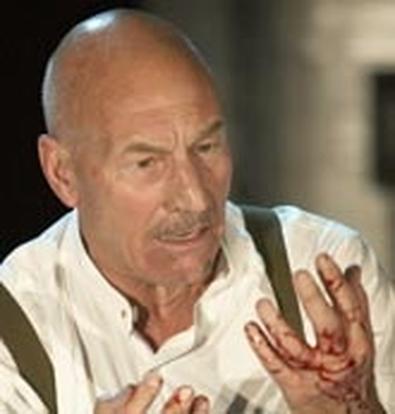
Rupert Goold's reimagining of Macbeth in Soviet Russia is a bloody, horrific affair that started in Chichester, England, moved to the Brooklyn Academy of Music, and then transferred to Broadway's Lyceum Theatre. Goold limns the theme of treachery disguised as decency, and who better to help carry that out than Patrick Stewart?
By subverting his usual hero's mien, the Royal Shakespeare Company alumnus delivers a performance that's surprising and powerful and, in the end, full of frailty.
"Patrick Stewart skillfully conveys the murderous thane's journey from loyal subject to treacherous tyrant," wrote David Sheward in Back Stage's review. "He shows the cracks in Macbeth's composure with small gestures and suppressed cries, then undergoes a transformation to superhuman killer when the witches convince him he's invulnerable."
In addition to its gory doings, Macbeth is a story of a mental breakdown, which Stewart handles with equal aplomb. Of his acting, Ben Brantley wrote in The New York Times, "His performance is the first I have seen to completely realize what Harold Bloom calls a 'tragedy of the imagination.'"
For this role, Stewart was nominated for an Outer Critics Circle Award for outstanding actor in a play. This is his first Tony nomination.