Hollywood, and the entertainment industry as a whole, has always been overwhelmingly obsessed with thinness—a legacy that persists today. Plus-size actors face unique challenges in an industry that disproportionately rewards thinness, from limited casting opportunities to typecasting. But as the conversation around body diversity continues to evolve, performers are pushing back against these narrow standards, demanding roles that reflect the full spectrum of human experience.
Here are just a few actors who’ve addressed the weight-related challenges they’ve faced while carving out space for themselves in the spotlight.
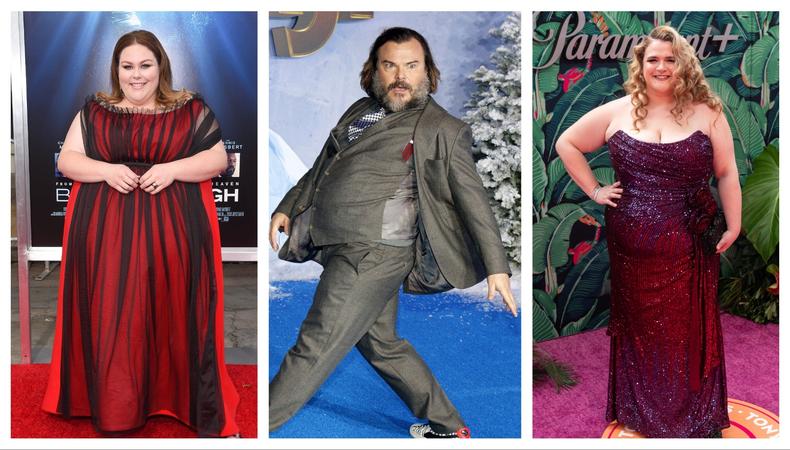
Jack Black: Beloved comedic actor Black has had a slew of box-office hits, starring in memorable films like “School of Rock,” “A Minecraft Movie,” and, frankly, more sequels to “Kung Fu Panda” than you knew were possible. In 2016, the Times called Black “one of the most successful fat American actors for nearly a century.” When asked if he had any desire to change his build, Black remarked, “You know what? Hope springs eternal, but I don’t know that I want to Chris Pratt it out now. I think that could actually ruin my career. People will be like, ‘What happened to Jack? He used to be funny when he was fat.’ ”
Chrissy Metz: “The Hunting Wives” star Metz rocketed from relative obscurity to being a household name when she was cast as Kate Pearson on NBC’s “This Is Us.” Outside of a few sitcom appearances, Metz had only one major onscreen role (she had a recurring part on FX’s “American Horror Story: Freak Show”) when she suddenly found herself on a top-rated network show and even nominated for an Emmy. When asked by Vanity Fair in 2017 about being at the center of so many conversations about the representation of plus-size actors, Metz said she’s “of two minds” about it: “One half could care less because I’m not my body; I don’t care. Why does everybody care that I have more fabric on as opposed to less? And then the other half is like, Ugh, OK. Like a lefty living in a righty world, when you’re a plus-sized actress living in a straight-sized world… people still aren’t as accepting.”
Bonnie Milligan: Milligan has one of Broadway’s most powerful voices. Her absurdly wide vocal range and comedic sensibility got her cast in Broadway’s 2018 musical “Head Over Heels,” and ultimately won her a 2023 Tony Award for her role in “Kimberly Akimbo.” Despite being a Broadway success story, Milligan’s road to stardom wasn’t bump-free, particularly concerning criticisms made about her weight. She told Town & Country in 2023, “I basically had someone tell me that this wouldn’t happen for me because I’m fat. And that really destroyed a part of my confidence I didn’t even know I had.” On her casting in “Head Over Heels,” she recalled, “I was playing this beautiful princess, and my weight isn’t mentioned, which is the point, and every review was like how crazy it was I was cast…. There are a lot of times I have felt, in my career, that I’ve had to fight really hard to be seen as worthy and enough and just as talented, if not more than some people. I have to fight through their bias.”
There are disproportionately fewer jobs. Despite the fact that nearly 75% of American adults are plus-size, it doesn’t take a keen eye to notice that there’s no way 75% of the actors in any given play, film, or TV show, are plus-size. There aren’t as many roles explicitly written for larger people, and when they are, sometimes they end up frustratingly being played by a thin actor in a suit—a practice that sounds antiquated but seems to happen over and over. Representation is important, not just for the actors to be able to authentically play their own stories, but for the audience who can see themselves represented.
You might be more likely to be typecast. Many plus-size actors find themselves relegated to sidekick or comedic roles, and for some, that can become stale before too long. Still, for others, the pigeonhole in question might be the thing they like doing most. On the “Call Her Daddy” podcast in 2023, Rebel Wilson (whose roles include Brynn in “Bridesmaids” and Fat Amy in the “Pitch Perfect” films—an unfortunate or empowering name, depending on who you ask), described the push-and-pull between loving a type of role and wanting to be seen as more than that. She said, “I was stereotyped in playing that fat, funny friend, which is so hard because I love those roles. Like, I mean, I love doing the roles. I love those characters. But then I did want to do more things, but I felt like, yeah, being the bigger girl, you’re just more pigeonholed.”
It might become a way to stand out. OK, so the above points were maybe a little bleak, but stay with us here. The industry does seem to be shifting. It takes no time to find dozens and dozens of editorials calling for better representation of plus-size actors in the media. Recent sitcoms like Hulu’s “Shrill” and Netflix’s “Too Much” have cast plus-size women (Aidy Bryant and Meg Stalter, respectively) as romantic leads. Jade Jones also made waves when they were cast as Belle in Olney Theatre Center’s “Beauty and the Beast” (to rave reviews, no less).
At the end of the day, the best thing you can do as a plus-size actor trying to stay afloat in this insane industry is refuse to pigeonhole yourself. While you can’t control how the casting process ultimately plays out, you can control which opportunities you pursue—so go after roles you feel you’re right for. It’s fine to have dream roles that are typically played by plus-size actors, but that shouldn’t be a limiting factor. You should put yourself in front of casting for any role you want and that suits you (age-wise, type-wise, voice-wise), regardless of whether or not the role is typically played by actors with a different physique.
Ready to go after the jobs you want? Check out our audition callboard here.