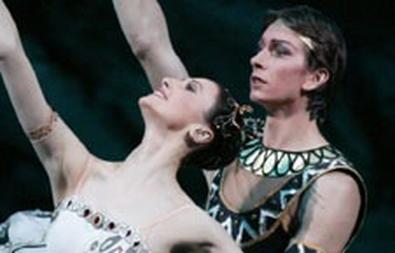
Many might question why Marius Petipa's "The Pharaoh's Daughter," which was first seen in 1862 in Russia, rates a revival. Well, the Bolshoi Ballet presented a new production with choreography, sets, and costumes by Pierre Lacotte, and Lacotte came through nobly in that tremendous undertaking. His succinct choreography and luxurious designs are awesome indeed.
Although "The Pharaoh's Daughter" was Petipa's first huge success in Russia, the running time was five hours. Can you imagine anyone sitting through anything lasting that long today? Three hours is about the limit that even the most avid contemporary fan can take. Thus the need for this new version, which premiered in 2000 and follows the original plot quite faithfully. The old Russian Imperial Ballet movements would seem stilted in our times, and so Lacotte is justified in suggesting the Petipa style while creating a new approach.
Lord Wilson, a British traveler, is going through Egypt with his servant, John Bull. They meet a caravan of merchants at a pyramid. Lord Wilson is told that he is in the tomb of Aspicia, daughter of a powerful pharaoh. When the young explorer is invited by the merchants to join them in smoking an opium pipe, he accepts, then falls into a deep sleep in which he sees the Egyptian princess Aspicia come to life. In the dream, Lord Wilson becomes an Egyptian named Ta-Hor and John Bull becomes one named Passiphonte.
A group of hunters appears chasing a lion, which manages to lunge at the princess. Ta-Hor shoots an arrow into the lion. The pharaoh, resplendently garbed, arrives in a chariot led by a beautiful white horse. His phenomenal Majesty sees his daughter in the arms of a stranger and orders his arrest. Aspicia tells her father that Ta-Hor saved her life.
Unfortunately, the king of Nubia has asked for the hand of Aspicia and the pharaoh has consented. So, at the height of celebratory festivities, Ta-Hor and Aspicia escape through a secret door. The Nubian king discovers the secret door and, together with his bodyguards, pursues the lovers.
Ta-Hor and Aspicia find refuge in a fisherman's hut on the Nile River. While Ta-Hor is away with a group of fishermen, the king of Nubia enters the hut, but when he threatens Aspicia, she runs to the window and jumps into the water. Although the god of the river welcomes her, when Aspicia begs him to reunite her with Ta-Hor, he sympathizes and sends her back to dry land.
The fishermen find Aspicia and return her to the palace, but the pharaoh can't forgive Ta-Hor for abducting his daughter and orders that he be bitten by the sacred snake. When Aspicia offers her own hand to the snake to receive its poisonous bite, her father relents and gives his blessing to the young couple.
At the height of their celebration, the stage fills with clouds and the pyramid reappears. Lord Wilson awakens. As he looks around in astonishment, he sees, in the far corner of the pyramid, the sarcophagus of the pharaoh's daughter.
The role of Aspicia is many-faceted and Svetlana Lunkina was a true royal out of ancient Egypt in attitude. However, it wasn't until the last act, when Aspicia defies the Nubian king and makes her escape from him, that Lunkina's performance began to stun in intensity. The pas de deux in which Aspicia begs the god of the Nile to reunite her with Ta-Hor was notable for the floating-in-water illusion Lunkina created with her arms whenever Rinat Arifulin lifted her high overhead.
The dual role of Lord Wilson/Ta-Hor called for heroic proportions, which were lacking in Vladimir Neporozhny's performance. Denis Medvedev as John Bull/Passiphonte may have had a lesser solo, but he exhibited far stronger projection.
Anastasia Yatsenko as RamzĂŠ, Aspicia's Nubian slave, gave a powerful performance when she disguised herself in order to allow the young lovers to escape, and later when she pleaded for her life before the pharaoh. She performed with amazing dignity, both in her dancing skills and dramatic intensity, avoiding any trace of the melodramatic.
Alexey Loparevich made an awe-inducing appearance as the pharaoh in a nondancing role.
One of the grand surprises and a source of sheer delight was the performance of Alexander Pshenitsyn as a monkey. A real primate could not possibly perform the supple acrobatics of Pshenitsyn. That mischievous demeanor of his was also totally winning.
"The Pharaoh's Daughter" will be incised in memory, not only for Lacotte's luxurious scenic and costume design, but also for his imaginative reconstruction of the choreography as a whole.