From the highly divisive fly-catching episode of “Breaking Bad” to the missing pen drama on “Community,” bottle episodes are budget-friendly but rich in imagination. Want to learn about this claustrophobic yet creative television episode format? Let’s reveal the secrets behind the bottle episode’s narrative lockdown.
A bottle episode is an episode of a TV show that takes place and is filmed entirely (or almost entirely) in one location, usually due to budgetary concerns. The term has been used in television production circles for decades, but it wasn’t added to the dictionary until 2019.
Bottle episodes are not the same as departure or standalone episodes, although the terms are often conflated. Departure episodes send the series in an entirely new direction, while standalones focus on a single storyline or are “special,” such as musical or flashback episodes.
 How to Write a Cold Open In Your Script
 While some standalone episodes can also be bottle episodes, not all bottle episodes are standalones—much like how all squares are rectangles, but not all rectangles are squares. For instance, a Season 4 episode of “Mad Men,” titled “The Suitcase,” focuses solely on the relationship between Peggy (Elisabeth Moss) and Don (Jon Hamm) over the course of an evening. Although this may feel like a bottle episode, it is not since it takes place in several locations.
Why do shows make bottle episodes?
To save money: The primary function of a bottle episode is, ultimately, to save the production money for its other pricier episodes. Making television costs a lot: Sets, costumes, visual effects, and day players (as well as recurring or guest star actors who don’t have full-season contracts) don’t come cheap. It was from these factors that the bottle episode was born, likely back in the ’60s with the show “The Outer Limits.”
To get creative: The tight structure and formatting inherent in a bottle episode lend itself to deeper character exploration with few distractions.
“The One Where No One’s Ready” (Season 3, Episode 2), “Friends”: The ultimate countdown episode finds Ross (David Schwimmer) slowly losing his mind as the rest of the titular friends take their sweet, sweet time getting ready for an important event at his museum. The episode expertly (and hilariously) builds tension through minor annoyances, all while confined to Monica (Courteney Cox) and Rachel’s (Jennifer Aniston) apartment. It was so well-received that the show would go on to include multiple bottle episodes throughout its run.
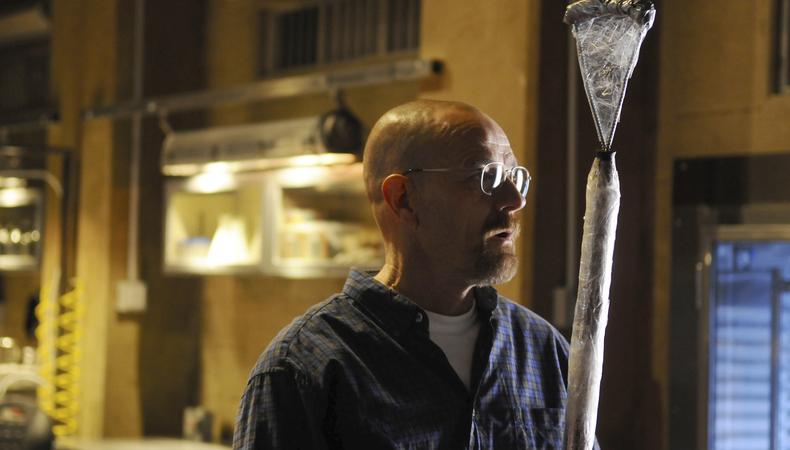
“Fly” (Season 3, Episode 10), “Breaking Bad”: Directed by Rian Johnson, this episode follows Walt (Bryan Cranston) and Jesse (Aaron Paul) as they try to get rid of a fly that’s gotten into their meth lab, possibly contaminating their product. The entire episode features only Walt, Jesse, and that pesky little house fly, and it takes place entirely in their underground lab.
“Cooperative Calligraphy” (Season 2, Episode 8), “Community”: The Dan Harmon sitcom has included several closed-room episodes, often to great hilarity. This early iteration finds the cast stuck in a single room trying to figure out who stole Annie’s (Alison Brie) pen, with Abed (Danny Pudi) even pointing out that they’re in a bottle episode.
“Remedial Chaos Theory” (Season 3, Episode 4), “Community”: This multiverse-exploring episode is often cited as one of the best episodes of all time. Although it may not have exactly been budget-friendly, it does take place entirely in Troy (Donald Glover) and Abed’s new apartment with only the main cast.