A Day in the Life at:
- London Academy of Performing Arts
- Rose Bruford College
- Court Theatre Training Company
- The London Academy of Music and Dramatic Art
Talk to practically any American studying drama in London and you will be told that British training is very different from American training. What makes it different? To find out, David McGillivray spent four days at four London drama schools.
9:30 am
St. Matthew's Church is an imposing edifice towering over neighboring buildings in London's fashionable Bayswater district. It was built in 1816, but is now a church only on Sundays. During the rest of the week, it is inhabited by the London Academy of Performing Arts. The administrative office is behind a curtain at the side of the altar; what may once have been the vestry is now a classroom; and the church hall next door has become a small rehearsal and performance space.
While seven of the 15 students in this year's post-graduate course are rehearsing "Oedipus" in the hall, the remainder attend Keith Connelly's history class. Connelly is a very jolly little academic, unperturbed by the impossible task of teaching virtually the entire history of theatre from the Greeks to the 1920s. Today the subject is Gorky's "The Lower Depths," and the discussion centers on social conditions, both in Gorky's time and in the 1970s, when the English translation was published. "Do you remember the '70s?" Connelly enquires tentatively, trying not to look directly at those who obviously do. The age range is quite broad. Cheri Dammann, one of four American students in the course, is 44. Some of the class members want to prepare a scene from O'Casey's "The Plough and the Stars" for the week after next.
Boasting around 1,000 students, the Rose Bruford College claims to be the biggest drama school in Europe. First-year students in the three-year acting course study mainly at Lamorbey Park, a beautiful 18th-century country house in Sidcup, Kent, where the Prince of Wales, later King Edward VII, reputedly entertained his mistress actress Lillie Langtry. The house is full of wooden paneling and ornate ceilings.
In the former music room, 11 students, all aged between 19 and 20, stand barefoot in a circle for a Voice Articulation class given by Morwenna Rowe, who can't possibly be the same age as her students, but looks it. She invites them to contribute a warm-up exercise. "Oh, this is such an RSC stretch, isn't it?" she groans as everyone points towards the ceiling with one hand. The students try to recite a nursery rhyme with tongues protruding from mouths. "How was that? Did it hurt? Bit achy?" Morwenna asks. There is a low grumble. "Right, we'll do that one again then." There is work done on alveolar plosives. ("Ten tiny toads came tumbling into town.") After more than an hour of this, there is much restless shifting and stretching.
10:10 am
The Court Theatre Training Company occupies a warren of hidey-holes and lofts in former Victorian stables in King's Cross (London's Skid Row). Mistress of all she surveys is the husky-voiced, hyperactive June Abbott, the nearest equivalent to New York's great acting teachers. Twenty-three-year-old Amanda Ifrah, from Orlando, Fla., the only American in the current acting course, says of her mentor, "She's very commanding, a very big presence. She can talk you into doing just about anything." Abbott loves the Greeks, and at the moment she is marshaling her "babies," actually a motley crew ranging in age from 18 to‹let's be charitable‹50, for a production of Euripedes' "The Trojan Women," which opens March 2. In an icy loft, encircled by electric heaters apparently installed by a former student, Abbott organizes preparatory exercises. Never has the word "warm-up" been so appropriate. "Try and get mmmaaaaaa‹all those resounding cavities," Abbott growls. The babies are soon itching to attack Euripedes.
10:30 am
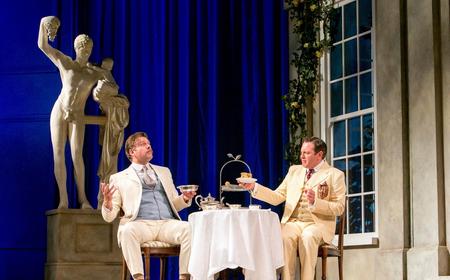
The London Academy of Music and Dramatic Art, founded in 1861, is the oldest drama school in the English-speaking world. It boasts a one-year course that has been most popular with foreign students, since it began in 1956. More than a third of this year's 39 pupils are American or Canadian. Today they are among the audience for a workshop production of "As You Like It," performed by second-year students in the three-year course. It is taking place in the hall of St. Philip's Church, Earl's Court, another Sunday-only church, and one of several west London spaces rented by LAMDA. There is an unsubstantiated rumor that the hall is heated.
Co-director Peter James (also LAMDA's principal) dismisses the production as "just an exercise," but within minutes it is clear he is being modest. There is not a weak link in the marvelous cast. Orlando and Rosalind are played by the two most glamorous students, Joseph Monk and Emma Fildes, who can hardly fail to be movie stars within months of graduation.
At LAPA the students are on a break. Most congregate in the students' room, down a staircase in the bowels of the church, where there are lockers, armchairs, and real coffee, still regarded as a luxury in the U.K. There is agonizing over which headshots to choose for the upcoming Agents' Day. Everyone seems to think highly of the teaching staff here. "Awesome," says Louie Zambrano, 35. He was born in Colombia, but moved to Los Angeles at age six. He was a part-time actor, wanting to learn something different. He saw an advertisement in Back Stage West for LAPA's summer school, which he loved so much that he came back.
10:40 am
At the Court, Abbott begins a rehearsal of the first 10 pages of "The Trojan Women." Unlike LAPA's Daniel Wozniak, who decrees, "Greek tragedy was very static," Abbott goes for hair-raising realism more in keeping with "Marat/Sade." The girls are locked in a cage in the center of the room, and the boys beat the bars with sticks. Earlier in the week, Abbott's assistant director, Mirko Sekulic, who served with the Swiss Army, drilled the boys 'round King's Cross. Later the girls hid in the theatre, and the boys had to find them.
The actress playing Hecabe has a startling intensity, considering this is her first time off the book, but some of the others clearly need some help. Abbott is very attentive to them, particularly the chap playing Poseidon, who won't take his hands out of his pockets. "It's very difficult to play a god," she reassures him, then calls out, "Well done, darlings. We've got something there. Coffee and pee break. Fifteen minutes?"
10:55 pm
Exhausted Rose Bruford students just about have time to grab a coffee in the utilitarian canteen. The next class starts at 11:05.
11:00 am
At LAPA the two groups in the one-year course swap classes. In the church hall, tutor Daniel Wozniak prepares to stage Act III of Ted Hughes' translation of Seneca's "Oedipus." By the end of the school year Wozniak will have introduced his students to all theatrical styles. He studied in Warsaw with students of Grotowski and has been at LAPA for the past 11 years. He is dressed entirely in gray and black and sits to observe the proceedings with great patrician splendor. When he hears the verse, his leg trembles with excitement. He sounds as if he learned English from British movies made between the wars. "Bravo, fellows!" he exclaims. "First class!"
The girls think Wozniak has spent too much time on the boys and want to move on to the chorus work. "Let's just do it now, Danny," they demand when Wozniak continues to prevaricate. The students constantly urge him to move on, but are obviously fond of him. He knows exactly how to modify their performances. "It doesn't mean you have to shout; you have to intensify," is one of his instructions, "Not intonation, insight" is another.
11:05 am
In a more modest room‹formerly part of the servants' quarters?‹at Rose Bruford College, Mary Nelson enthusiastically teaches the first-year students how to read a play before it goes into rehearsal. Today they are studying Chekhov's "The Three Sisters," and separate into three groups to read the scenes from Acts II and III, which focus on Natasha. Every action is analyzed and related to life in 19th-century Russia. Even the price of candles comes under discussion. After nearly two hours, the students clatter down the back stairs to the canteen for an hour's lunch break.
11:35 am
During the intermission of LAMDA's production of "As You Like It," Aaron Preusse, 24, from Minneapolis, rates the play "one of the best things I've seen at LAMDA so far." Preusse investigated the Actors' Studio and Juilliard, but didn't find the emphasis on voice work and classical theatre that he gets at LAMDA. Canadian Andrew Pifco, 28, finds it fascinating to observe how the second-year actors are developing. "At first it was just, "I'm performing,' " he notes, "but now they're looking at what other people onstage are doing. It's not just acting; it's reacting."
Back home in Toronto, Pifco helped workshop Marvin Hamlisch's new musical "The Sweet Smell of Success," but still felt he needed a "mid-career training check." He chose LAMDA because, "Unless you have a good classical basis, it's difficult to launch in different directions." Bolstered by solid audience response, the cast of "As You Like It" sends the second half flying, and goes off to explosive applause. Then everybody pours into the pub over the road.
The 15-minute coffee and pee break at the Court has somehow stretched to 35 minutes. This is what happens when the director also has to oversee the poster design and contact audiences. Finally Abbott decides to dismiss the cast except for the girl playing Cassandra. Abbott fires questions at her: "What is your need? How are you going to excite them? You're a priestess. Do you know what priestesses did? You have to know that." Abbott tries to get the girl to put more feeling into the line, "Raise up the torch!" The girl tries desperately hard, but, after nearly an hour, she is no closer to exciting anyone. Abbott calls a halt for an hour.
12:30 pm
The LAPA students have only half an hour for lunch. This allows for nothing more than a sandwich snatched from a nearby deli. At the back of the church Louie Zambrano practices, as Malvolio, business he's going to put into this afternoon's rehearsal of "Twelfth Night."
1:00 pm
King's Cross is not renowned for its places to eat, and many Court students bring their lunch from home and congregate in the theatre lobby. Amanda Ifrah is in no doubt as to why she came to London to train. "In the US there's more frontier [cutting-edge] work, but generally a lack of interest in theatre, so you don't get to work much unless you create it yourself," she explains. "Here there's a lot more support for the arts." She was accepted by Drama Studio London, but chose the Court because "there's so much emphasis on performance." (Drama schools rarely, if ever, play graduate productions for more than a few days, but "The Trojan Women" will run for four weeks.) Ifrah will leave the Court in July. She might move to Seattle: "There are so many exciting things going on there."
All LAPA's students get together to continue rehearsals begun four weeks ago for an abridged version of "Twelfth Night," which will tour schools. The guest director is George Roman, a tubby but dapper Hungarian in blue shirt and big floral tie. He looks at the scene Zambrano was rehearsing during the lunch break and advises him not to labor the business of mislaying Olivia's ring. Roman's charming Hungarian phrasing is reminiscent of no less than the Bard himself. "Be moderate in order that the truth not be betrayed," he tells his student. The cast runs the play from Act I Scene V. It is in good shape. A difficult scene between Orsino and Viola, disguised as a boy, is rich with implications. Orsino is 25-year-old Alex Gunn from Utah. Roman is delighted and calls a 15-minute break.
1:10 pm
In the Hansom Cab pub, LAMDA students reflect on their first few months in London. Nicolas E. Pavlos, 22, born of American parents in Warsaw, Poland, has been coming to London since he was a child. (He's the only one of today's group who drinks Guinness.) After auditioning successfully for LAMDA in Chicago, he was plagued by self-doubt. "I didn't feel confident about my talent," he confesses. "I thought, "Am I the bad example brought in to show the rest of the school?' " He needn't have worried. His experience here has been "incredible." He adds, "I've grown more in four months than in the past four years."
Nick Cagle, 21, from Southern California, originally planned to study theatre in New York, but changed his mind after attending LAMDA's summer school and falling in love with London. Now he'd like to stay: "There's a different appreciation of theatre, a respect for being an artist, and an intelligence I really, really enjoy."
Inger Tudor, 34, comes from Cincinnati, but is now based in New York. She knows LAMDA alumna Katrina Kropa, interviewed in Back Stage's "British Alternative" feature two years ago. For Tudor, the most impressive aspect of the training is the variety. "You're presented with lots of different ways to be a working actor," she says. "You have to find what's going to work for you." The downside is London's rising cost of living. (In the latest list of the 10 most expensive capitals in the world, London ranks number nine.) At 1:50 pm the group disperses to various parts of west London for rehearsals of "The Recruiting Officer," "The Plain Dealer," and "The Country Wife."
2:00 pm
At the Court, Abbott is persevering with Cassandra. After 10 minutes the priestess is sent out of the building to run up and down a flight of steps four times. She returns panting to the rehearsal loft and launches straight into her speech: "Raise up the torch!" This time it has an air of desperation and is surprisingly effective. "Remember that sensation," Abbott advises. "When you were out of breath, you didn't shout, did you?" The rest of the cast is called and hurled back into the tragedy of "The Trojan Women." The others seem inspired by Cassandra's new insight, and the play begins to come to life.
2:15 pm
A challenging afternoon lies ahead for Rose Bruford students. The British first-years are joined by four students from Stephen F. Austin University, Texas, who are participating in a new scheme. "Acting USA/UK" offers US citizens a year at Austin and two years at Bruford, leading to a British B.A. (Hons) and an American BFA. In the former conservatory at Lamorbey Park, Gabriel Gawin, scruffy, energetic, and multi-talented, drives his kids relentlessly through a series of exercises that test all their mental and physical abilities. Trust and co-ordination games lead directly into two- and three-part harmony practice. Within 20 minutes the group has learned a Catalonian chant, and the soaring choral sound leaves more than one young actor wiping tear-filled eyes.
Then, suddenly, the "Three Sisters" scripts are out again and one of the Texas students, Summer Finley, has to read out the description of the Act I set with enough expression to make spatial relationships apparent, a task that would defeat many an Oscar-winner. Forty-five minutes are spent dissecting a single paragraph. And there is worse to come after the tea break.
2:30 pm
At LAMDA's MacOwan theatre there is a matinee of "Cloud Nine," Caryl Churchill's now-dated and bewildering satire of English sexual repression. It's one of three graduation shows performed by students in the three-year course. In Act I they have a tough job playing characters mostly much older than their real ages, roles they would never be asked to play professionally. But they do work themselves up to splendid heights of sexual hysteria.
In the audience is student Ryan Ellsworth, 23, from British Columbia. Tonight he's in Edward Bond's "Saved." Ryan now finds it amusing that, as a kid, he idolized Gielgud and Olivier and thought, "This is what English theatre is all about." Now he realizes, after three years at LAMDA, that there is more to acting than "playing with your voice and standing in a certain way." He saw the light while touring Holland in "Twelfth Night" and failing to get the attention of audiences who didn't understand what he was saying.
2:40 pm
The LAPA students have 15 minutes to relax. Despite the temperature's being close to freezing, almost everyone is out in the alley next to the church. After graduating from Weber State University in Utah, Alex Gunn worked in children's theatre. He discovered LAPA's prospectus on the Internet and decided he needed to round out his training with a year's study of classical theatre.
Twenty-one-year-old Meg O'Brien trained at AMDA in New York, but every time she went to a Broadway musical show, she was convinced the acting wasn't strong enough. She contacted British drama schools through ads in Back Stage and chose LAPA because it was the smallest and offered more opportunity for individual attention.
2:50 pm
At the Court, Abbott is called away on more administrative business and assistant director Mirko Sekulic takes over the rehearsal. He and she are evidently of one mind. He demands more urgency from the boys, and he gets it.
2:55 pm
Meanwhile, at LAPA, George Roman runs the rest of "Twelfth Night."
3:00 pm
June Abbott sweeps back into the rehearsal loft at the Court and announces that she wants to do more work with Hecabe and Cassandra. Everyone else moves down to the lobby. Everything happens in the lobby. Lines are learned, and letters home are written. Actors help to sew costumes and, every Wednesday, everybody helps clean up. Abbott prides herself on giving all-'round theatrical training. "I came here because it was so friendly," is heard more than once.
At 4:25 the actors are summoned back to the loft. Abbott has a box of cakes and wants everyone to have one. Then the girls are thrown back in the cage for another hour of abuse.
3:40 pm
In the interval of "Cloud Nine" at LAMDA, Californian Jonathan Leveck, 22, illustrates the cultural adjustment necessary for an American in London: "Walking into a deli in New York, the first thing you get is, "Hey! What'll you have?' An American thinks, "Suddenly I have a friend,' a Brit thinks, "What a fake.' An American goes to a deli here, doesn't get the reaction he expects, and presumes the British are cold." Act II of "Cloud Nine" appears to have no structure, but is enlivened by Paul Ready's wonderful impersonation of a four-year-old girl.
3:50 pm
Like their colleagues at LAPA, the Rose Bruford students sip tea outside in biting winter air. There is snow on the ground. Professional actors wouldn't tolerate these conditions, but probably their adrenaline doesn't pump to such a degree. Among the Texans, there is absolute agreement: They love it here. The teachers aren't this friendly back home, or they hand everything to you on a plate and don't allow you to learn on your own. Here, everyone is so supportive. Head of Acting David Shirley gives students his home telephone number. "I wouldn't trade this opportunity for anything in the world," states Alison Hollinger. Lori Holder is so impressed that she wants to spend her whole three-year period in the UK. Aren't there any drawbacks? Yes, according to Stacey Oristano: "The food is awful."
At LAPA, director George Roman begins a long notes session. Cheri Dammann and Meg O'Brien are told to work on their English accents. Alex Gunn is told his performance is too studious. "What is coming over," Roman points out, is that "Everything is of the same importance." Later, Roman reminds Louie Zambrano to ask himself, "What do I really want?" Later still, there is a little restlessness around the circle of students. "You will go by five," Roman promises. And they do.
4:00 pm
Having dissected the stage directions, the Rose Bruford students turn their attention to the first line of "Three Sisters." "It's exactly a year ago that father died, isn't it?" says one of the sisters, Olga. Who would have thought that this statement is by no means unequivocal? Gabriel Gawin forces his class to consider every imaginable meaning, and then some. After 20 minutes, a few students are becoming hysterical. "Is there anything else we can get out of this line?" Gawin enquires. "No!" chorus several voices. A hapless student then has to read out the line, taking into regard every nuance wrung from it. Strangely enough, it sounds exactly the same. But there are still another 40 minutes before the end of class.
5:10 pm
The end of the day at LAPA. Outside the church there is much hugging. It is Friday and next week is a half-term holiday. Gunn thought Roman's notes made a lot of sense. "He makes me look into scripts in a way I haven't done before," Gunn admits. "He picks on my weaknesses. He tells me I can't rely on old tricks." Everybody disappears into the gathering darkness, and suddenly the church is quiet.
5:30 pm
At the Court, Abbott has spent an intensive hour on "The Trojan Women," and suddenly dismisses everyone earlier than usual. "They were all shattered," she confides. Cassandra has flowered in one afternoon. "I was very proud of her," Abbott declares, distributing the remainder of the cakes. "We got something contained, rather than dramatic." Many of the company members stagger into the Tun-a-Ri, the Irish pub round the corner. They are, indeed, shattered.
6:00 pm
LAMDA students return to base for one-on-one tutorials that will continue until 9:00 pm. New Yorker Eric K. Daniels ("Don't mention my age because I think I look younger") wants to work on his piece for an upcoming showcase at the Jermyn Street theatre in London's West End. He's done a lot of Off-Off- Broadway shows, but failed auditions for Broadway. "I knew what they were looking for, and I hadn't had the training," he admits. LAMDA is perfect for him. For one thing, he has singing classes every day, rather than once a week. For another, "I'm totally immersed, not distracted by family, friends, job..." By 9:00 pm he will have been working for 12 hours.
7:30 pm
At the Institute of Contemporary Arts, near Buckingham Palace, it is the opening night of Lorca's "The House of Bernarda Alba," part of a season of five plays performed by third-year students at Rose Bruford. The production is expertly staged by Pat O'Toole (daughter of Peter), and the set and lighting, entirely the work of students on Bruford's technical courses, are superb.
There are standout performances from Florencia Cordeu in the title role and Victoria John as La Poncia. But the playing is on the whole a little flat, and at the back of the auditorium, O'Toole is scribbling furiously. One has the feeling that the notes session will extend into the early hours. There is another performance tomorrow.
10:30 pm
Two of the Court students are still at work, on front-of-house duty. The theatre has been rented to a visiting company, which has had great success with a revival of Martin Sherman's "Bent." By the time the students lock up, they have also been working for 12 hours.
Next? The pubs won't close for half an hour. Then‹homework and some sleep.