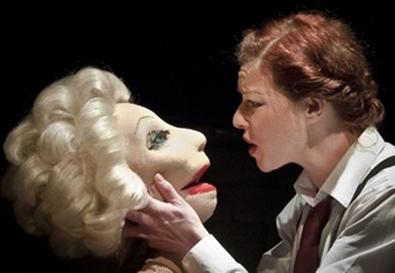
Alas, the interaction between the two characters is almost generic: A cranky elder snaps at her mostly obsequious caregiver in an ongoing love-hate relationship. The underling resents her position and envies the star that once was. The star wallows in recollection of her once-universal allure. This could be a lot of people, and we learn precious little about the specifics of this duo. Even when they break into song, as one or the other does four times, the numbers have almost nothing to do with Dietrich. She wonders aloud why she never sang "Mein Herr" before now. (It's probably because Kander and Ebb wrote it for the movie "Cabaret," released after she had stopped performing!) Gloria sings "Whatever Lola Wants" as her approach to a passionate kiss on her prone employer's lips. This is the only whiff of lesbianism we get here, and it's backwards: Marlene was famously the seducer, especially where women were concerned.
Skubik's vocal and attitude shiftings are remarkable, as are her quick costume changes for the puppet she designed with Barbara Poczwardowska and the puppet's bodily movements. As Gloria, however, Skubik is often almost inaudible. This could be a director's choice, to reinforce the servant's place in the background while the star bellows, but it's not exactly audience-friendly. We have to settle for the visual delights of the puppetry; to learn about and celebrate Marlene Dietrich you'll have to go somewhere else.
Presented by La MaMa ETC in association with the Polish Cultural Institute in New York as part of the La MaMa Puppet Series at La MaMa ETC, 74A E. Fourth St., NYC. Nov. 11–21. Thu.–Sat. 10 p.m.; Sun., 5:30 p.m. (212) 352-3101, (866) 811-4111, www.theatermania.com, or www.lamama.org.