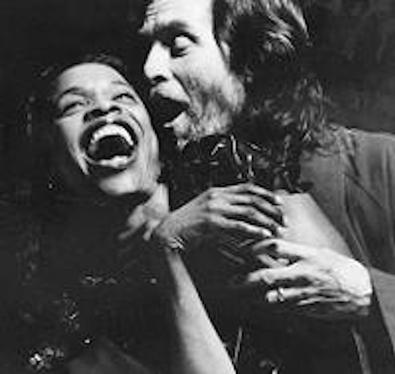
"I know Athol Fugard thinks of his characters in terms of their race," notes actress Charlayne Woodard during a phone interview. "But I don't see characters as black or white. I see them as human. When I wake up in the morning, I don't say to myself, 'Hi, black lady.' I say, 'Hi, lady!' "
Maybe. But there's no way to avoid the racial component in Athol Fugard's new play, "Sorrows And Rejoicings," which opened Off-Broadway at the Second Stage Theatre Feb. 4. Indeed, Woodard, who co-stars in the four-character piece, acknowledges that apartheid is the central protagonist in this work: molding, defining, and ultimately thwarting everyone.
Set in post-apartheid South Africa, "Sorrows And Rejoicings" tells the story of two women—one poor and black, the other wealthy, educated, and white—who have shared a lifetime of love with the same man (John Glover), and meet face-to-face following his funeral.
The emotionally fraught encounter is interspersed with flashbacks of their respective relationships with David, a self-obsessed white poet. Marta (Woodard) was David's mistress and the mother of his illegitimate, racially mixed daughter, Rebecca (Marcy Harriell). Allison (Judith Light) was David's upper-crust wife, who spirited him off to London for 15 years, leaving Marta and Rebecca behind in South Africa to fend for themselves.
"My big challenge was not to let Marta become a victim. And that's hard because she is in precisely the kind of abusive relationship I wouldn't put up with," says Woodard, an enthusiastic and articulate 40-something Albany, N.Y. native. "David is a major creep. In addition to his abusive relationship with the two women, he has a stake in maintaining apartheid, although he thinks he's fighting it. His identity—his poetry—is totally tied up with apartheid. Without apartheid, he'd have nothing to write about. In some ways he'd cease to exist. But Marta has fallen in love with David and that's it. We're not free to choose with whom we fall in love."
Woodard pauses, "David is larger than life, and he practically raised Marta, although she was a servant in his house. He helped her with her homework, brought her books, and became her connection to the outside world."
Woodard asserts that Marta is "the most dangerous" role she has ever played, adding that she decided to tackle it mostly because Marta changes, and is in some ways liberated at the end, thanks in part to the brutal honesty of her daughter, a product of post-apartheid South Africa.
"She makes me see David and my relationship with him for what they were. I'm not sure I would have done this role if there were no Rebecca. And, as much as I don't like playing beaten-down women—Marta is an introverted woman who is dancing on her knees—I wanted to give voice to an oppressed underclassman. I hope Marta has complexity, and that I present her true subtext."
And indeed she does. Throughout, Woodard evokes a character who grasps the subtleties and nuances; Marta has strong responses, yet cannot—or will not—make her views known. Consider the way she simply turns away when she learns that her daughter has destroyed David's unpublished poems. The fact is that she is not horrified by Rebecca's deed; still, Marta's gesture is ambiguous.
Woodard boasts an extensive resume. She appeared on Broadway in the original cast of "Ain't Misbehavin'," for which she received Tony and Drama Desk nominations. Off-Broadway, she starred in "In The Blood," garnering an Obie Award and a Drama Desk nomination. Movie credits include "Sunshine State," "Eye for an Eye," and "The Crucible." On TV, she appeared in "Chicago Hope," "Frazier," and "Family Law."
Woodard is also an accomplished playwright-performer. Her three solo shows—"Pretty Fire," "Neat," and "In Real Life"—have been mounted at theatres across the country, bringing in a host of awards, including the L.A. Drama Critics Circle Award, and twin NAACP Theatre Awards for Best Play and Best Playwright.
Muffled by Musicals
The daughter of a truck driver, Woodard had many ambitions—including astronomer and violinist—before setting her sights on acting. After graduating from the Goodman School of Drama in Chicago, where she earned her Equity card, Woodard came to New York, and within two weeks found herself in the revival of "Hair." "Ain't Misbehavin' " followed in short order.
From the outset, Woodard worked steadily in theatre (with no day jobs), yet recalls being typecast as a musical performer and, as such, not in the running—from the point of view of the powers that be—for anything other than song and dance shows.
Frustrated, and hungry to act in a straight play, Woodard decided to retrain as an actress and started taking classes at the Actors Studio. "It was a terrific experience. My whole idea of what makes for a good—or bad—scene changed. So did my approach to acting.
"I got my first break [in a straight play] when my good friend George Wolfe offered me the chance to be in the workshop production of 'Spunk,' which led to my appearing in his production of 'The Caucasian Chalk Circle', " Woodard continues. "Once I did that, other parts came my way."
Still, her most exciting acting gigs, she notes, were in class. And, on one level, that was okay with the young actress. "My goal was to do the best work I could." In fact, she started writing her one-person shows as classroom exercises "to help me build my chops and to stay in shape as an actress."
Although she has gone on to win acclaim as a playwright—and is currently commissioned by the Mark Taper Forum in Los Angeles to adapt a series of African-American folk tales for the stage—she maintains that acting (as opposed to writing) most defines her. "In either case [as writer or actress]," she says, "theatre is all about the story; secondly, it's about how am I going to tell it?"
Interestingly, Woodard has no desire to direct, although others have told her she should consider it. "I'm not sure I'm made to be the captain of a ship, and that's what a good director is. He is able to rally the crew after bad reviews. A good director shows the actors trust and creates a free play space where no one's hands will be slapped. A good director knows what he wants, but is secure enough to give actors a voice."
Woodard's ambition is to create roles, as writer and actress. "I want to be part of the new classics in theatre, whatever they may be. I no longer feel that there are roles in the existing literature that I'm dying to play."
At the present, however, her thoughts are focused on "Sorrows And Rejoicings," and her hope that audiences see Marta as "a woman who has taken a journey [in relationship to herself and Allison].
"In the beginning, Allison and Marta are enemies," says Woodard. "I blame Allison for everything. I believe she is responsible for taking David away from me and for destroying him. But, as the day goes on, I see we both fell in love with the wrong person. There is a coming together, although I use my daughter as a weapon against her. I had the child she couldn't have. I had her husband's child.
"At the end of the play, Marta is empowered to live a better life. She has shaken off the chains. It's not said in the play, but I would like to think that Marta is going to sell the house [that she has inherited from Allison], take the money, go to the city, and send her daughter to college. Her daughter will have the life she couldn't have."