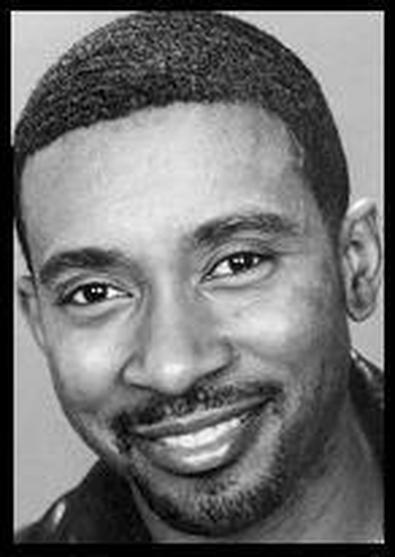
As a child, playwright Charles Randolph-Wright was told by his mother " 'Get an A or an F. But don't get any C's. We are not average.' " She frequently quoted Robert Frost's poetry and she directed her family--immediate and extended--to dress in white linen and play cricket on the front lawn.
Randolph-Wright is African-American and, contrary to what some may think, he stresses, during the course of a phone interview, for many blacks00upper-middle-class blacks--in the South of the '70s, the aforementioned scene on the lawn was not all that anomalous. "That kind of black family is not presented in the media and therefore may not be familiar to many [mostly white] viewers. But that does not make what I'm describing in 'Blue' a falsification. I want to introduce audiences to worlds and stories that they've not heard before."
The critical response to "Blue," which opened Off-Broadway at the Roundabout Theatre, July 5, has been mixed, Randolph-Wright admits frankly. He notes that for some reviewers, the total absence of race consciousness among the characters on stage is as difficult to buy as is the highfalutin' mother of the family (Phylicia Rashad) sporting furs, gushing "Divine!," and routinely serving foreign dishes--all of which she has purchased from various restaurants around town. This lady, who can reel off her culinary fare in Japanese or Italian--"polenta con porcini" for cornbread--has never cooked a meal in her life.
"Blue" is a memory play with lots of comic flourishes that recalls a well-to-do black southern family (funeral parlor owners) in the grip of a powerful (albeit colorful) matriarch whose dark secrets define her. The title "Blue" refers to Blue Williams, a jazz singer in the Luther Vandross-Frank Sinatra vein, who has literal and metaphorical significance for all of the characters.
"There are autobiographical elements in this work," asserts Randolph-Wright, an enthusiastic 43-year-old York, S.C. native. "And my mother was very much like Peggy [the Rashad character]. She was a professor of English in local community colleges and gave me the gift of expectation--the expectation that I would succeed. She used to say, 'A man's reach should exceed his grasp. Or what's a heaven for?'
"And while my father did not own a funeral parlor--he owned a construction business--other relatives in my family did own a franchise of funeral parlors. I grew up in a world of intergenerational success. And just because we were black didn't mean we spent all our time talking about race issues.
"That's like saying that all gay people talk about is AIDS and Jews only talk about the Holocaust," he continues. "None of the characters in 'Blue' complain about white people. It's a picture of a family [who happens to be black] trying to cope with itself. It's a look at an upwardly dysfunctional black family," he chortles. "I am both disturbed and thrilled when white people come up to me and say, 'I didn't know there were black families like this.' "
He pauses. "Steve Newsome, head of the African-American Museum at the Smithsonian, said, 'This is not a political play. But doing 'Blue' is a political act [in its blatant violation of stereotypes]."
Randolph-Wright, who has had his work mounted regionally, is perhaps best known as the producer-writer of the critically respected "Linc's," an HBO series that considered the trials and tribulations of a black Republican. Randolph-Wright recently directed the new national tour of "Guys and Dolls," starring Maurice Hines; and he is currently directing and co-writing the musical "Ball," a Greek tragedy set in the world of New York City street ball.
"I want to present new stories or old stories in new ways so that even if I don't change the world, I may have an impact on those that do," says Randolph-Wright, adding, "That's the kind of arrogance I grew up with.
"I'm interested in those stories where worlds collide, and I like the mix of drama and comedy, although that's challenging to write. So is the combination of reality and fiction. With 'Blue,' I was very concerned that it not become simply a therapy session for myself. I wanted the play to capture the joy and pain of coming-of-age."
Despite his cheery demeanor and the fact that none of his characters talk about race, Randolph-Wright is keenly aware of himself as a black man in a white world who has to be part of that world in order to succeed, but is oftentimes excluded from it.
He says, "Every black TV show has white writers. White TV shows rarely have black writers and that's odd since we live in a white world. Dubois said, 'Black people who are successful have an existential two-ness.' "
He adds, "I want black audiences to come and see 'Blue' and then go and see Roundabout's new production of 'Major Barbara.' We have become separatists and that bothers me."
Having said that, he acknowledges how delighted he is with the enthusiasm voiced by his white audiences and the fact that they seem to identify so intensely with the characters.
"I had one 72-year-old white man come up to me, tears streaming down his face, who said, 'Now that I've seen your play, for the first time I understand my own mother.' "
To continue reading this article, go to the Members Area