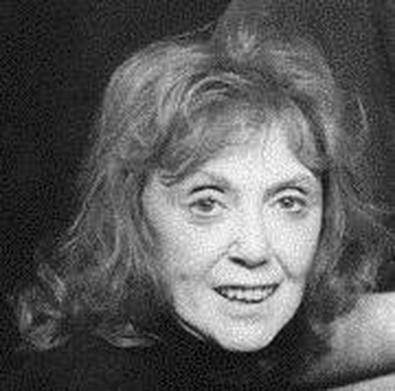
Despite its old-fashioned aesthetic--melodramatics and very broad comedy--Dion Boucicault's "The Streets of New York" was the right play to do at this time, says Charlotte Moore, who directed the work at the Irish Repertory Theatre, a company she co-founded in 1998 and where she serves as artistic director. Moore also wrote songs--lyrics and music--for Boucicault's play, which opened on Nov. 18 and is now enjoying an extended run through Jan. 20.
" 'The Streets of New York' is an uplifting piece about the people of New York, who are all inwardly good," continues the affable Moore, who is chatting with us over the phone. "I also like the fact that 'New York' is in the title, the work is written by an Irish playwright whose plays I love--he wrote over 120 plays--and it has an Irish sensibility: passion, hardship, starvation, and poverty. Yet everyone comes out ahead at the end."
Set in Five Points, in the mid-19th century during a period of financial strife and social upheaval, "The Streets of New York" tells a convoluted tale of greed, corruption, and manipulation?-all of which are ultimately undermined and conquered by true love. Good triumphs over evil and, in the end, even the wrongdoers have been transformed.
One of the inevitable major challenges in mounting this piece, Moore says, comes in maintaining plausibility while capturing the over-the-top style of the work. But, she acknowledges, there is a larger question: Should the acting style replicate the way it was performed in the mid-19th century? And, perhaps most central, how can contemporary theatre artists know how it was performed?
Moore contends that one can accurately gauge how it was performed on the basis of research, including Boucicault's own writings; she stresses that, indeed, the Irish Repertory Theatre production is faithful to what the author intended.
Yet she concedes that the inflated acting style required for "The Streets of New York" is alien to most contemporary actors. "If they don't have the experience doing this kind of acting, they at least need the courage to look the other actor in the eye, say the lines, and mean them. Actors in this show need to be able to concentrate and focus."
Moore recalls facing another equally daunting challenge: forging the right songs once she decided the story would be enhanced with music. "Initially, I looked for songs from the period. I wanted a song for each character, but the existing songs were either too sickly sweet or too sentimental. So I sat down and wrote them myself. Placing the songs just happened naturally."
Moore modestly insists that she is neither a composer nor lyricist. Indeed, the only other songs she has written were for Dylan Thomas' "A Child's Christmas in Wales." Her credits as both an actress and director, however, are impressive.
Moore, who started her career as an actress more than 30 years ago--and, indeed, continues to act--has worked with such notable directors as Harold Prince, John Tillinger, Arvin Brown, and Ellis Rabb. She has received two Tony nominations, the Outer Critics Circle Award, and the Drama Desk Award. In her director's hat, she has helmed 22 productions at the Irish Repertory Theatre. The latter, a small Off-Broadway theatre that houses 137 seats, operates on a $1.2 million budget and boasts 1,100 subscribers.
"Originally, most of our audiences were made up of Irish or Irish-Americans," Moore recollects. "Now, it's a very mixed bag, although we continue to do plays by Irish playwrights about the Irish or Irish-American experience. We have no ironclad format for programming a season. Very often we'll do a play because a particular actor we want to work with is available at that time.
"In the future, I'd like to do more contemporary plays," she emphasizes, "and we're going to have to make more of an effort to get young Irish-Americans, who spend too much time in pubs, into the theatre instead. We are reaching out to some of those pubs now. For example, the musicians in this piece, who also perform at pubs, are letting the younger patrons know about this theatre and what we do here. We're trying to be interactive."
Coal Miner's Daughter
A native of Herrin, Ill., and the daughter of the owner of a coalmine, Moore admits frankly she had no particular goals growing up. She earned her undergraduate degree at Smith College and went on to garner a Masters degree in comparative literature at Washington University, where the acting bug bit. "I appeared in a college play and knew acting is what I wanted to do."
Moore arrived in New York following graduation and began to act. Interestingly, she never studied acting formally--"I learned through on-the-job experience"--and for the next 20 years she worked steadily as an actress. Moore turned her attention to directing in 1988 when she slipped, broke both arms, and found herself out of commission as an actress. Early on, she concedes, she felt intimidated "both as a woman and as an inexperienced director."
Those experiences have long since disappeared, she stresses; indeed, by her own account she is one tough director. "Never say 'I can't do that.' Not to me. You can do it. Hal Prince never takes 'no' for an answer."
As noted, Moore continues to act and wears both her acting and directing hats with equal pride, observing that each skill informs the other. "When I'm acting, I'm easier on directors than I used to be because I've done it [directing]. And because I'm an actress, I know how important it is when I'm directing to respect the actor and let him grow."
At the Irish Repertory Theatre, Moore uses a core group of actors, many of whom are Irish-born or Irish-American, not that they have to be. Nonetheless, she maintains, "When we do an Irish play, I like the actors to have a native's understanding of the material and an Irish sensibility. I do not like fake accents."